

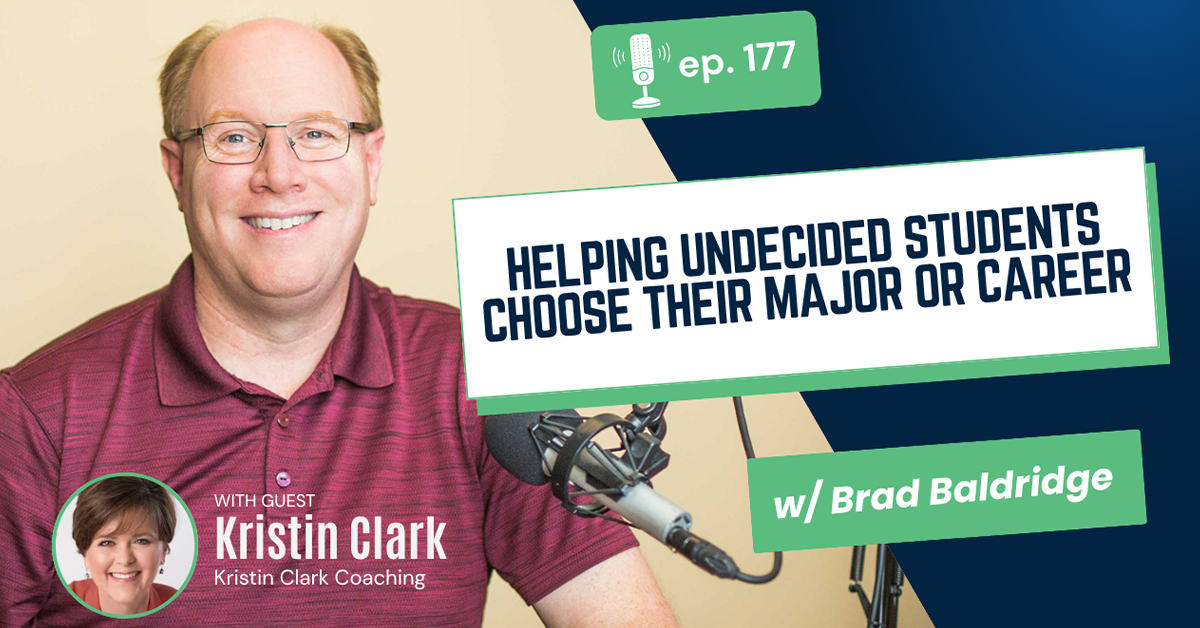
Today’s Guest:
Kristin Clark, Career Exploration Specialist
Kristin Clark helps students ages 16 to 26 discover career paths that excite them and align with their strengths. She guides families through the challenges of choosing majors and planning for the future, focusing first on what makes students happy in their day-to-day work before considering financial outcomes.
Through one-on-one coaching, small group programs, and her innovative Parent Lab, Kristin empowers both students and parents to have meaningful conversations about careers and college. Her passion is watching students light up when they find a career direction that truly inspires them.
Questions Answered Today:
How should families try to help a student choose a major or career path?
“Are you going to get excited about waking up on a Monday morning to do that?” – Kristin Clark
That’s one of the guiding questions that Kristin asks the students she helps coach and advice.
To answer that question, Kristin suggests starting with duties and responsibilities rather than salary. She helps students focus on what they’ll be doing every day and whether that excites them. Once they find a career that sparks joy, then they can explore how to make money in that field.
She notes that many students are only familiar with 10 to 12 careers, so parents should encourage exploration through job shadowing, conversations, and assessments.l choices. They help students discover preferences early, narrowing their list of schools.
Why do so many students feel “stuck” and undecided?
Many students freeze up when asked to choose a major or career path because they fear making the wrong choice and being “locked in” forever. This fear often comes from limited exposure. Most teenagers only know about the careers they see around them (teachers, doctors, lawyers, engineers). Without broader knowledge, they struggle to imagine what else is possible.
Kristin encourages parents to help students reframe the process:
- Normalize mistakes. Choosing a path isn’t permanent — it’s okay to explore, pivot, and change direction.
- Make exploration safe. Talking through options, shadowing professionals, or trying internships can help students test ideas without long-term commitment.
- Start conversations early. Career discussions shouldn’t wait until junior year of high school. Beginning earlier reduces the “pressure cooker” effect later.
- Focus on experiences. Instead of asking “What do you want to be?” ask “What kind of work excites you?” or “What environments do you enjoy?”
“Let’s make it okay to explore and not feel like, okay, once we’ve explored, we’re writing it in blood. Because that’s not what this is about. Let’s have fun.” – Kristin Clark
What happens if a student goes to college without a clear plan?
Kristin points out that many students enter college unsure of why they’re there or what they want to study. This lack of direction can lead to wasted time, money, and frustration. In fact, statistics show that about 50% of people don’t end up working in the field of their degree. While that’s common, Kristin believes that families can do better by helping students narrow their focus earlier.
Key challenges of going in without a plan:
- Switching majors or extending time in college often means paying for extra semesters or losing credits.
- Students who don’t see a clear purpose may disengage, struggle academically, or even drop out.
- Without a career direction, students might overlook internships, campus jobs, or networking chances that build experience.
Kristin’s philosophy is to guide students into what she calls a “pie shape” of interest:
- Start broad, identifying general areas that excite them (e.g., science, arts, business).
- Use classes, internships, and campus activities to gradually narrow the focus.
By graduation, the “pie slice” should be much smaller, pointing toward a clear first job or career path.
“Hopefully, we’re helping them move towards something and not just, ‘I’m in college, but I don’t quite know why I’m here.’” – Kristin Clark
Should students and their families consider a gap year?
Kristin acknowledges that many parents fear a gap year will derail their child’s education, but she emphasizes that research shows the opposite: students who take gap years often perform better academically and are more likely to complete their degrees.
As a key rule, a gap year is fine. But you can’t do nothing. It must involve meaningful activity, whether that’s working, volunteering, traveling, or joining a structured program. Kristin warns that letting students “coast” without responsibility can lead to failure to launch.
Brad adds nuance by sharing examples of different types of gap years:
- Work-based gap years where onestudent worked at national parks during COVID, traveling across the country while earning money.
- Structured programs where some students join formal, paid programs abroad or in research, which can cost money but provide valuable experience.
- Exploratory gap years where studentsuse the time to test careers or industries before committing to college.
Learn more about maximizing gap years in this previous episode.
What programs and tools can help undecided students?
If you’re looking for guidance or expertise to help your student, Kristin is a great resource to consider. As a career exploration specialist, she offers:
- Pick the Right Major group program (small class size, focused on career exploration).
- One-on-one coaching for students who prefer individualized guidance.
- The Parent Lab where parents meet twice a month to share experiences and learn strategies.
She also uses tools such as:
- CliftonStrengths to identify activities that energize students.
- Career assessments to spark conversations.
Are there colleges that support undecided students?
YES. Many schools such as Northeastern, Brown, the University of Michigan, New York University (NYU), and Ohio State allow students to delay declaring a major.
Families should ask:
- Does the school provide structured programs to help undecided students explore?
- Will counselors proactively guide students, or must students seek help themselves?
- Is your child comfortable with ambiguity, or do they need more stability?
Links and Resources
Helpful Articles and Resources
- Taming The High Cost Of College
- THCC Episode 131 Gap Years and Gap Time
- Parent Lab
- Kristin Clark’s Contact Info:
THANKS FOR JOINING US!
We’d like to extend an invitation to our listeners to share their feedback and questions. Contact us to submit a question.
If you find our podcasts helpful, please share us on social media and tell your friends!
The bottom line is that we care what you think and want to help you out, so we’d appreciate you reviewing us on your favorite podcast platform. Even better, receive automatic updates by subscribing to the show through your preferred podcast service.
Presenter 0:00
Welcome to the Taming the High Cost of College podcast. Here is your host, certified financial planner Brad Baldridge.
Brad Baldridge 0:10
Welcome to Taming the High Cost of College. This is a podcast where we help families plan and pay for college. Today, we're going to talk with Kristin Clark. She works in career exploration. Welcome, Kristin
Kristin Clark 0:22
Brad, hello, it's good day here in Texas
Brad Baldridge 0:25
Today I wanted to talk a little bit about your core expertise, the things that you work on day in and day out, and kind of go from there.
Kristin Clark 0:33
Yeah, so Brad, I specialize in working with 16 to 26 year olds and help them figure out what they were wanting to do for a career, and what I help them to do is first focus on a career that's going to make them happy, and then we talk about what can actually make them money. So I really force them to think about the duties and responsibilities first, and what they'd be doing every day when they walk into work, and sometimes this is hard. I got to tell you, because they do worry about the money, which actually should make families happy, moms and dads, because a good thing for moms and dads to realize is they want out of your house as badly as you want them out someday. Yeah, and they get it, they get the joke. So I'm always talking to them about here's what you're going to be doing every day, day in and day out, and are you going to get, get excited about waking up on a Monday morning to do that, and that then we can talk about gathering facts, and how do we get you to making the paycheck that you're happy with. So, yeah, and it's a lot of fun, and Brad, I got to tell you, the best part of this is watching for them to have that smile from ear to ear, and when they start leaning into the camera, and their eyes start lighting up because they're excited about a career choice, that's when it's a good day.
Brad Baldridge 1:46
Right. Absolutely. So, and obviously, in the consulting that I'm doing, and working with families, the undecided comes up, or how do we choose a major or a career? And I know you've got a kind of an opinion on that, as far as lots of families are throwing darts or trying to come up with a major or something like that. Can you explain your philosophy a little bit, as far as you know the right way, or your at least your opinion of the right way to pick out a major?
Kristin Clark 2:10
Yeah, this is all really going back to basics, and I know a lot of families hear this, and that is to think about what their interests are. The challenge that I see happening in households is they're not having the conversation around what does that mean, and I'll give you an example of this, and I may have told you this the last time we talked, but it's a good story and a quick story. I was working with Noah, one of the things that he was really interested in is golf, and he even talked about, he goes, Kristen, I love going to the pro shop, I love going to the restaurants. He goes, "You know, I even love the smell of the grass." He goes, "Obviously, I love playing, but I'm never going to be a pro golfer." And through lots of conversations about not only his interests, but his skills and his strengths, where we ended up is he now is at A and F studying landscape architecture with the intention that he's going to build golf courses at some point, design and build golf courses, so it's not always a straight shot to, well, golf has to be golfing, it's let's incorporate that, because he loves it, right, he loves the atmosphere. So, how do we get creative and say, how do you be a part of golf without necessarily being a golfer? And I think that's the piece that families miss out on. They just think it's a straight shot. And one of the challenges that I do see in families is, and especially with kids, sometimes with adults too, is most kids only know 10 to 12 careers, so it's hard for them to, like, look and do brainstorming because they don't know what's out there.
Brad Baldridge 3:39
Right. Absolutely, I would say that that is important, that most careers from the outside is really hard to understand what people do. So, doing things like job shadowing and getting involved in doing that exploration, which I know you talk with families about quite a bit, is a great strategy. So, let's talk a little bit more about the concerns when we talk about undecided. I see parents a lot, so when I'm talking with parents, they get up concerned about the undecided, probably for two reasons. One is it's stopping the process because little Johnny cannot figure out what he wants to be when he grows up, or he can't pick a major. We're dead in the water, we can't pick a school, we can't, we can't do anything around college, so we're just gonna wait for him to mature, or somehow, where we have to get past this log jam before we can do any sort of college planning, which, by the way, is not true. You can do lots of college planning with or without the student, right? So, and you know, we'll talk about lots of podcasts about that, but that's the reality that I hear is, well, because we're stuck, we're stuck and waiting for them to mature, or some of those things, I think is okay if you're talking about a freshman or a sophomore, but if you have a junior, it's time to start waiting, and it's really time to start doing. I don't know exactly what to do. We're going to talk about that, but we need to do something. We can't just wait and see if the problem goes away.
Kristin Clark 4:55
Right? Well, and you know some of the problems that I see out there, Brad, and we. Kind of started talking about this, but a lot of the kids, like I said, they don't know what jobs are out there. They're afraid that if they make this one decision, they're stuck, so they're afraid they're going to make the wrong decision. And I think parents can help them there, where it's like you're not stuck. But let's again have more conversation around what is it you think you want to do, and let's talk through what that means, and I'm going to give you an example. I would tell you 90% of the kids that I work with, they're like, "I don't want to work in an office, Kristin," and I'm like, "Well, okay, let's talk about what it's like to work in an office." And once they hear that, for instance, when I was working in marketing, and I 30% of my job was traveling to different parts of the country, and another 30% was having meetings around the entire company. They're like, okay, that's what it's about, and I'm like, yeah, it's not just sitting in a cubicle typing on your computer. Then they go, okay, well, I might consider it now. So, you know, as parents, we forget what they don't know, so it's really helping them to understand and just kind of visualize what that looks like, so they don't know what they don't know, they're afraid they're going to make a mistake. We got to let them know that number one, it's okay to make mistakes, it's okay to try stuff, and then say, you know what, that was the wrong thing. And when I say try stuff, Brad, it's let's talk about it, and then if you talk about it and you decide it's the wrong thing, it's okay to drop it and move on to the next thing. Let's make it okay to explore and not feel like okay, once we've explored, we're writing in blood, because that's not what this is about, you know. Let's have fun, and I'll tell you one other thing, and this is especially for the parents that have younger kids, let's start having these conversations much earlier than high school, you know. Let's start having these conversations when they're younger, so that it's not this pressure cooker by the time we get to high school. But...
Brad Baldridge 6:47
Right
Kristin Clark 6:48
I digress a little bit, because we are talking about people with high school kids right now, but you know, let's have those conversations early.
Brad Baldridge 6:55
Right? Exactly. Again, I always talk about the overall college planning needs to start earlier than most families on the financial side, just because of the way it works, certainly on the student side, as far as careers and majors, and that type of stuff, and the stuff we're doing is often is more of a preliminary work. It isn't, "Oh, we have to pick a college by the time we're a freshman." It's well, what kind of colleges are on the table, you know? Do you think you have a far and wide kid that's going to want to look all over the country, or do you have someone that's just going to go to the local community college? And if you don't know, start working that out. Same thing with major, right? If you, you know, my oldest was an engineer from the time he was six, he just didn't know it yet. Now, will he stay an engineer? I don't know, but he's just recently graduated with an engineering engineering degree, I had no worries about what he was going to be when he grew up. I knew it was going to be tech, you know, maybe computer science, maybe engineering, maybe math major. Who knows? But that's where he excelled. That's what he enjoyed. It was a pretty safe, don't need to worry about it too much now. Youngest, you know who you know, obviously, because she worked with you, she was very undecided. She doesn't know, still doesn't know for sure, but at least she has a path now where she's comfortable with her undergrad, thinking about maybe law, and she's, I think, a little grateful she doesn't have to decide if she's going to law school yet, but she's off to college and thriving, enjoying her major. Well, she ultimately is that a lifelong career that she's going to be in. I mean, nobody knows, that's, you know, parents need to talk a little bit about, you know, talk to 10 year colleagues and ask them, you know, what their path was, and then share that with your student, because what you'll find is, you know, half the people out there had pretty hard left turns in their career path, you know, I studied this in college, then this opportunity came along and I switched careers, or whatever it might be. I mean, you and I are similar to that, right? We had corporate jobs for a while, and then we started our own businesses, and I have an engineering degree, and I'm not per se using engineering, so I think parents need to just try and get unstuck. I mean, they need to take action, and I think that's the biggest challenge, and I think you know, and then why is this a problem? Well, for many families, they don't, maybe don't realize it, but the, it's the money. I mean, I know you know some of those statistics, but I mean, what happens when kids are off to college and it's not a good fit.
Kristin Clark 9:13
Not only if the college isn't a good fit, but if they don't have a plan, if they don't feel comfortable about why they're there and what they're studying, and you know, you brought up something, Brad. Yeah, a lot of times we're studying something, or we have studied something in the past, and we didn't use it right, and there's lots of statistics around that. 50% of people don't use the major that they are, the degree that they went to study for. However, I will tell you, my philosophy on that is we got to do better. Hopefully, we're going to college and we're going to learn something that's going to help us in our career. So, my philosophy on that is let's get them into what I call the pie shape, you know, into at least pushing them into the area that is of interest, so that they can get the on-campus job. Jobs, so that they can get the internships, they can take the classes that expose them to all those different things, so that as they go through college, that pie shape keeps getting narrower and narrower, so by the time they're out, they have an idea of what that first job looks like, and instead of coming to me at 22 years old and going, I've got my degree now, what am I going to do with it, you know? Hopefully we're helping them move towards something, and not just this flimsy... I'm in college, but I don't quite know why I'm here.
Brad Baldridge 10:29
Right? Absolutely. So, so I guess undecided is a problem for many. I guess I'd caution that undecided isn't automatically terrible. There are some kids that I see where undecided is a different situation. I mean, I see two types of kids out there, and again, I'm not through the parents' eyes, as this is what I see, because again, I'm talking mostly with parents. But we have the kid that's, I'm.. I've been playing instruments since I've been little, and I'm in the choir, and I love music, but I'm also good at math, and that would lead me to some good paying careers, but I find history interesting too, and I can't decide if I want to be a musician or a history professor, or maybe I should take advantage of my skills in math, or.. and I'm so undecided, I love everything I can't decide. And then the other end of the spectrum is more of a nothing really speaks to me. When people, people always ask me, well, what's your favorite class in high school? It's like, I don't have a favorite, they're all bad or they're all mediocre at best.
Kristin Clark 11:27
Yeah, struggling to get through, just get me to the end. Yeah
Brad Baldridge 11:30
Right, exactly. So, I think the context always matters, and that's where there's no always and never in this. You have to start with some of that context of...
Kristin Clark 11:42
There's always a never in a family, we know that too, right? Every kid's different, yeah,
Brad Baldridge 11:47
Exactly. Assuming we have kids that are struggling and with this, and maybe it is holding up our college planning, or maybe it just feels like a problem that should be solved. I mean, what are the options out there that we might consider, as far as, or at least some of the options, and we kind of brainstorm some ideas here.
Kristin Clark 12:07
Yeah, I'd say the first one, Brad, and I hear this a lot from parents, especially for that kid that maybe is really struggling, and maybe even a little bit immature, and they're like, I just don't know if he's ready, and I don't know what to do, so many parents are afraid of that gap year, and I hear a lot of times they're like, well, if they take off that gap year, they're never going to go back, and I always tell them, I'm like, listen, I know that the research says that the kids that take a gap year actually do better in school, and they end up staying in school and completing their degree at a higher level, so I wouldn't be afraid of that gap here. If you've got this, is a blip on the radar. It's like, why are we in such a rush? You know, I know you want your kid to launch, I know that we're trying to keep up with the Joneses and do all this stuff, but if you're looking that kid square in the eye and he's not ready, or she's not ready, mostly, I've got to tell you, it's more boys than girls, typically, but if he's not ready, why are we forcing this?
Brad Baldridge 13:04
Right. Absolutely. And if you look back in the podcast, the audio podcast backlog, we do have an episode all about gap year, and I guess let's define that a little bit too, because there's the gap year where we're not going to go to college and we're going to just go out in the workforce and decide if college is right, and that type of thing. There's also the very formal gap year of I just want to take a break, so I'm going to go to Africa, and I'm going to spend $25,000 to get involved in a research project, because that sounds like fun, and I just want to take an academic break, and again, and there's a everything in between, from free. I had a young lady for her gap year because of Covid, that she wanted to take the gap year. She didn't feel like going to college and then being in lockdown. She just decided to work at all the federal parks out there, so she find a 12 week stint at this park and a 10 week stint at that park, and traveled around, and it didn't cost her anything. A matter of fact, she was earning money, and I've had other people where they literally sign up for a formal program that you pay for, and it's guided, and you know, and again, they're trying to do stuff that's quasi educational, but it's not college.
Kristin Clark 14:15
I have a firm opinion on this, firm opinion, and that is, you can't do nothing right now. You, you gave a couple examples. My first go-to is, especially when you're talking to a kid that's, they're just confused, and they're like, I don't know what, what I'm going to do. There's not an option of, you get to sit in your room, play video games. It is, you will be working, or you will be doing something that will at least expose you to different things, that, like you said, some formal programs, something they have to be contributing adults, and I want to make that really clear to people, because I see too many kids failing to launch because we've let them just coast and not do anything. So, yeah, I'm glad you brought that up.
Brad Baldridge 14:56
Right?
Kristin Clark 14:57
Yes. Yeah, so Brad, I. Got a group program that I do for high school and early college students that's called Pick the Right Major. So, these are for the kids that not only know they want to go to college, but it's also for kids that may not need to go to college. So, 98% of the class is really about choosing a career path, and we usually spend about I don't know, two to 5% on, okay? What major do you need if college is the option you need to pick, because by the time you figure out the career path, it narrows it down to about three majors that you need to consider. So, from the 1500 majors that are out there, we usually get it down to about three majors, you know, based on the that pie shape. Keep in mind I'm just pushing them in a direction. We're not defining exactly what they want to do, like I'm going to get into marine biology, focusing on dolphins in the Great Northwest, and how they spawn. We're not even nearly close to that. It's I know I want to get into marine biology, and I think this is kind of the area I'm interested in
Brad Baldridge 16:00
Right?
Kristin Clark 16:02
But again, by that point we have a really good idea of what the major should be, and by the way, at that point it also kind of dictates in a lot of cases which colleges should I consider. Once you know that, you know what SAT and ACT scores should I do I need, what's a good score for me to get into that college? What's a good score for me to get merit scholarships or to get financial aid? So the dominoes start to fall once they've gone through this process.
Brad Baldridge 16:29
Right? I think one of the big benefits that we're talking about here is the student getting unstuck and them actually doing something. Remember when I said, yeah, if you've got a freshman and they're undecided. That's not at all uncommon. You have a late junior that's holding up the whole process, and you need to do something. Well, what can you do? Well, the types of things that you're talking about, right, helping them with career exploration, and so you've got activities, and again, this isn't your first rodeo. You've done this before, so you have some inkling of what a typical 17 year old, what their responses might be to, well, let's take an interest inventory, or let's, you know, whatever the things are. So, can you talk a little bit about some of the tools that you find useful when you're working with students?
Kristin Clark 17:14
Yeah, so one of the biggest challenges that I see, Brad, is that they just, they're like, they don't have an anchor to say this, this is where we're going to start. So one of the places I start is a career assessment, and it's a place for us to start talking about why does that look interesting to you, why does that career like start a spark, or you know, draw you in, and we can talk through what does that mean, what does that look like, how much schooling do you need for that, or is it just certifications, or, you know, what does that look like? How much can you make of that career? How long is it going to take? So it gives us a place to start, for them to start gathering facts, and go, am I interested enough in this to do what it takes to get to be that that career, and that a lot of times makes them feel like they're moving forward, and we're in the same process, deciding a lot of things that they know that they don't want to do, which is just as important, right? And I ask them all the time, I'm like, what's the worst job you can think of? And a lot of you know, if they say, I don't want to work with kids, I'm like, great, that takes a lot of jobs out of the mix, I don't want to cut people open
Kristin Clark 18:18
I don't want to touch old people, you know, whatever it is, we're taking a lot of jobs out of the mix, so they feel like they're moving forward, and that's what this is all about too. It's about action. And then the other big tool that I use is the Clifton Strengths Assessment, which it's an assessment that helps you understand the activities that you do so well. It's like breathing to you, so we want to make sure that they have those activities in their work, so it's not a tool that's going to help you decide on your career, but it's a tool that helps them understand what activities in that job are going to make them happy and energize them, and if they get to do those every day, they're going to love what they do
Brad Baldridge 18:54
Right? Exactly. So, and then, of course, you're around to help them interpret the results of said tests, and I think that's the other key point of this process, right? Is well, okay, it says, most kids will take some sort of what do you want to be when you grow up as part of high school. Most kids may not take it real seriously, but some do. But in the end, you know, you get this list of, I could be a photographer or a garbage man or a scientist or a lawyer, and they look at that and go, that doesn't make sense to me. I don't understand it, and I think that's the next step is, well, how do you help a student understand that?
Kristin Clark 19:33
And you will always, and you will always hear me say that the beauty of this, the most important part, and parents, if you're going to do this at home, you got to have these conversations. It's got to be conversations that back and forth, and if you're going to do this at home on your own, pick a night. I always say Sunday dinner, because that seems to be a time that people end up eating together for the most part. Pick Sunday night and just say that's the night that we're going to talk about careers in college and. Make it fun and make it comfortable, so it's not again a pressure cooker of, are you always talking about college, college, college, college, college, and the kids going, oh my gosh, just leave me alone, right? I don't want to talk about it 24/7 because they're hearing about it at school all the time too, especially when they get to be that junior and senior, and Graham is asking them, and the neighbor's asking them, and the lady at Tom Thumb is asking them, you know, it's like, oh my gosh, can I just be a kid? So, you know, pick a day a week, let them be a kid.
Brad Baldridge 20:27
Yes, absolutely. All right, so I know you offer a couple different programs, can we? So, let's define them a little bit. I know you've got one on one consulting, and then I think there's got a couple other group programs as well. Can you tell us about those?
Kristin Clark 20:39
Yeah, so for the kid that is like, I really don't like the group process, and by the way, that group program, I limit it to six students in that class, so it is a really small group, but for the kid that's just like, nope, I really want one on one, I have one on one programs available, and then I also do what I call parent lab, so if the parent is like, I really want to do this with my kid, and I bond with my kid before they head off to college. I want to be a part of that process. I have parent lab that parents come in twice a month. We sit down and we talk about what am I going through, what stage am I at with my kid, so that we can learn from each other. And by the way, with all of my programs, Brad, with pick the right major group class, as well as my one on one. I include Parent Lab in those programs, so that parents can also have that piece of the puzzle figured out as well, so they get it, they get a part of that. Yeah
Brad Baldridge 21:33
Right. So great. So I guess Parent Lab is kind of coaching the coach versus directly, and so helping parents help their student and giving them some ideas and direction...
Kristin Clark 21:42
Yes
Brad Baldridge 21:42
And then working directly with the student would be either one on one with you or as part of a group with you.
Kristin Clark 21:49
Exactly.
Brad Baldridge 21:49
Great. All right, so I think ultimately, though, undecided is a problem for some, but I don't know that it's necessarily the end of the road. If you can't decide, there are some undecided paths where maybe going undecided is also okay, so let's talk a little bit about that. There's colleges out there that's quote unquote specialize in undecided, where they intentionally say, as far as part of their intake, or their, you know, when you do a visit, they say, oh, by the way, one of our great features is you can't pick a major until sophomore year, so they're intentionally saying undecided is okay, and I think that's their niche, right? Where, okay, we'll accept the undecided kid, we'll cater to the undecided kid, but if they're going to choose that type of path, any thoughts on how we would determine A, if we should take that path, and B, if we are taking the path, how do we know we're going to get what the college is selling, so to speak, and take advantage of that.
Kristin Clark 22:44
Yeah, so we searched before we got on here, just to give you some ideas of the different colleges that offer this. So, Northeastern, Brown University, University of Michigan, I saw one in Iowa, where I'm from, so I got excited about that. The University of Northern Iowa, New York University, Ohio State. So, there are definitely schools that say, 'Hey, we specialize in this. I think the most important thing for families to ask is, 'You specialize in this. So, how are you helping my kid figure this out if they don't have to declare, you know? Is it just, whoa, yay for us. We're, you know, you can wait until you're a sophomore, or are they saying we're going to actually provide programs to help them figure this out? Do they get to that first year, you know, first year of most colleges, you're knocking out basics, you know, your basic math, your basic English, all the stuff. Well, are there programs that they get to try and dabble in stuff, so that they get to, you know, experience some of this, this work and be involved, so you know what exactly are they doing, and those are the questions you need to ask.
Brad Baldridge 23:52
Right. Absolutely, what kind of services are available? As a parent, I think the other thing that you might want to gage, depending on your student, is you know, first assess your student, are they the type of student that will go after things and actually pursue things, or are they the student that's going to sit back and say, you know, well, I just going to take these courses that, you know, they're they're generic enough courses that they will apply to any major, and then a year later you're just right back where you started. Now they've got a year of generic courses, but they haven't done anything to further the cause. They've just put it off for a year,
Kristin Clark 24:27
And yeah, kick the can down the road. Yeah, good point. Excellent point.
Brad Baldridge 24:31
Right, so, and again, a lot of times there are these counselors that are available, but do those counselors come and hunt down the student, or does the student need to get in line and demand to get the services, because they're really busy, because I think in a lot of cases, at a lot of colleges, some of the programs and some of the services are overworked, and therefore they're not looking to find students, they're just dealing with the students that are in line waiting to be helped,
Kristin Clark 24:55
And in a lot of those cases, the student has to know the right question. Questions to ask to get the right answers, so excellent points on both of those. What definitely is the student progressive enough and asking the right questions? Is the school helping them know the right questions to ask and providing the services? You brought up something else too. I think the other thing is, is your kid one that is okay with ambiguity, walking in and knowing that this is going to be a little bit like we're trying some things out, and they don't require a plan personally, because I do see what I see is most of my clients, they feel so much better walking into school knowing why they're there, and that's a comfort to them, so is your kid one of those that goes, I can kind of go with the flow, and I'm okay figuring out as I go. I can tell you most of them are really wanting more, a little bit more stability. So, yeah, you got to ask those good questions
Brad Baldridge 25:54
Right? Exactly. And I think, as a parent, too, assessing your student, I've seen students, or to talk with parents, where this, you get this feeling that the student's going to succeed pretty much no matter where they go or what they do, because they're already quote unquote succeeding, right? They started a small business for fun, and they made $32,000 last year, or all these crazy things that you might hear, versus again, the kind of the undecided kid. My big caution is we've got a large state university here in town, and got a lot of good majors in that type of stuff, but there's also a whole bunch of people that say, well, I don't know what, how you know what my next step is, so I'm just going to go to the local university, I'm going to live at home that way, all I have to pay is tuition, and the costs are low, and I'm going to figure it out, and what I see when I talk with parents about this, is you know, there's a few 100, maybe even 1000 students that are all milling around the student center, they're all undecided, and they're all giving each other permission to screw off, and "mom's making me do this, I don't really want to be here," kind of stuff, and you fall into that crowd that we're undecided and lack of motivation is just fine, you know. Let's, let's go skip class and do this instead, or whatever it might be. Versus at the exact same university, if you're a nursing major and you're in the nursing crowd, you don't really associate with that group that's undecided and taking the basics, or the architecture program, or some of these other programs that they're known for. It's a completely different experience, and I think that's where, again, picking the tires and digging into digging into this and understanding, you know, is undecided something we want to quote unquote solve. Is it not really a problem? Any final thoughts on, you know, where we'd want to go, or any stories that you have around this topic?
Kristin Clark 27:41
Yeah, well, I think you nailed the end story here, and that is, you have to know your kid, you have to know, are they going to take advantage of these opportunities, and I think Brad, one of the things we missed is what's the challenge for the parents, or the outcome for the parents when we go down these paths, and maybe it doesn't work out, so we know that 30% of kids that go to college don't go back for their sophomore year. Let's talk about the money, that means the last two years that you spent time and money getting these kids into this college, and the tuition that you spent for that first year or half year, gone. You get nothing for it. You also have some possible mental health issues, where the kid feels like a failure, and they feel like they, you know, they wasted time and energy as well. We also know that, you know, it's taking five and a half years on average, on average, and I want people to hear that five and a half years on average to get a four-year degree. So, let's talk about money again
Brad Baldridge 28:37
Right?
Kristin Clark 28:38
That's huge. Yeah, yeah, you talk about that, that's your, that's your area, man, and you know that's a lot of money.
Brad Baldridge 28:45
Absolutely, that whole delay, it takes us five and a half years to get out. I think one of the root causes of that is the colleges are not incentivized to get the students out, that's one thing, right? They, and quite frankly, and I think at a lot of colleges the advising is bad, so the advising, you know, they kind of say, well, it's the student's responsibility to take the right courses at the right time in order to graduate in four years, and then they have advisors that don't really understand the system very well. It's high turnover, a lot of colleges in the advisor areas. I think parents that like to plan, if you have students that don't like to plan, you might need to interject yourself a little into the overall advising, or just be aware that a lot of colleges, there's nobody there that owns the how are we going to get this done in four years if the student's not doing it, and the parents aren't doing it, and the colleges isn't doing it. I think that, you know, we see the results of that, right? There's lots of kids end up staying longer than they needed to. I had it happen with my own kids, where my son could graduate a semester early, except he needed four classes. Two of them were offered in the spring, two of them were offered in the fall. There's no way that he could get it all done in one semester, so he ended up taking two semesters to finish, so he was done. In four, which was great, could have been done in three and a half, and he took some fun courses on top of that, and was president of the fraternity, and did lots of great things. So it's not all bad, but that's as I started, you know, that's when I started to realize that most colleges, they may have some good advisors. The question is, did that good advisor advise your student, or did you get the new one? And quite frankly, they're just giving them the basics, but not helping them with a four year plan, not helping them graduate on time, that kind of stuff.
Kristin Clark 30:26
Well, and I do think that the advisors, I number one, I totally agree with everything you said. I think their hearts are all in the right place. The challenge is they have a 15 or 20 minute slot that, again, if the kid's walking in and they don't know the right questions to ask, they're not getting the right answers, so you know it's kind of stacked against them. So, yeah, parents on that piece of it, I think you absolutely have to insert yourself, and at least again, it goes back to just having the conversations with your kid. You don't have to tell them what they have to do, but I think it's asking the right questions and saying, How are you handling this? How do you need my help on anything? I'm here to help you. Do we need to brainstorm on what questions you need to ask your counselor? What's your plan? Are you loving what you're doing? Do you still enjoy this major? If you don't enjoy it, let's take a step back. If this doesn't feel right, let's take a step back. I will tell you, my oldest son is when I first started doing this work, I was working with him on this. He got into biochemical engineering. He came to me after his freshman year. He said, "Mom, I can do all the math, but I just don't love it all. I don't feel like I want to do this every day, all day long." I said, "Great, let's make a decision." We changed to finance. Loved it, was happy doing that, but guess what? It still cost us a year, because when you get into engineering, that's what engineering is all about, is engineering. So, it cost us some time, and you know, but you have to act quickly. But here's the key, and Brad, I still every time my kids come to me and talk about jobs, and they're 27 and 25 now, right? When they ask me about their jobs, or they say, "Mom, this sucks," or my boss, and this, and then they're complaining. My first question is, do you still love what you're doing? And if the answer is no, then let's talk about it.
Brad Baldridge 32:13
Right?
Kristin Clark 32:13
And I think parents have to really think about that, because if they're not happy, life's long, let's keep them doing something they love, and we can always make those adjustments, and I think that's what we're talking about here, right? Is getting them launched into something that they enjoy doing, and I mean, that's what my whole goal is with my coaching, is let's get them launched, get them launched as fast as we can. Sometimes it's a miss, you know, sometimes we got to work a little harder, depending on the kid, but there are lots of options out there, and college isn't the all end all, you know. We didn't even bring up the fact that they can go to community college, they can go to trade school, they can go into the military, they can get a career coach or a business coach, you know. There's so many more options, but we just have to have the conversations,
Brad Baldridge 32:57
Right. Absolutely. All right. Well, we will leave it there. We will put all the information for your websites and your programs in the show notes, as well as in the comments below. And thanks for spending some time with us, Kristen. And we'll talk again soon.
Kristin Clark 33:11
All right, thanks, Brad.
Presenter 33:12
Thank you for listening to the Taming the High Cost of College podcast. Now it's time for you to take action. Head to tamingthehighcostofcollege.com for show notes, bonus content, and to leave feedback for Brad. The next step on your college journey starts now.
Presenter 1 33:29
Brad Baldridge is a registered representative of Cambridge Investment Research and an investment advisor representative of Cambridge Investment Research Advisors, a registered investment advisor. Securities are offered through Cambridge Investment Research Incorporated, a broker dealer and member of FINRA and SIPC. Brad owns two companies, Baldridge Wealth Management and Baldridge College Solutions. The Baldridge companies are not affiliated with Cambridge Investment Research. e
Transcribed by https://otter.ai
Sign up to receive email updates
Enter your name and email address below and I'll send you periodic updates about the podcast.