

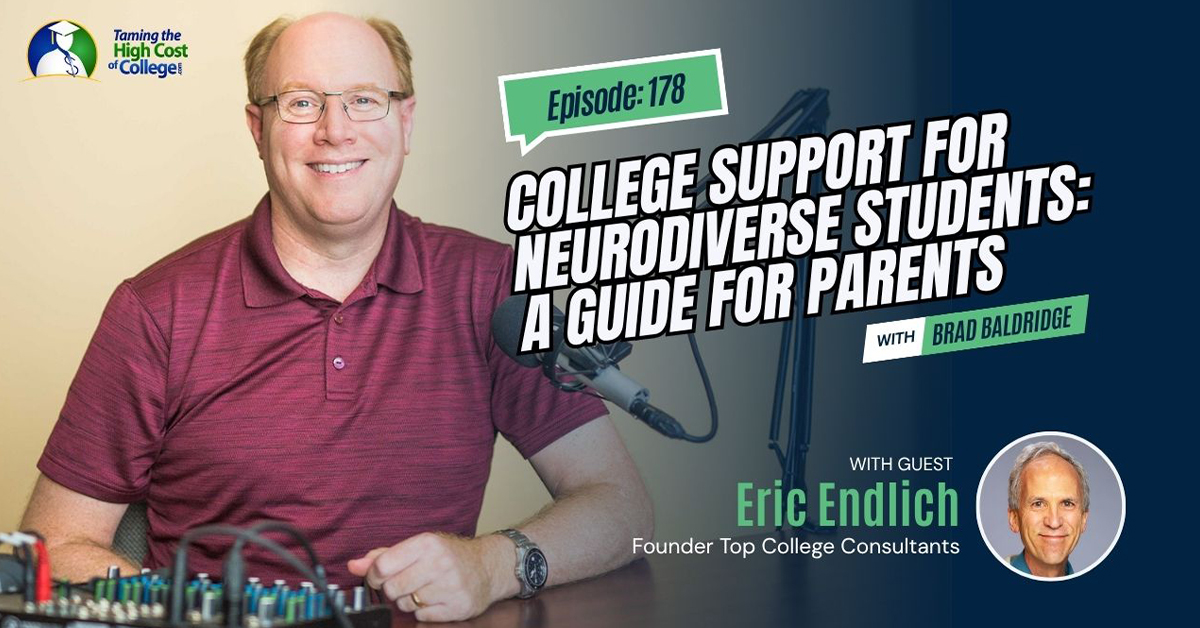
Today’s Guest:
Eric Endlich, Ph.D., Founder of Top College Consultants
Eric is a clinical psychologist and educational consultant specializing in students with learning differences. He founded Top College Consultants to help families ensure that students with ADHD, dyslexia, autism, and other diagnoses are college‑ready and supported through the transition from high school. His team works nationwide, guiding students and helping them secure accommodations, build readiness skills, and find the right college fit.
Questions Answered Today:
How do college accommodations differ from high school?
Eric explains that one of the biggest shocks for families is how different the system becomes once students leave high school. In K-12, schools are legally obligated under the Americans with Disabilities Act (ADA) to identify students with disabilities, create individualized education plans (IEP) or 504 plans, and deliver accommodations. Parents often advocate, but the district drives the process.
How exactly do things change in college?
- Responsibility shifts to the student. Colleges do not automatically know that a student has ADHD, dyslexia, or autism. Students must disclose their diagnosis, provide documentation, and request accommodations.
- Accommodations look familiar but not identical. Extra time on tests is common, but support such as extended assignment deadlines might disappear. New options such as assistive technology or residence hall accommodations may be available.
- Different laws apply. Colleges follow the ADA and Section 504, which guarantees “reasonable accommodations” but not individualized education plans.
- Self‑advocacy is essential. Students must learn to approach disability services, professors, and campus resources themselves.
Families who assume college will mirror high school often face a rude awakening. Success depends not just on academic ability but on whether students can step forward, disclose their needs, and navigate a new system of support.
What role do parents play once students enter college?
Brad and Eric highlight that parents often face a rude awakening. In college, students are treated as adults, even if parents are footing the bill, which means that:
- Privacy laws limit access. The Family Educational Rights and Privacy Act (FERPA) prevents colleges from sharing grades, attendance, or financial details with parents unless the student signs a waiver.
- Parents may be in the dark. A student could stop attending classes or face academic probation without parents knowing. Weekly phone calls with your student might not reveal the full picture.
- Waivers help but do not guarantee communication. Even with FERPA waivers, colleges rarely provide proactive updates. Disability services offices vary in how much they involve parents.
- Families must adjust expectations. Parents can still support students behind the scenes, but the student is the college’s client, not the parent.
This shift can feel uncomfortable, but it is also an opportunity for growth. Parents move from being managers to mentors, guiding their teens toward independence while trusting them to take ownership of their education.
What kinds of support programs do colleges offer, and how do they differ?
Eric outlines the wide range of programs available beyond basic accommodations. While every college must provide free disability services, some go further with specialized support.
Examples from Eric’s database:
- Marquette University in Milwaukee: the On Your Mark program for autism and ADHD, ($4,000/semester)
- Northeastern University in Boston: Learning Disabilities Program, twice‑weekly meetings with specialists ($2,900/semester)
- Syracuse University: Similar program ($2,800/semester)
- Tufts University: Special-interest housing for neurodiverse students (no fee)
- UCLA: the All Brains program with peer mentoring and workshops (no fee)
- University of Denver: Tutoring and organizational coaching ($1,700/quarter)
- University of Iowa & University of Wisconsin—Madison: Group workshops and skills coaching (no fee)
Key insights for families:
- Paid programs often provide intensive coaching and mentoring.
- Free programs may focus on peer support, workshops, or housing options.
- Costs and services vary widely, so families must compare carefully.
- Families should ask not just, “Do you have services?” but “How are they delivered, and who delivers them?”
The variety of programs means families can find options that match both their student’s needs and their budget. What matters most is not whether a program exists but whether it provides the right kind of support for that particular student.
How should families approach college visits to evaluate support?
Brad and Eric emphasize that college visits are critical, but families must go beyond the standard tour. They explore ways to dig deeper during campus visits:
- Schedule separate meetings – Disability services staff or program directors can explain accommodations, services, and staff qualifications.
- Ask detailed questions – How many sessions are available? Who delivers tutoring or counseling—peers, graduate students, or licensed professionals? Are services group‑based or individual?
- Look for subtleties – Peer tutoring is common, but professional tutors might offer more expertise. Counseling centers vary in session limits and staff credentials.
- Observe the environment – In‑person visits reveal staff attitudes, office resources, and program culture. Are staff approachable and well‑resourced or overworked and frazzled?
- Discover differentiators – Just as Brad’s son learned that engineering projects such as Baja buggies and concrete canoes were “table stakes,” families might find that disability services vary in quality, not just existence.
College visits are not just about liking the campus or hearing the sales pitch. They’re a chance to uncover the hidden details that determine whether a student will thrive once they arrive.
What broader lessons apply to all families—not just those with neurodiverse students?
Brad and Eric conclude by noting that, while neurodiverse families face unique challenges, many lessons apply universally.
Broader takeaways:
- Core planning applies to everyone. Financial aid, affordability, and admissions strategy are universal. Neurodiverse families simply add another layer of complexity.
- Unique circumstances matter. Families might face complications such as special diets, business ownership, twins/triplets, or inheritances. Neurodiversity is one of many factors that can shape planning.
- Support is part of college fit. Just as families evaluate academics, costs, and campus culture, they must also evaluate support systems. For some, neurodiversity is front and center; for others, it’s a secondary consideration.
- Fairness vs. fit. The bigger question is not just “fairness” in admissions but fit: finding the right environment where the student can thrive academically, socially, and personally.
Families who approach college planning with this broader lens are better equipped to make thoughtful choices. Whether the challenge is neurodiversity, finances, or something else, the goal is always the same: finding a college where the student can succeed and grow.
Links and Resources
Helpful Articles and Resources
- Taming The High Cost Of College
- What Questions Should I Ask the Student Disabilities Office?
- The Americans with Disabilities Act (ADA)
- Eric Endlich’s Contact Info:
THANKS FOR JOINING US!
We’d like to extend an invitation to our listeners to share their feedback and questions. Contact us to submit a question.
If you find our podcasts helpful, please share us on social media and tell your friends!
The bottom line is that we care what you think and want to help you out, so we’d appreciate you reviewing us on your favorite podcast platform. Even better, receive automatic updates by subscribing to the show through your preferred podcast service.
Presenter 0:00
Welcome to the Taming the High Cost of College podcast. Here is your host, certified financial planner Brad Baldridge.
Brad Baldridge 0:10
Hello, and welcome to Taming the High Cost of College. I'm your host, Brad Baldridge. Today we're meeting with Eric Endlich. He is the founder of Top College Consultants. You guys specialize in neurodiversity and lots of other things, so why don't you explain a little bit more about what you do and how you came to do it?
Eric Endlich 0:28
Sure, and thanks for having me on the show, Brad. So, I'm Eric Endlich, I'm a clinical psychologist by training, worked for many years in mental health, and saw some students who would then transition to college and have an unsuccessful experience, and I really thought, you know, there must be a better way to prevent these unfortunate outcomes for high school students transitioning to college, and that's part of why I became an educational consultant, specializing in students with learning differences, so that we can ensure that when students are in high school, they get the college readiness skills, and they get the support they need to be successful in college. So, started my company, Top College Consultants. We work with, I've got a team of consultants around the country, work with students around the country transitioning to high school, and I mean to college, and occasionally to grad school.
Brad Baldridge 1:17
Okay, great. So, then, so your focus is on what is broadly called learning differences, so can you explain a little bit about what we're talking about there?
Eric Endlich 1:26
Sure, so most common diagnoses would be ADHD, dyslexia, autism, plenty of other diagnoses to other kinds of learning disabilities, but those are the ones that people tend to have heard of, and often students have a bunch of other diagnoses. There might be anxiety or other mental health diagnoses. There might be physical disabilities, other medical conditions, migraines, what have you. So our students often come with a bunch of diagnoses, but I would say autism, ADHD, and dyslexia are sort of the headline diagnoses for many students, right?
Brad Baldridge 2:00
Exactly. So certainly with ADHD, there's a lot of stuff in the news, and it's getting political in some areas, and so forth, and so on, but I think the reality of it is that students sometimes need help and figuring out how it's going to work and understanding it is usually it falls on the parents, right, so we're in that situation of saying, well, college is next, high school was interesting, we had to deal with this and deal with that, and now we're going to take the next step. How do things change, generally or broadly, from going from high school to college? As far as the what we've learned and how we do things in high school, is it similar for college? Is it drastically different?
Eric Endlich 2:43
It's pretty different. And when families assume it's going to be the same, that can be a really a rude awakening. When the students get to college and they find that it's a different system, there's a lot of support available in college. There is support for students with disabilities, learning differences, physical disabilities, etc. but it's a different system, partly because it's governed by different laws, and I don't want to go too far into the weeds, but when a student's in K through 12, including high school, the responsibility is on the school district, legally they're legally obligated to identify students with disabilities, come up with a plan to serve them, and deliver that plan, so the student can kind of sit back and, and let that happen. Obviously, parents are often involved in advocating. I'm a parent, so you know, I know what it's like to be on the front lines advocating for your child, but if all goes well, the district is really making that happen. Is that student can just kind of show up at school and have the accommodations and services delivered to them. It's almost flipped in college. When students go to college, if they don't disclose a disability, there's no way for the college to know that they even have a diagnosis. So, a student could go through four years or more of college without ever being identified, without ever getting any accommodations for services, unless they step up and go to Disability Services and say, I have a disability, here's my documentation, I want, I need these accommodations to be successful. And in college, it's there's sort of a baseline of accommodations that any student with a disability who has documentation can get those. Some of those will be familiar to students who've been in high school, like extra time on tests, probably the most common one. Some of them might be things that they haven't encountered before, like assistive technology, or maybe an accommodation in the residence hall, which wasn't really relevant or applicable in high school. And then there might be other things that they were used to in high school that kind of go away or disappear in college, like extra time on assignment deadlines.
Brad Baldridge 4:45
Okay, so I guess one of the other changes that I note, they are on finances for sure is, you know, the students are now adults,
Eric Endlich 4:53
Right?
Brad Baldridge 4:53
So it's, you know, it's their education, they get the bill, and parents are allowed to help, they have to go through the process, and a lot of colleges know that a lot of parents are doing a lot behind the scenes, and they kind of facilitate it, but I mean, the true concept, right, is that the student is going to college, the student is paying the bills with help, of course, most of the time, so I would assume something is similar there. From a can, the colleges can't talk to parents about grades, they can't talk to parents about actual bills and what's going on financially. Well, who paid the bill? Or they're not going to disclose all that stuff, even though the parents are saying, well, wait a minute, I wrote a check for x amount, you know, big numbers, I'm spending a lot of money here, and now you're not going to talk to me? And the answer is yes, that's true. They're not going to talk to you.
Eric Endlich 5:45
Yeah, and that can be a rude awakening for parents as well, to because they're used to, again, you know, I know this is from being a parent, you're used to having that communication with the school, with the teachers, with the staff, and knowing what's going on, knowing if something's going wrong, but in college a kid could stop going to classes, they could start failing all their classes, they could be on academic probation, and a parent might never know. And a parent, you know, you call up your kid every week, how's it going? Oh, it's great. I love college, not not knowing that your child's not even going to class or or on the verge of being kicked out, so that's, you know, worst-case scenario. Not saying that happens all the time, but it is possible if, if there's that sort of firewall. Now, a student can sign something called a FERPA waiver to give parents access to information. Still doesn't mean the college is going to proactively communicate. Disability services kind of vary in terms of their comfort level, communicating with parents. Many of them will say it's not really how we work, as you said, our client is the student. Others, especially if there's a support program, might have a built-in community component of we're going to communicate with the parent once in a while to sort of keep them in the loop, but that's not the default
Brad Baldridge 7:00
Right? So, let's talk a little bit about what types of services colleges offer, and how they differ, and how they might be the same.
Eric Endlich 7:10
Sure
Brad Baldridge 7:11
But what types of things are, again, hypothetically, you know, lots of people that you know, if your student has ADHD and has been on a some sort of education plan. Now we want to transition to college. Obviously, is there something similar? Do we get together somehow and create an education plan, or what? How does it change?
Eric Endlich 7:31
Yes, and no. So it's not the same plan, and this is something that there's a lot of myths that just refuse to die. IEPs, individualized education plans and 504 plans, that is special ed plans for students with disabilities in K through 12. Those do not transfer to college. There's no advantage to switching to a 504 in high school. It doesn't help things transfer, doesn't transfer. Some colleges won't even look at those plans, some of them will, but there's no guarantee that they will, so across the board, virtually all colleges offer disability accommodations under federal law. It's a different law than K through 12, it's the Americans with Disabilities Act, and part of the 504 Act. So all students can get disability accommodations, those are free, and those are freely available at virtually all colleges with the documentation, if the student discloses a diagnosis, again...
Brad Baldridge 8:25
Is this falling under the is this falling under the broad category of similarly, like you know, you have to have an elevator, you know, so for people with disabilities, or you need to have all these different reasonable accommodations
Eric Endlich 8:39
Exactly, yeah, reasonable accommodations in the workplace, same idea, it's the same law, the ADA, and you know we're talking about learning differences, so you know, again, extra time on tests, etc. But same is true for students in a wheelchair who has a visual or hearing impairment, they might need different kinds of accommodations, maybe if they're in a wheelchair, they need to have a dorm room on the first floor. They need to have all their classes in buildings that have elevators, or who knows what it might be
Brad Baldridge 9:10
Right, all those things.
Eric Endlich 9:11
So, yeah, a student could have, you know, allergies, lots of different disabilities, in addition to mental health and learning differences, right? So that's the base level. All colleges have that. All students can get that free. Some colleges, and we have a list of them on our website, go above and beyond and offer services, not just accommodations, but services like meeting with a learning specialist or an academic coach to help you manage your time or manage your assignments, social events, early registration, peer mentors, a host of other components in learning support program, or an autism support.
Brad Baldridge 9:50
Right. Okay. Yeah, so I know you, there's obviously you guys work hard on this. You have a database on your website, so let's talk a little bit about, I'll give you some examples here, just so people can kind of understand, just hold some random colleges out of your database. We'll start with Marquette. I mean, I'm in Milwaukee. Marquette is in Milwaukee. I'm very familiar with Marquette. They offer On Your Mark, is what they call the program for autism, ADHD, and other forms of neurodiversity, and they have a price tag on it of $4,000 per semester. Northeastern in Boston, they have LDP for learning disabilities, ADHD, autism, twice weekly individual meetings with a professional learning specialist, 2900 a semester, Syracuse similar, twice weekly, 2800 a semester, Tufts, no fee special interest housing for neuro diverse students, University UCLA, which I think you're associated with some, so they have something called All Brains, which is peer mentoring and social events and workshops, no fee. University of Denver, tutor, peer mentoring, help with organizational skills, 1700 a quarter, University of Iowa, no fee, group workshops and events, neurodiversity skills coaching at University of Wisconsin-Madison, another Wisconsin school, no fee. So, there seems to be a, just in this database, there's a few 100 schools, some targeting ADHD, some very specifically autism. So, it seems like there's a lot going on. So, how does a kind of a parent start trying to figure this out? If we've got all these different programs, you know, when do we start thinking about it? How do we make this kind of fit into our life if we think we're going to have to include this as part of our plan?
Eric Endlich 11:29
Sure, yeah. Well, I love the fact that you, that you picked Marquette right off the bat, because I know the director, Emily Radclaw, well, she's super dedicated, has been running the program for years, and has actually won one awards for the program, so great example, so you know this is something I start talking to students of MS about from our very first meeting. I'll ask, what kind of support are you getting in high school now that's helpful to you? I don't want to know just what are the accommodations you're getting, but what are you actually using? What do you actually find helpful, and I get a range of answers, right? So some students say, "Oh yeah, I have this plan," or "I have this, you know, I get extra time, but I don't really need it," or "there's this resource room or study hall, and I don't really like it," and "I want to get off my IEP." So that's one end of the spectrum. I had a student tell me the other day, I love my 504 plan. I was like, "Wow, that's that's refreshing to hear." Or students will say, "Yeah, I go to this resource room and there's a teacher or staff member who helps me, you know, get my assignments done, and it's super helpful. Or I really do rely on that extra time." So, you know, we'll start with, "What are you getting now in high school? What is helpful to you," so we can start to estimate or guess what might be helpful in college. Also, want to see if they've had a neuropsychological evaluation recently, which can be extremely helpful. Often those evaluations, especially if they've done late in high school, will provide a list of recommended accommodations and services in college, and they'll say, you know, for this student to be successful in college, we think they're going to need the following things, and that can be almost a blueprint for going to the disability services in college to ask for accommodations, and for looking at colleges in the first place. To your point, so I want to kind of look at what are your needs, and of course, you know, I'm making my own assessment too. I've been working with teens for many, many years as a psychologist. I'm talking to the parents, I'm having them fill out questionnaires. I'm also talking sometimes to other folks in the picture, might be a tutor, therapist, school counselor. Truly, get kind of a 360 degree picture of the student. Do they struggle with executive function, with managing time, do they struggle with making friends or socializing, and possibly struggling to live with a roommate? How are they with self advocacy? If they have trouble in college, are they going to be able to go to their professor to talk about it, or go to the tutoring center, or the counseling center, whatever that need might be? What about independent living? Do they know how to do laundry? Do they know how to do a little bit of cooking? Can they manage getting around, making appointments if they get sick, or they need to refill their medication? All these different life skills. I'm looking at all these areas of college readiness, totally apart from their academic ability to get into college and to handle college levels courses, we're talking about not just being college capable, but being college ready, and so that would kind of drive our thinking about what kind of colleges and support programs might be helpful or necessary in college, and it could be a really big range. I haven't even given you all the different options, we've, we've talked about some of them, like just basic accommodations and support programs. There's, there's more, but if I get the picture from the student, from the parents, from other folks. Hey, yes, I have this, this label of ADHD or autism, but I'm knocking out of the park in high school, I'm doing great. Yeah, I had this 504 plan. I don't really need it that much.
Eric Endlich 15:02
I can prob... Some of those students can go to any college they get into and do fine, maybe with very little support, maybe with just a couple of accommodations. And then there might be at the other end of the spectrum students who are getting a lot of support to be successful in college, in high school, and are going to need a good support network in college, too. So that's a broad overview
Brad Baldridge 15:23
Right. Absolutely, so one thing that comes to mind, you know, I work with a lot of parents that are on the financial side of college, so mostly I work with parents on what the parents have to do to save and invest and financial aid and all that stuff, and one of the areas that doesn't get a lot of love is the college visit, right? Nobody's Googling how to do great college visits, for whatever reason, they don't, but I wish they might not go on and out, right? My dad pointed out, college visits is a key piece of this puzzle. It's your opportunity to go to the financial aid office and talk about scholarships and talk about financial aid and understand the prices, and there's, you know, ways, substantial ways to save money by doing good college visits, and I would believe that when you're working with families, you're probably coaching them a lot about, well, go ask about this, go ask about that, because how do you, you know, especially because it's a little bit political, if you ask any college, well, do you have services for people with disabilities, they better say yes, right? I mean, no, we break the law regularly. They have to have it that they have right. They have to say yes. We have accommodations for people with disabilities, but then again, when we're actually picking a school and finding a good fit, I think the neurodiversity piece could be front and center for a lot of families. It could be maybe a little bit on the side for other families, but if it is front and center, are there things that we should or shouldn't do? And when do we start? And how do we do visits? And can you talk a little bit about that?
Eric Endlich 16:50
Certainly, yeah, lots to say about that. So, when to start visits, generally we're encouraging students to do that in junior year, in 11th grade. I don't, I love working with students in ninth grade, 10th grade, but it's not really to talk about college, it's to talk about summer plans and picking courses for next year and other stuff, getting ready for college, but as far as sort of actually looking at colleges and going, you know, boots on the ground, going to visit, generally that starts in 11th grade, unless a student really wants to, or they're tagging along with an older sibling prior to 11th grade, so that's the win. The college visits, you know, if you register for a tour, which I highly recommend, there's typically two parts. There's a information session about half an hour with an admissions rep, typically indoors with a slideshow, and then a college tour outdoors, walking around the campus, led by a current student, or sometimes they call them student ambassadors, and that may be around an hour or so. So, the whole thing's around an hour and a half, depending on the size of the college, and so on. Though that is not really the best place to ask those kinds of questions, like, hey, my kid has ADHD, tell me what you have at this college for them, because you're not talking to the specialist, you're talking to a random student who's giving a tour, and an admissions rep who's there in kind of a sales capacity, but they're not a disability specialist, right? You want to do...
Brad Baldridge 18:09
Right,, help people
Eric Endlich 18:10
Ideally is to set up a separate meeting, just like you would with financial aid, a separate meeting with disability services, and or the support program, if there is one. Now, those support programs are often run out of disability services, but not always. Sometimes it's a separate, separate department, separate meeting. If they don't have a support program, obviously that would be irrelevant, but they always have a disability services office. You're going to find that at pretty much every college. Once in a great while, disability services staff will say, "Sorry, we only talk to two enrolled students. We don't talk to prospective students or families." So, if they say that, okay, so be it. That doesn't mean that they're being, you know, unfriendly. It may just mean that they're really busy, and they don't have time to talk to every prospective student who walks in the door. But most of the time, many many cases, they'll say, "Sure, come by, you know, we can talk to you." Or it could be a Zoom interview, it could be online or phone call. I like the in-person when you can make it happen, because you can go into the office and look around and see where is it located. How many staff do they have? What's the vibe? Does staff seem happy and friendly, and you know, relaxed, or do they seem frazzled and overworked, and you know, irritable. So, there's things you can pick up in person that you wouldn't. And then you might wonder, okay, so I go there. What do I ask them? What am I supposed to learn? I have a blog post on that topic of 25 or so questions that you can ask to do a deeper dive to how does this college's disability service differ from another college?
Brad Baldridge 19:45
Right, exactly. And I think that's the key, is there's two things you're doing when you're evaluating a college. One is learning about college in general, right. So you do three visits, and the third visit you discover that they. Have a learning disabilities office, and you ask some questions, and then you realize, well, I didn't even ask those questions at the other colleges, because I didn't know they had an office, so maybe I need to go back to those colleges, figure out if they have the office, and go ask the questions.
Eric Endlich 20:12
Yeah, we're doing that
Brad Baldridge 20:13
So now I can compare them, right? You see similar things around something like internships, you know? You learn about internships at a college, and that's on, oh, that is actually something I'm really interested in. Now that gets put on your list of questions to ask going forward, and also maybe going backwards, and gathering it as well, where it's like, okay, and then you start diving into it, and you realize that they all say, you know, we've got this, or we've got that, you know, a quick anecdote. When I was visiting with my son, he was interested in engineering, and the first visit we went to, they, you know, they took us to the engineering building, and they showed us the Baja Buggy that they build and compete, and they showed us the concrete canoe and the solar vehicle, and he got all excited about all these cool projects that are going on. Then we went to the next engineering school, and they showed us the Baja Buggy and the concrete canoe, and then we went to the third engineering school, and they showed us the, and all of a sudden it's like that's it seems to be table stakes, everybody has Baja Buggies and concrete canoes and all that stuff, so that's not a differentiator, it's great that they have them and he's excited about it, but that's not a differentiator, so what types of questions might you ask to try and get to something that you know, I think a big one from my side of it is these schools have paid programs and these schools do not, so
Eric Endlich 21:29
Right, right,
Brad Baldridge 21:31
That'd be an obvious question.
Eric Endlich 21:32
Sure, you can figure that out from from the database on our website, which, by the way, being a database, you can sort it by state if you're just looking for schools in Texas or Virginia or Iowa, you can sort it and kind of hone in on the areas that you're looking for, and see, as you said, how much they cost and what exactly the services, but you can still ask that when you go, you know, I didn't see anything online about any special programs or services. Do you folks have anything, because colleges are adding programs all the time. There are new, there's new stuff coming online every year. It's, it's great. So, there could be something that you didn't see on their website that they're about to introduce for the coming year. So, it's always worth asking that question. Don't assume just because you didn't see it that you know they have only minimal services, and you also may discover sort of subtleties or nuances about the services. Get into the, you know, don't be hesitant to get into the weeds of, well, who's delivering the services? What's the training of the folks delivering these services? For example, you know, pretty much all colleges have free peer tutoring. That's a great service, can be really helpful for students. Some colleges have professional tutors who have, you know, master's degrees and have been trained in how, you know, in how to tutor and have just more knowledge than a college junior or senior has. So, you know, those are the kinds of differences that you want to look into same thing for mental health services. Most colleges have free mental health counseling, you know. When you go on the college tour and they say, "Here's our counseling center, every student's entitled to free counseling." Wonderful. My kid's in therapy now. Great to know that they can get help in college too. But you want to go beyond that and find out, well, how many sessions can they get, is it a maximum of 10, or is it unlimited? Who's delivering the services? Is it graduate students in on internships or practica, or is it licensed professionals, etc. etc. Is it all group therapy? Can you get individual therapy? Can they get prescriptions filled? There's a lot beyond just we have this service versus well, how is it delivered, and who's delivering it. Tours are so important, not just to decide thumbs up or thumbs down, do I like this college, but to your point, you discover things that you didn't even, you don't know what you don't know. So when I talk to students early in the process, going into junior year, they often say, I don't really know if I want a big or small college, I don't really know what I'm looking for, I don't really have any preferences, and I say, go out and tour a variety of colleges nearby that don't require paying for a plane ticket, big, small, urban, suburban, public, private, stem, liberal arts, and they go to these colleges, and then they see, ooh, this college had an amazing maker space, you know, and I love to work with my hands. I want to find more colleges that have that, or, oh, they had a gym with a climb climbing wall, and I like to climb, so you know, I didn't realize I could get that in college, or whatever it might be, sweet style housing, you know, special gluten-free area in the dining hall, smaller classes, you name it, you know. Once you once you go out and see different colleges, you start kind of discovering things that you might actually want, and then you know you ask at the next college, or you start then refining the crime. Criteria for your list, not just which colleges go on the list, but you know what, I don't think I want a college that's right in the city. I don't really like crowds, I think maybe I want to be adjacent to a city, or whatever it might be. And though that's true for all students, so all of the same factors, same things, cost and affordability, that's true for families of students with learning differences, we're all looking at the same factors. It's just that our families are also looking at
Brad Baldridge 25:25
Right exactly. Yes, I mean, I've been saying that for years, is there's a core thing or planning that all families have to do around financial aid and getting into college, and then you might have additional complications, learning differences, or special diets, or maybe the family is a business as a business owner, so their financial aid is a little more complicated, or you've got twins or triplets, and that gets complicated, or just received an inheritance, or there's all kinds of reasons and differences that will apply, but just realize that at the end of this process, at the very end, come May, your senior year, you're going to pick a college. may 1 is the deadline, and you're going to say, I applied to these 12 colleges, I got accepted at these eight colleges, and four of them are 30,000 a year, and four of them are 40,000 a year, and one of them is 50,000 a year. And, of course, the one my student loves the best is 70,000 a year. Now we have to decide, is it worth more money to take this college over that college, and part of those factors again, where we're talking about, well, what are their support services? Am I? Does that extra money include the $4,000 fee that we're talking about?
Eric Endlich 26:35
Yeah, so you're getting onto this sort of intersection between neurodiversity and affordability, and so you know all the same things about college affordability and scholarships and financial aid apply to these families, but there's that extra layer, and if you get into college and you get a financial aid award or offer, you can go back to financial aid and say, hey, we want you to understand, because our child has a disability, we're paying an extra $10,000 a year currently for certain services, maybe it's an executive function coach or something else, and when they go to college, it's going to cost us another 10,000 on top of that force for the learning support program, or maybe it's a physical disability and they need a personal care aid or something else, so you know you can have those conversations, so colleges understand what your financial picture is and take that into account, because those aren't the typical questions that the FAFSA asks
Brad Baldridge 27:35
Right? For sure, and just so people are aware that these additional costs fall under the broad umbrella of cost of attendance, so you're eligible for loans to cover them, you're eligible to take it out of your 529 you're eligible to cover it through need-based aid and merit aid, and but it is a higher cost, of course, and for a lot of families, you know, financial aid is not covering the whole cost, then that effect of a $4,000 a semester program for many families will be, it's going to be out of pocket, $4,000 for that family. Some families, it'll be like, well, but this loan will cover the grant will cover it, or
Eric Endlich 28:12
Right, right.
Brad Baldridge 28:13
And then you know the net cost, you could be less, so
Eric Endlich 28:17
That to be the straw that breaks the camel's back, right. A couple things to mention, there's lots to say on this, of course. One is, you know, I often ask families, have you explored public benefits, and sometimes families say, what is that? What do you mean? Because students with disabilities may be eligible for a bunch of different benefits that other students are not, many of which are not dependent on the family's financial status, so if you're a middle class or upper middle class family, you might think, oh, well, our kid's not going to be eligible for any of those things. I mean, things like vocational rehabilitation has different names in different states, but every state has some version of that, voc rehab, or VR, social security income, a supplemental security income, SSI, that's a federal benefit. Medicaid, which has sometimes has different names, like in Massachusetts, it's called MassHealth. In California, it's called Medi-Cal, but Medicaid, that's the type of insurance you can get as a student with a disability. So, VR, Medicaid, there might be services in a particular state, like developmental disabilities office in California. There's something called the regional centers, which is specific to California, can be hugely helpful financially, and there may be other benefits too. Might be so. Those are a few examples, and sometimes those can help fund the cost of college. So voc rehab in some states is helping pay college tuition, and students without disabilities, that's not on their radar screen. If you have a disability, it should definitely be on your radar screen to learn about it, look into it. Doesn't cost anything to apply, you can often get an answer very quickly, whether you're eligible or not, and see what how. That can help you. I co-manage a large Facebook group, 29,000 parents of neurodivergent college-bound students, and this is the type of thing parents are often sharing with each other. Hey, in my state, I got this amazing support from the state, you should look into it too, if you're in my state. So, because families go into this blind, not knowing what's available, and the high school may or may not inform them, typically not, they're not typically saying, "Hey, there's all these services you can apply for that could help with college costs, or you know, could be helping you now while your child's in high school. So that's one point. The other point I want to make is there are scholarships specifically for students with disabilities and learning differences, there's not a ton of them, and they're not a ton of money, but they do exist, and I also have a list of those on the website. So
Brad Baldridge 30:48
Okay
Eric Endlich 30:49
You know, free resources, you don't have to give me your email address, you can just go on to the website and find all this information. The, as I'm sure you know, the main source of money is from the colleges themselves, so building the college list carefully is the key, is the key differentiator. Have you picked colleges that are generous with merit aid, but assuming that you know that's all taken care of, you know, and you have time to burn, go ahead and apply to autism scholarships, or disability scholarships, or scholarships for a particular diagnosis, they're not as competitive as big nationwide scholarships like Microsoft or Coca Cola, and you might get, you know, a few 100 bucks here and there, and it adds up
Brad Baldridge 31:30
Right? So, what about, like, reputation? Are there schools that are known for stepping up and being a good place? I mean, you have that, you know, that list in your back pocket of schools that are, you just had a lot of success with when you send students there. What kind of feedback do you get, and you know that type of thing in general? I mean, we're not saying which school necessarily, but I'm assuming that some schools are better than others for different
Eric Endlich 31:56
And it's all about doing just, just like it is with any other aspect of the college process, financially, academically, it's all about doing that, the deeper dive, like we said, meeting with staff, seeing, you know, who are these people delivering the services, talking to other families is super helpful again in the Facebook group, because we now have 29,000 parents as of this week, if you go in there and say, hey, my kids considering this college, has anybody sent their kid there? Most of the time, other families are going to chime in and say, oh yeah, and it might be, you know, my kids there right now. If you want to, you know, have a conversation, the services and support are amazing, or maybe not so amazing. So, other families are a great place to get feedback, going and talking with the staff yourself, things change from year to year, you know. Staff turnover, so what was a great program five years ago may or may not be as good today. Sometimes there's a way to get a taste of it by going to a summer program or a pre-college program. Some colleges have pre-college summer programs, college readiness programs, not just to have fun or take a class or two, but to actually learn skills to become college ready for students with learning differences. And if you spend a couple weeks on the campus, you're going to get a feel for what the staff are like, what the vibe is like. So, not all colleges have that, but some of them do. So, if it's a college that you're thinking about, and they offer one of those programs, it might, you know, serve many purposes. You go to the program, develop some skills, maybe make a couple friends, and maybe you decide, you know, hey, I really like it here. I think I do want to keep it on my list
Brad Baldridge 33:36
Right? Yeah, that's good advice to just kick the tires where you can. What about this, the student-parent relationship, those... I think there's, in some regards, I mean, pretty much all 18 year olds. I wish this problem came up when I was 18, when I knew everything, kind of the typical 18 year old has got their own opinions, and they're trying to sever the relationship with parents, or not severs the wrong word, but change the relationship with parents, right? They want to go from I depend on you to whatever comes next, and there's a lot of angst, just in general. And I assume you would also see it, maybe around education plans and stuff. Are there... I mean, are there situations where the student is opposed to this whole process? They just want to go to college, not disclose anything, versus, so how does a parent navigate that? I mean, what's your best advice, or is it case by case of, oh, should we let them keep a secret and just give it a shot, or then pick up the pieces later? I mean, what happens at a college if you spiral out of control freshman year, which most parents, that's their fear, right? And then you disclose, well, actually, here's why this is going on. We didn't tell you, because we thought maybe we could survive without it. It's clear now we can't. Is that, you know, what advice will you give them?
Eric Endlich 34:54
And that's the disaster I'm trying to prevent. That's part of why I went into this field, so that students don't have the. Happen, so there's a range. I see a lot of students who are very comfortable with their diagnosis. They embrace it, maybe they choose to write about it in their college essay, maybe they join a neurodiversity club in college, or start one. So, you know, I see students who are very comfortable, say, you know, like I said, the student earlier, you know, I love my 504 plan. I'm absolutely going to get accommodations in college, you know. I'm excited about this support program. They've, they've toured it, they've met with the staff. They, they know they're going to make friends there. And then there's, there's students on the other end who, who say, you know, yeah, this person gave me a diagnosis of ADHD or autism, but I disagree. I don't think I have that, so they're, they're not even embracing the diagnosis in the first place, or they say I have it, but you know, I don't think it really affects me that much. And I think I'm kind of outgrowing it, and I don't want, you know, I don't like getting services. I've been a special ed kid my whole life, and I want to get away from that in college. I just want to go to college and have a normal experience and not deal with any of that stuff. So, we absolutely do see that that worries me when students have that, that idea, you know. It's kind of like saying, you know, I have car insurance right now, but I haven't been in an accident in the past year, so I think I'm going to get rid of my car insurance, you know, legally you can't typically do that, but it's that kind of idea of like I don't want that protection. The accommodations are free, there's no downside, they're free, they're confidential, disabilities, not services, not broadcasting to your peers or or the college that you are a client there, so it's free and confidential, and also in college, typically students are disclosing to each professor on a case by case basis that they have accommodations. Doesn't work that way at every college, but it's very common to work that way, where a student decides at the beginning of the term, okay, I'm going to approach this professor and let them know that I'm entitled to accommodations, but let's say your accommodation was extra time on tests, which is a common accommodation. Well, if it's an art class or a music class that doesn't have tests, maybe you don't need to bring it up to the professor because it's irrelevant
Brad Baldridge 37:15
Right?
Eric Endlich 37:15
So you can, you can decide on a case by case basis, but what you can't do is get accommodations retroactively. In other words, if you fail a test and you're like, darn, you know, I have ADHD and I know I deserve extra time, I'm going to go to the professor and say I should have had extra time, or I want to retake the test, even though I've never disclosed a disability before. Once the damage is done, you can't really go back, so that's why it's good to have those things available in case you need them
Brad Baldridge 37:45
Right? Exactly, yeah. Because I think in a lot of times I think parents are trying to figure out, just in general, is this a hill worth dying on in the overall negotiating with the student and the stress, and now typically
Eric Endlich 37:58
And I don't think of it as a single conversation, like you have to do this. I think of it as a process, so if a student has a certain position at the beginning of the process of saying I don't think I want to do that in college. Okay, same thing with gap years. You know, lots of students would benefit from gap years, and I often bring it up early in the process, and lots of students say no, I'm not interested in that, just sort of slamming the door on that, okay? That's your right, it's your, it's your life, it's your process, but I try to keep it on the table, all right. Well, maybe we'll revisit it, you know. Let's see where you are a year from now. Same thing with the disability accommodations or services, okay? Fair enough, you know, it's your choice, but let's keep talking and see where we're at, maybe things will change.
Brad Baldridge 38:42
All right. Well, I learned a ton, and hopefully our listeners did as well. Can you tell us a little bit more about your services, and if you know how people could get in touch with you, and some of the things that you offer? So that
Eric Endlich 38:54
Sure, yeah. Again, is Top College Consultants website is topcollegeconsultants.com and we help students with learning differences and other disabilities, often mental health challenges, apply for and transition to college. So, building the college list, working on college readiness in high school, looking for summer programs, choosing high school courses, figuring out what extracurricular curricular activities might be good if you let's say you want to be an engineer, you want to be a musician, whatever it might be. You know what could you be doing now to set yourself up for success later, building again, building the college list with with all of the factors in mind that we've discussed, affordability, support, academics, right? Thinking about that
Brad Baldridge 39:40
Are you doing the full services that a typical independent education consultant would do, things like essay help and choosing majors, and you want to be where you grow up, right? Okay, and then you add on the neurodiversity piece, in addition, okay?
Eric Endlich 39:58
Correct. Yep, yep, I'm an independent educational consultants, a term that most parents don't know, IEC, and we help with, we go into the Common App, and I'm looking with students of all the questions and figuring out what to write for their activities list, so we, we get into all the details of the application itself, the essays. I'm a lifelong writer, so I love helping students with their essays. That's actually one of the reasons I went into this field, it's that's my favorite part of the process, is the essays. So, yeah, we help with all of that
Brad Baldridge 40:27
Right? Exactly. Okay. So, then, because I always, the way I would explain it is, there's kind of specialties now in many professions, right? Some people would say, I need a, my pipes are leaking, I need a plumber. Other people would say, well, I need a plumber that understands houses built in the 1850s and how the plumbing is different, and how the special things you have to do to really fix this weird problem that we have. You know, that's kind of here. So, you know, I think some education consultants work with anybody and everybody, and they have some skills around neurodiversity and that type of thing, but I think if neurodiversity is front and center, you may want to again find the specialists.
Eric Endlich 41:07
There are specialists with athletes, with performing artists, with all different areas. I happen to have someone on my team who works with athletes as well. I have some on my team who works with transfer students, students who want to leave one college and go to another college, so we have a pretty good range, but we don't do everything, and if someone comes along looking for a specialty we don't have, I know lots of colleagues I can refer them to
Brad Baldridge 41:32
Right? And when typically do you want to hear from a family? Then I'm assuming you know what I generally tell people is, when you know people call me very late in the process, right. We applied to seven schools, we were only accepted at two, and these two are crazy expensive, and they come to me and say, Brad, wave the magic wand to make these expensive schools less expensive. And it's like, well, I mean, I wish you would have come to me two years ago, exactly. We could have prevented this problem to begin with. So, is a ninth or 10th grader too soon, too late.
Eric Endlich 42:01
No, no. We love getting them in ninth or 10th grade. It's a way to try us out at a fairly low risk way to see, do like working together, because when we get to 11th and 12th grade, we're going to be spending a lot of time together. Ninth and 10th grade, we're not meeting that often, but it's developing that relationship, and it's looking at what you can do now. Hey, there's a college readiness program, so let's get the ball rolling on that, or let's look at courses for next year. Given that you say you want to study math in college, you want to study history or political science, whatever it might be. Let's kind of build your high school process accordingly, or look at clubs for you to join, so by the time we get to 11th grade, then we really hit the ground running, and we know the students, so we can say, I've got an I've got ideas for a bunch of colleges I think you're really going to like. If students come to us, you know, well into junior year, we can still help them, but it's more of a catch-up process of like, hey, we don't know you, so it's going to take time for us to even figure out what colleges to recommend. We like to have all junior year to get out and look at colleges in a more leisurely fashion, not in a rushed fashion
Brad Baldridge 43:11
Right? Yeah, the way I think about it is there's college planning, and then there's college crisis repair, so to speak.
Eric Endlich 43:19
Yeah, yeah
Brad Baldridge 43:20
Planning is better than crisis repair. We can do crisis repair. I mean
Eric Endlich 43:24
Yeah, oh yeah, yeah. I mean, my current record is I had a senior, a high school senior, approach me in January of this year to ask for help with the college process. At that point, most of my high school seniors already got into college, and this student hadn't even built a college list or started a Common App application. There were reasons for it, not criticizing the family, they had a lot going on, but that was halfway most of the way well into senior year, at a time when other students had not only applied but gotten in, they hadn't started, and I still helped them, and we still made it happen really quickly in a matter of weeks, but I prefer to have years.
Brad Baldridge 44:06
Yes, exactly right. And then it's similar with what you know what I'm doing is, you know financial aid, as an example, looks all the way back to the taxes and your sophomore year, so you know if we have the opportunity to plan your taxes in the sophomore year. Great, if it's water under the bridge, well, that's one less lever we can maneuver, but we can still help
Brad Baldridge 44:27
And that's the... So it sounds like you're probably similar with, you know, many other things where college probably needs to kind of start. And maybe the one way to what I tell families is, for those stuff that I do, you can separate, is the student ready versus is the parent ready, right? Parents, you know, college is coming. Maybe you can't visit, maybe the student's not ready to figure out what they want to be when they grow up, but a parent can still think about, will they qualify for need-based aid, or are they saving and investing enough, or how are they going to be fair if they've got three kids and all. And all that kind of stuff that you know they can start that conversation, the student doesn't have to be visit ready to do all that, and then when the student becomes ready, then we can kind of shift into it, so I guess in a similar vein, then what types of things would be kind of early stage stuff that might
Eric Endlich 45:16
Well, college readiness would be really important, so if a student came to us late in high school, well into junior year, or even senior year, and we ascertained from talking to the student, the parents, and other folks in the picture, and reading documentation that they are not ready for college, they can get in, but they're not ready to be successful, to live with a roommate, to self-advocate with professors, to keep track of their homework, all the skills that go into actually succeeding in college, not just getting in. If we get since late in high school, oh, wow, this student, great student, they're getting A's, but they're not ready for college, they might need a gap year. They, we need, might need to sort of stretch out the timeline. If they come to us in ninth or 10th grade, we can say, okay, let's let's start working on this stuff now. Let's go to go to a summer program, hire an executive function coach. Let's build these skills. Let's, you know, learn how to refill your medication, make appointments with your therapist, get your homework done without your parents intervening, all those various skills. We've got that longer runway to work on the skills, then they could go straight to college, not that there's anything wrong with the gap year, but, but it's just better to have that time, just as it is financially, to not be trying to, you know, plug the dikes at the last minute
Brad Baldridge 46:35
Right. Absolutely. All right. Well, it was great talking with you. I'm sure we'll stay in touch. If there's any other final words or thoughts, as far as what other services or activities you're offering, webinars or anything.
Eric Endlich 46:48
Oh, yeah, we've all played webinars. I just did one on gap years. I have one coming up on disability accommodations in college. We haven't set a date yet, but it's going to be great panel of folks who've worked at places like Princeton and Georgetown and USC, University of Southern California. So, yeah, stay tuned. You know, follow me on social media, Top College Consultants, or Eric Endlich, depending on which social media platform you're on. Feel free to reach out, go to our website, you know, no obligation, just poke around and look at the resources. Join the Facebook group, maybe in the show notes, you can put a link to the Facebook group that has a long, has a long name
Brad Baldridge 47:24
Exactly. Yeah, we will put links to everything in the show notes, and yeah, down below in YouTube, so
Eric Endlich 47:30
Lots of articles and other stuff on the website that's totally free. I don't make people give me your email address to me.
Presenter 47:36
Thank you for listening to Taming the High Cost of College. It's time for you to take action. Head to tamingthehighcostofcollege.com for show notes, bonus content, and to leave feedback for Brad. The next step on your college journey starts now.
Presenter 1 47:53
Brad Baldridge is a registered representative of Cambridge Investment Research and an investment advisor representative of Cambridge Investment Research Advisors, a registered investment advisor. Securities are offered through Cambridge Investment Research Incorporated, a broker dealer and member of FINRA and SIPC. Brad owns two companies: Baldridge Wealth Management and Baldridge College Solutions. The Baldrige companies are not affiliated with Cambridge Investment Research
Transcribed by https://otter.ai
Sign up to receive email updates
Enter your name and email address below and I'll send you periodic updates about the podcast.