

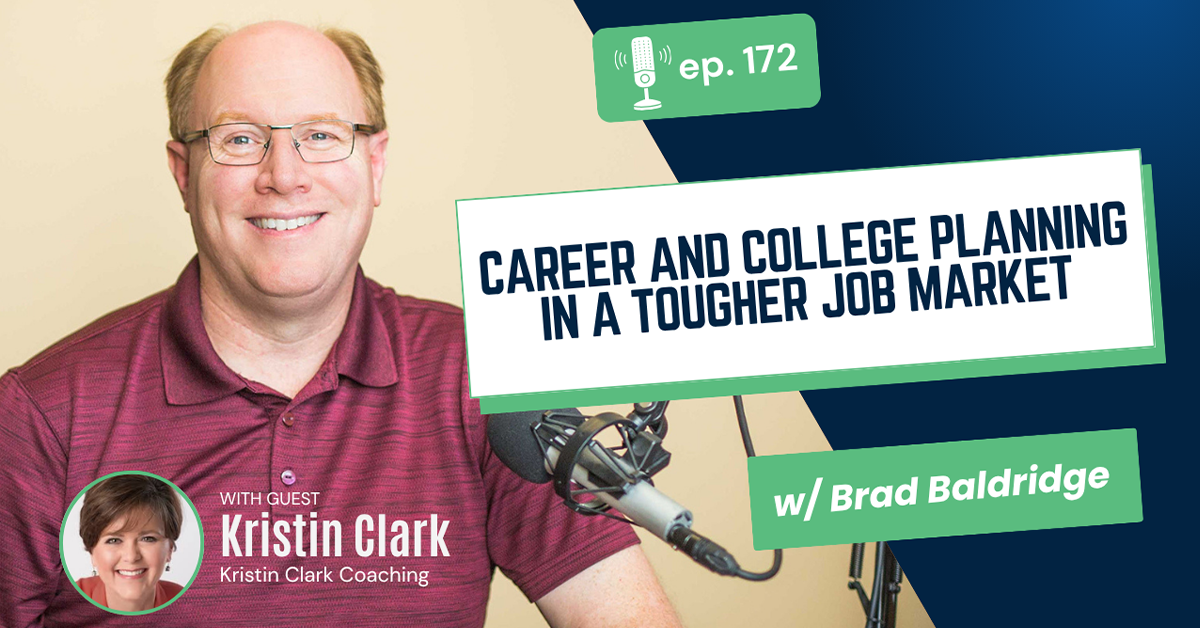
Today’s Guest:
Kristin Clark, Career Exploration Specialist
Kristin Clark helps students ages 16 to 26 discover career paths that excite them and align with their strengths. Based in Texas, she guides families through the challenges of choosing majors and planning for the future, focusing first on what makes students happy in their day-to-day work before considering financial outcomes.
Through one-on-one coaching, small group programs, and her innovative Parent Lab, Kristin empowers both students and parents to have meaningful conversations about careers and college. Her passion is watching students light up when they find a career direction that truly inspires them.
Questions Answered Today:
What challenges do new graduates face in today’s job market?
Kristin explains that entry‑level opportunities are down about 16%, and layoffs mean experienced professionals are competing with new grads. It’s more difficult to get work. AI is also reshaping the landscape, slowing hiring as companies experiment with automation. This means students need to be prepared for a tougher transition into work than in previous years. Brad and Kristin discussed all of this further with many more key details.
Why should high school students work part‑time jobs?
Jobs aren’t just about earning money; they’re about growing up, building confidence, and learning skills that school or sports don’t always teach. Kristin shares how her son realized the value of money when he had to work two hours just to afford a lunch at Chili’s. That changed his spending habits and gave him independence. Working also forces teens to interact with the world beyond their peer group, which helps them develop maturity and resilience.
The benefits go even further:
- Teens who work often show better academic performance, since they learn discipline and time management.
- They gain financial awareness, understanding how far their earnings go and making smarter spending choices.
- Jobs build soft skills like communication and responsibility, which employers say are often missing in young hires.
- Having their own money gives teens a sense of control and independence, reducing reliance on parents.
“I can go on and on about the merits of working, but one of the things I always like to tell my parents is, kids that work actually do better in school. They get better grades. What does that tell you?” – Kristin Clark
Are parents helping or hindering career readiness?
Kristin points out that many parents over‑plan their child’s life or avoid planning altogether. This leaves students unprepared for the realities of adulthood. She stresses that, while some teens may be shy or hesitant, being an adult requires the ability to communicate, make decisions, and take initiative. A balanced approach means guiding students toward opportunities while letting them make choices, rather than dictating or ignoring the process.
Brad shares a personal story about his daughter, who was once too shy to order at Starbucks, and how pushing her into everyday challenges helped her grow. Kristin emphasizes that employers are now hiring “soft skills coaches” because too many young workers lack basic interpersonal skills. This is a direct result of fewer teens working during high school.
“When you’re an adult, the expectation is yes, you can talk to other people. You can make decisions on your own and not be told every step of the way… you put your kid in that situation, then they’re going to be better at those things.” – Kristin Clark
How can families prepare students for success in a changing world?
Kristin emphasizes that AI is not going away, and families need to accept that it will be part of working life moving forward. She encourages parents to expose their kids to AI in a positive way, showing how it can be used productively rather than feared. In her coaching, she uses AI as a brainstorming tool to quickly generate career ideas based on a student’s strengths and interests, which helps teens see progress fast and stay engaged. Brad adds that, while AI is often hyped as replacing jobs, it also creates opportunities for students to take initiative, build networks, and think entrepreneurially.
Here’s how families can build on this:
- Introduce AI tools as career brainstorming aids, helping teens explore options they may not have considered.
- Encourage students to experiment independently with AI platforms, since colleges are still catching up in teaching these skills.
- Use AI discussions to spark conversations about entrepreneurship and agency — students can’t control results, but they can control activity, like networking or sending resumes.
- Frame AI as part of a broader skillset: adaptability, curiosity, and initiative will matter more than fearing automation.
“AI is not going away. So, one of the things that we have to do is accept that it’s here, accept that it is going to be part of working life moving forward. Not in its evil form, but in its productive, here’s how we can use it.” – Kristin Clark
What role do career conversations play in guiding teens?
Kristin highlights the importance of talking with teens about interests, strengths, and dislikes. These conversations help identify patterns and point students toward a “sweet spot” of careers they’ll enjoy. She emphasizes that the goal isn’t to have all the answers immediately, but to start narrowing the field and uncovering what resonates with the student.
How do these conversations unfold?
- Begin with lighthearted questions, such as asking what sort of jobs they don’t want, to ease into the discussion.
- Listen for recurring themes in what excites or frustrates them. These patterns reveal direction.
- Use interests as a starting point. Then, layer in skills and strengths to refine possible career paths.
- Keep the process open‑ended, focusing on exploration rather than rushing to a final decision.
Links and Resources
Helpful Articles and Resources
- Taming The High Cost Of College
- Parent Lab
- Kristin Clark’s Contact Info:
THANKS FOR JOINING US!
We’d like to extend an invitation to our listeners to share their feedback and questions. Contact us to submit a question.
If you find our podcasts helpful, please share us on social media and tell your friends!
The bottom line is that we care what you think and want to help you out, so we’d appreciate you reviewing us on your favorite podcast platform. Even better, receive automatic updates by subscribing to the show through your preferred podcast service.
Presenter 0:00
Welcome to the Taming the High Cost of College podcast. Here is your host, certified financial planner Brad Baldridge.
Brad Baldridge 0:10
All right, today I'm talking with Kristin Clark. She's someone that I've known for years, and she's actually helped some of my own children. So, welcome, Kristin.
Kristin Clark 0:19
Brad, hello. This is a good day to talk about all things college and finances.
Brad Baldridge 0:25
All right. Yes, let's jump into a little bit. First of all, why don't you just tell us a little bit more about what avenues that you work in around the college process?
Kristin Clark 0:33
For sure, so I help my students figure out what kind of career is going to make them happy. When I found out Brad when I was getting my own kids into college, or thinking about college, is there are so many people around them that are helping them get into college, and I, what I realized is nobody was helping them figure out what was going to make them happy, and that's really where I kind of swooped in, and I was like, I had finished up my corporate career, I ran marketing departments for years and years hired a lot of 20 somethings and figured out that where they really needed the help was figuring out, you know, what kind of life do they want, and making sure that not only they're choosing wisely, but sometimes college isn't the only answer, so really helping them think through that and get to a point where they're excited about work. I always say, you know, let's quit making work a four-letter word. People can actually enjoy what they do, and that's what I help kids do.
Brad Baldridge 1:28
Absolutely. Okay. Well, on that note, then let's talk a little bit about some of the headlines we're seeing out there, or some of the scare tactics I think that some of the press are using around what's going on with the young people today, and I guess primarily it'd be the job market, and right now supposedly the rules, you know, that they're talking about is opportunities are down for the typical graduate. What are you finding?
Kristin Clark 1:49
That's for sure. It's no joke out there. And what I'm seeing is that it's taking college students a lot longer to get that first job, at least some of our college students, and we really are seeing that it's, it's a thing, so I don't want parents to think that their kids being lazy or they're not trying. It is more difficult right now to get work. So, in fact, what we're seeing is that even on our job boards, that the number of job listings for that lower level employee, that entry level employee, are down about 16% that's a big number. Yeah
Brad Baldridge 2:24
Right. So things are a little slower now for the typical college graduate, but I guess on the flip side, it's not like no college graduates are getting jobs. There's still certainly plenty of jobs out there, and lots of students are getting them. I think maybe would it be fair to say that maybe employers are getting a little more selective and are not rushing into it.
Kristin Clark 2:45
It's more complex than that, for sure. In that, because of a lot of things going on in the economy today, we've got a lot of layoffs happening. So, not only are these new grads trying to get these jobs, you also have people that are in middle management that are trying to get these entry level jobs, so that's one piece of it for sure. The other, and I know this is a big topic that we talk about quite a bit these days, is AI. You know, it's much easier - I always call it the faster, better, cheaper, right, to have AI do a lot of these entry level gigs versus paying a body to do it
Brad Baldridge 3:20
And yeah, and I guess my opinion there is AI is not doing it yet, but I think a lot of businesses are pressured into the hype a little bit of we're going to have to figure out how to make them do it, therefore maybe we shouldn't hire as quickly, so I think there's a possibility there's some sort of rebound where they realize that to get AI up and running and doing all the things that their new hires used to do is a lot more work than they realize. It's kind of like the driverless car, driverless car has been coming for 20 years, they're much closer now, and we'll get there, but the actual timeline, I think, for some of these things may be a lot different than people realize.
Kristin Clark 3:58
You're bringing up a really good point on this too, Brad, so there's so much happening around AI, and it's changing so fast, and the reality is our colleges aren't keeping up with it. They don't quite know what to do with it, as far as training the college students on how to actually use it. So one of the things that I find with my families right now, I'm like, depending on what you're trying to get into, what career path you're gunning for, they've got to go out there and they've got to see what tools are available and start to just acclimate to it and learn a little bit of this on their own, because the colleges aren't able to do it yet, they're working on it, you know, they're trying, but they're just not quite there yet, so that's a big factor as well.
Brad Baldridge 4:37
Absolutely. All right, so I think I would agree that there's lots of change afoot, and therefore families need to kind of understand what they're up against. What about the longer lead time, right? If we're talking about someone that's graduating from college, maybe they just graduated this past May, or they're going to graduate this coming May. Well, they've got what they've got, right? But what about. The parents of a high school sophomore or junior, right? Are they are they supposed to do things differently? Or let's talk a little bit about what your thoughts are there.
Kristin Clark 5:07
Yeah, definitely they need to do things differently than what we've done in the past. And one of the things that will help every kid out, hands down, Brad, is having them get jobs now, and I will tell you this is a little bit of a controversy. I hear parents all the time saying they just don't have the time to do this, and in my mind the reality is number one, yes, in a lot of cases they do, or we're making possibly some choices that maybe need to be revisited, like does a kid need to be in four activities at school, right?
Brad Baldridge 5:43
Right
Kristin Clark 5:45
A lot of times people will ask me, they're like, yeah, but he's in football, and that's an all-day event, and I agree with them. It is so during the season, let's not get a job, but after the season, get a job, right? I think what I hear people saying is kind of one of the reasons why I came up with let's quit making work a four letter word, is that they're like they've got all the time in the world, they're going to be working after they get out of college. Why are we making them work now? And the reality is, quite frankly, it's a growing up process, it's teaching them skills that they're not figuring out in sports or in volunteering, or in school, taking the AP classes and the dual credits, and all that stuff, there's so many benefits to having a job that I think parents need to kind of sit back and think about, are they thinking about themselves or are they thinking about this kid and what's best for them. I can go on and on about the merits of working, but one of the things I always like to tell my parents is kids that work actually do better in school, they get better grades
Brad Baldridge 6:37
Right?
Kristin Clark 6:40
What does that tell you?
Brad Baldridge 6:48
Yes, I would agree with that. Is it the working, or is it the interacting with people outside your peer groups? Because I think there's a, again, another stereotype that the typical student, you know, doesn't want to talk to anybody, they're terrified of making a phone call, they barely understand how email works, and they think it's for old people, and therefore they're just not going to do it, you know. So, I think there's a lot of that type of thing going on, where they want to be on the cutting edge of TikTok, and all that type of stuff, and the world's not there. So, I think some of working is forcing students to meet the world where the world is.
Kristin Clark 7:23
Yeah, well, Brad, here's the deal. People were made physically made to interact with people. I mean, that's how we stay healthy, that's how we have great relationships. And yes, getting out and getting a job forces that hand a little bit, instead of them laying in the room and playing video games or just hanging out with the people they know, or you know, doom scrolling, so getting the job helps in that way. And I'll tell you another huge benefit that I saw, and I remember this when my younger son got his job. There were a couple things that happened. Number one, he's like, "Mom, do you realize I have to work two hours to be able to afford a lunch at Chili's?" Right, and I was like, yes, I do understand that. So he would make choices, he would sometimes just go and have you know, if all of his friends wanted to go to Chili's, he'd go and order a Coke, and that's what he had. Or the other thing that happened is when he had this money and he got to buy what he wanted, because in my mind I was like, this is your money, you do with it what you want. There's such a huge confidence and like this sense of control that a lot of kids don't have because they're having to ask mom and dad for 20 bucks to go do something, you know? When he wanted to do something, he went and did it, because he had this money, so he had control over his life, and it wasn't, you know, it just was this growing up period,
Brad Baldridge 8:41
Right? Yeah, I think that's again kind of the challenge of when people are talking about this, and what should we do, and that type of stuff. I mean, often the right answer is, it depends. So that's the other piece of it, right? Is there's a wide spectrum of students out there, and some students are, you know, just in my own kids. You know, my oldest is much more outgoing, and was willing to sit down with the adults and have conversations. My other two, not so much, you know, and it shows in the fact that, you know, he was out there, out in the employment from junior year of high school, and he was able to do those things because he just kind of had a proclivity for it, and I think that's the challenge, right? Is some kids are just good at these things, and some kids are good at those things. And do those things line up with what employers want? Is one concern I think that a lot of families need to understand.
Kristin Clark 9:33
Tell me more. Tell me what you're thinking around that, because you know, I hear this a lot, where people say, well, my kids really shy, or they, you know, they're just not good at that stuff. The reality, in my perspective on this, Brad, and I would love to hear yours, is when you're an adult, the expectation is, yes, you can talk to other people, you can make decisions on your own and not be told every step of the way. You do have to just kind of get out. Both there and make things happen, right. So I look at it and kind of go, is it a chicken and the egg thing?
Brad Baldridge 10:06
Absolutely.
Kristin Clark 10:08
If you put your kid in that situation, then they'll be better at those things,
Brad Baldridge 10:11
Right. Yeah, so when my daughter was about 13-ish, maybe a little younger, maybe a little older, she was very shy to the point of she would not order at Starbucks, right? So, if we happen to be at a store, I think I was a Target, we typically went to that. Also, had a Starbucks in the back, so it'd be like, "Well, you go get your Starbucks while I check out," and she'd be like, "No, I can't, I can't do that, you have to order it for me." It's like, "Okay, well, I guess we're not having Starbucks. Let's go."
Kristin Clark 10:37
Yes
Brad Baldridge 10:38
Right? I mean, that's some of the reality of it, right, and she's since outgrown that, but it was a lot of work to push her out of that. Just mom and dad are going to take care of everything, and so there's a lot of life lessons I think around getting your kids to grow up a little to start interacting with the world, and it's a little bit of a challenge as well from the bad attitude that we often get from our children when we try and encourage them to get out there and do things
Kristin Clark 11:05
Well. This is a stat that totally killed me inside. I died a little bit inside, and that is that the employers out there - there's so many companies out there right now that are having to hire soft skills coaches, say that fast - soft skills coaches, because the kids that are coming out of college, or those kids getting those first jobs, the 20 somethings, they don't have the soft skills that they need. Brad, and I think that this is a direct correlation to the fact that we've moved away from having these kids have jobs in high school, and even before high school, but high school and college, specifically
Brad Baldridge 11:41
Right, yeah, and again, I think there's still opportunity, maybe there's less in some regards, but I think there's more in other regards, from a there's more internships and more career-related jobs out there than there was when I was young, almost for sure, but there's also jobs in general, right, you know, bagging at the grocery store and that kind of stuff is still there, and, but now I think a lot of parents are like, well, that's not career ready, that they need to get the internship at the bank, or they need to get the whatever puts them on their career path.
Kristin Clark 12:13
I'm gonna tell you that I don't think that they're thinking ahead the way that way. I really don't.
Brad Baldridge 12:18
Well, okay, many parents are not. There's the other side of that crowd of, well, we gotta get our kids in the right kindergarten, so that we can get them in the right grade school, so that we can get them in the right high school, so we can get them in the right college, so they can go to work for Goldman Sachs, or whatever, or Google, or whatever the big company is, that right, so there's a subset, and again, that's the challenge with some of the stuff we're talking about is the right answer for any particular situation, is a very big, it depends, but for that crowd, where they're literally, you know, trying to plan out their child's life from four on to 18, and okay, well, they're gonna get an internship when they're 16 at this particular, you know, etc. etc.
Kristin Clark 12:59
Yeah, you just triggered me as well, like it, because yes, I've seen those parents. I agree with you that have their kids plan, you know, kind of thought through and figured out, and as a career exploration coach, and helping the teenagers and 20 somethings really figure that out for themselves. I gotta tell you, there's no reason in my mind that a parent should be making those decisions for these kids, can they guide all day long, but who are they to say what's going to make their kid happy and what activities those kids are going to want to do in a career. So I think that's a whole 'nother show.
Brad Baldridge 13:36
Yes
Kristin Clark 13:37
Yes, but I will tell you that thinking about this idea that the parents are thinking forward. What I've seen is parents really aren't thinking forward at all, for the most part. In that, you know, is it the right kind of job? What I'm seeing is a lot of parents going, "I don't think they should have a job." I see more of that, or just not thinking about it at all, just kind of letting life roll by, and not thinking about why not have them get out there and do the babysitting and do the hostessing, etc. but even on, even on that accord, I will tell you this: it is a little bit harder for teenagers to get jobs than it was when we were younger, and I see things like companies not wanting to hire teenagers because they just think it's too, too challenging, but the ones that do it right, I gotta tell you, those kids are lining up wanting to work for them, where they are more flexible, they, you know, understand that these kids are under pressure in different ways, and they really help work around that, but I'm seeing things like you can't wait tables now until you're 18, 19, years old, which I think is ridiculous, and it's all around alcohol, and I was waiting tables, I wasn't taking the can of whatever, the glass of whatever, and drinking it. I was like, oh my gosh, we've gotten so litigious and so weird about certain things that it is a little bit harder for kids to get jobs.
Brad Baldridge 14:55
Yes
Kristin Clark 14:56
Yeah
Brad Baldridge 14:57
I would agree that, and I think once again at some point. Circles around to the quality of the job, so to speak, where I mean there's a whole lot of fast food and that type of stuff that will probably take anybody that's willing to show up and work hard, but that's the challenge, right? Is your teen one of those? Are they willing to show up and work hard, or do they just want the job?
Kristin Clark 15:18
Well, so many will tell me I don't want to work in fast food. I was like, fast food is like one of the best places to work. You get free food a lot of times, it's fast-paced. You're getting to meet other kids your age. For some reason, Brad, it's like this big like thing these days, where in the past that's where we work, right? It was all fast food
Brad Baldridge 15:37
Right? Exactly. Yeah, so I think you know... I guess to kind of put a pin in this idea, there's I think there's a spectrum of parents that are planning on one end of the spectrum, there's the parents that are literally planning the poor kids to death and trying to figure it all out early on and kind of laying the groundwork, and etc, which I think is probably a relatively small percentage, and then on the other end of the spectrum I think there's a whole lot of families that just aren't forward focused hardly at all, they're just no, we'll have time for that later, let the kids be kids, whatever the reasons, they're kind of moving, avoiding or either intentionally again, let the kids be kids, we're not going to burden them with that, or unintentionally, in that we're just thinking about other things, so how do we assess where we stand, and then what do we do about it?
Kristin Clark 16:26
Yeah, you know, here's the part about AI, because I don't know that we kind of finalized that AI is not going away. So one of the things that we have to do is accept that it's here, accept that it is going to be part of working life moving forward, so I think not being afraid of it and exposing your kids in a way that's positive to show AI not in its evil form but in its productive. Here's how we can use it for, and even in my coaching, we'll go out and we'll do some brainstorming on careers, and I love AI because it's so fast and kids can see progress so fast, because we'll go, oh, what could I do, you know, based on my strengths? What can I do, because I like this type of activity, and AI spits out all kinds of stuff, and then we direct it, and we ask it more questions, so that's a lot of fun, and it's a great brainstorming tool, right? So, not being afraid of it, and just helping our kids understand how to use it for good, not evil.
Brad Baldridge 17:23
Absolutely, yeah. So, I think, right. So, AI, I think, is one piece of the puzzle, for sure, where we see a lot of challenges around, you know, AI is coming for this job or that job, and that type of thing. And we'll probably make a whole episode on that subject, but then, once again, you know, figuring out how that fits in, but I think it's also on the maybe the entrepreneurial spectrum as well, of how much agency does your student have to say, you know, this is what I'm going to do, this is, you know, versus nobody's calling me and offering me a job, so you know what do you want me to do? I mean, I guess we're done here, right? That whole excuses versus you can't control results, but you at least can control activity, and without activity, lots of people say, "Well, that guy got lucky, he got the job." Really, how many resumes did he send out, and how hard did he work at it? And how many networking meetings did he go to? And how much, you know, how big is his network? Maybe he was lucky, and he did none of those things, and the job just fell in his lap, or maybe he worked really, really hard for it
Kristin Clark 18:23
Right. And I think it's one of those things that always behind the scenes he probably was making decisions and working towards that. Very few times do we have stuff just fall in our lap, right? We create the opportunities in my mind, and so for high school parents, what can they do to make sure that when their kid gets out of college, or they choose a different path, how do they, you know, set their kid up for success? We've talked about the job, you know, getting the jobs, so that they have these soft skills, getting the internships, but how do you direct some of that, Brad, to make sure that when they do get out, there's a job to be had, and you know what my answer is going to be. But what do you think they need to be doing?
Brad Baldridge 19:05
Yeah, I mean, I guess first of all, understanding that there's jobs that, and again, now it's a two-person event, right? Somebody needs to want to hire you in order to get the job, versus there's also the entrepreneurial side of the world of I'm just going to go solve some problems, and people won't pay me to solve those problems. Well, now you're a business owner, potentially, or a consultant, or a influencer, or a right. A lot of jobs out there now again may not be at the large corporations, so that's a little different mindset of, well, I'm just going to go, you know, solve a problem, or come up with a plan that either other companies need my help for whatever it might be, but you know, if you can build that robot that cleans my gutters, I'm all in, right? I mean, there's lots of problems out there, and we're looking for solutions, and that's the challenge. I think that a lot of both parents and students start need to think a little outside at that, and then...
Kristin Clark 20:00
So you're dancing around what I'm, what I'm about to write in, right?
Brad Baldridge 20:04
Exactly, and I think it extends even to the career now. There's certainly a lot of talk out there around even if you're, again, going to work for the corporations, you're going to work in sales for corporations, you have to think of it as an entrepreneurial venture in some ways, as in I'm going to build my network, so that I have opportunities, and the corporation doesn't own my network, and I'm going to go get involved in professional organizations, or I'm going to write some stuff around the law profession, or whatever it is that I'm doing, where I'm known, not just my company is known, where it's some of that belongs to me.
Kristin Clark 20:41
Yes, and here's another thing that I am hearing out there is that the world as we know it, it's going to be a little bit less company focused and a little bit more focused on gig work, where you're coming in with something that you know how to do and not necessarily working for the company, but they're hiring you to do specific things, so that's something. Yes, I think that we have to see and watch how the world's changing on that aspect. But getting back to how does the high school and parent of juniors and seniors, how do they set their kid up for success? Because when you say, well, Brad, you just go out and figure out something that you know you can fix. What I hear parents saying, and kids saying, is my gosh, there's so much. How do I ever figure it out? What I'm going to be good at, and what I can do. And I'm telling you, it all centers around having these career conversations with this high school student to talk about what are you interested in doing, like what types of roles would you be interested in, and even saying that parents are like, my gosh, that's so much, but I will tell you, these kids want to have these conversations. I've gone out and asked them, I'm like, guys, is this too stressful, is this too much to have these career conversations, and hands down, 100% every kid has told me they're like, why would we not want to have these conversations, you know. Why do we not want to start figuring out what we want to do now versus waiting until I'm getting ready to go into college, or I'm graduating from college, or I've graduated and I'm sitting here with this degree, and I don't know what to do with it. They want to have these conversations, and I think the key to it is helping them really kind of hone in on what activities within a job are truly going to make you happy? And there are different layers of this in my mind. It is talking about interest, because they know the things they're interested in today, layering over skills, talking about what are their strengths. There's so much that they can be talking about that will help kind of push them into a direction. I always call it the pie shape. I'm like, if in this whole big circle there are all the careers, how do we get you in here, where we at least know this is your sweet spot, and this is where we want you, you know, or where you want you really is the true answer. And even having conversations like, what do you know you don't want to do, you know, I've started conversations with, what do you think is the worst job that you could ever think of? And I always, I always bring up, you know, cleaning out the porta potties is definitely a job I don't really want, you know, but it gets them having fun and talking about this versus like this, got to figure it out, you don't have to figure it all out, but you do have to start making decisions, and I think that's where parents get confused, because they, they want to get to the answer so fast, and I'm like, just start having the conversation, start letting this unfold, and listen for the patterns of the things you hear over and over, so that you know we can get that kid into that pie shape
Brad Baldridge 23:32
Right? Yes, and I think that's, you know, if kids get into the areas that either they enjoy or they excel, that's a really good first step, and again, this is probably another podcast, but I think for a lot of families, and I don't know what the percentages are, maybe you could come up with some numbers, but I would say roughly 50% of kids are very focused. I want to be an engineer, I want to be a nurse, I want to be a teacher. I've already, you know, my career path is pretty clear, and they may be wrong, and they may change career paths, that's also true, but at least they have one, versus the other side of that coin, which is either I like just about everything I touch, so I can't decide if I want to be a magician or a mathematician, or because it's all fun, I enjoy it all, or none of it speaks to me, I'm not really interested in science, I'm not interested in what courses in high school did you like the most? None of them. I hated school. Okay. Well, that said that end question. How do we, so what do you see out there, is it 50-50 or is it 70-30? Or...
Kristin Clark 24:32
Gosh, that's such a loaded question. Because a lot of times I'll have students come to me and they've, they're like, I'm going to be an engineer. I'm like, great. Why are you going to be an engineer? Because my dad told me I'd be good at it. That's not the right answer, Brad. In fact, to me, that's one of those answers that's the scariest, because we've, as parents, have made really good decisions for our kids, you know, for the most part. So our kids trust us to make some of those decisions, and quite frankly, when we're talking. About this career idea is daunting, you know, it's daunting for everybody, and sometimes for a kid it's easier to hit the easy button and say, well, dad thought I should be an engineer, so I guess I'm going to be an engineer. They get into school, guess what happens, they hate it, or you know, and they don't know how to get out of it, or they are afraid to go and talk to their parents and say, that's really not what I want to do, and now we're in trouble, so I'm going to tell you that your, your 50% is way too high, is much lower than they even have an idea of what they want to do, and here's something that a lot of people don't understand, most kids, they can name 10 to 12 careers out of the 1000s, 1000s of careers that are out there, so their little world is so small, they've got no idea what they can do, and when you start having these conversations, now you can expand on it, right? You can start going, well, you know what? If you want to, I'll use Noah, he's one of my favorite go-tos in this conversation. When he came to me, he's like, Kristin, I don't know what I want to do, but one of my interests is golf. We talked about golf, and when he was speaking about golf, he was leaning into the camera, he was voice went up, his eyes lit up, and I was like, if you could do something around golf, would you, would that make you happy? He goes, yeah, but I'm not going to be a player, I'm like, there's a lot you can do in golf, and when we started talking about his skills, he was creative. He was good at juggling a lot of things. He was good with people, and all of a sudden, where we ended up is he's off getting a landscape architecture degree to ultimately build golf courses, right? So it wasn't a straight narrow shot. Yeah.
Brad Baldridge 26:38
Yeah, I think that makes a lot of sense. So I guess maybe you need to rephrase it a little bit, and I would say upping to the parents, because I'm talking mostly to parents. According to the parents, about 50% have a path and 50% don't. And what you're saying is maybe a big chunk of what the parents think is figured out and solid should be explored a little deeper. Is that a fair statement?
Kristin Clark 27:00
Absolutely fair. When my little guy, he used to sit down with the stack of paper and tape, and he'd build these big stadiums, like in detail. In my head as a parent, I was like, he's probably going to be an architect or a builder or construction, because he's got this great spatial, you know, he understood it all. No, you know what he does, he works, you don't know, but I'll tell you, you will soon. He works in equipment management for football teams. He loved stadiums. He loved that atmosphere of stadiums. So, as parents, we can think that we know, but we do not, right? That's, yeah, that's why I keep saying yes. The parents that are coming to you, you know what they're hearing? What's the soup du jour in the high schools? When my oldest was on the football team, and they had parent night. I'd say eight out of 10 of the kids were going to get into kinesiology. Do we need that many kinesiologists? No, we don't, right? We don't need that many personal trainers and physical therapy people, et cetera. So, even though they think they know, they've just scratched the surface of having these conversations
Brad Baldridge 27:58
Right? Okay. Well, let's wrap things up here. Can you tell people a little bit more about some of the things you have going on as far as services and so forth?
Kristin Clark 28:07
Yes, so if during this conversation you felt like, oh my gosh, where in the heck do I start? You know, one of the things I've found, and I was asked for quite a while, Brad, to do is to start something for parents. Now I coach kids one on one to figure out career paths, but the parents were like, well, what about the parents that really want to be a part of this at home? And so I started Parent Lab, where we come together first and third Fridays at noon, and we sit down and we talk about what's going on in your house, and how do you handle certain situations, and really more, how do you start having these conversations around careers, so that your kid does go to college very confident that they know what they're, they're wanting to do there when they go there, they're not changing their major because they're clear on what they want to do, so they're getting out in the four years that it should take to get out versus the five and a half that we're seeing most kids take, which you know, how that affects people's financial well-being. It's an extra $50,000 which, who wants to do that if they don't have to. Parent Lab's a great way for parents just to kind of come in and say, help me, help my kids. You know, how do we have these conversations?
Brad Baldridge 29:16
Right? Okay, and if they're interested, obviously they can get to your website, and we'll put all that in the show notes and in the YouTube comments. I guess that's all we have for today. Any final words?
Kristin Clark 29:26
I just say, guys, get out there and let's start having fun. Let's make work something fun, because it can be, especially when you're in the right place and doing the right thing.
Brad Baldridge 29:33
That's right, just do it. Okay, it's all for today. We'll see you next week.
Presenter 29:38
Thank you for listening to the Taming the High Cost of College podcast. Now it's time for you to take action. Head to tamingthehighcostofcollege.com for show notes, bonus content, and to leave feedback for Brad. The next step on your college journey starts now.
Presenter 1 29:55
Brad Baldridge is a registered representative of Cambridge Investment Research and. And an investment advisor representative of Cambridge Investment Research Advisors, a registered investment advisor. Securities are offered through Cambridge Investment Research Incorporated, a broker dealer and member of FINRA and SIPC. Brad owns two companies, Baldridge Wealth Management and Baldridge College Solutions. The Baldridge companies are not affiliated with Cambridge Investment Research.
Transcribed by https://otter.ai
Sign up to receive email updates
Enter your name and email address below and I'll send you periodic updates about the podcast.