

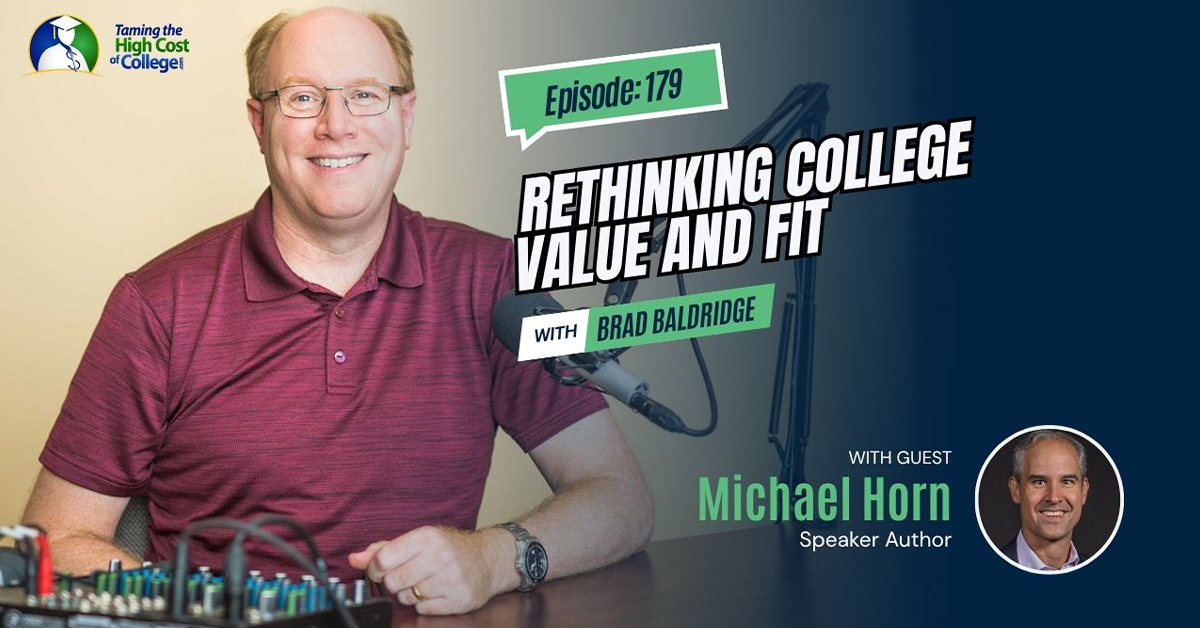
Today’s Guest:
Michael B. Horn, Author, Podcaster, and Educator
Michael B. Horn teaches at the Harvard Graduate School of Education and writes extensively on the future of learning. He advises college leaders, parents, and students on how to navigate the changing higher education landscape, evaluate ROI, and explore alternative pathways.
Questions Answered Today:
Is higher education losing its value?
Skepticism about college has grown significantly in recent years. Enrollment has dropped from roughly 70–75% of high school graduates in 2018–19 to about 61% today. Families are questioning whether college is worth the cost, especially as AI reshapes the workplace and raises uncertainty about future jobs.
Why families are questioning college:
- Many families are increasingly skeptical about the value of higher education. Surveys showing declining confidence in colleges and universities.
- The rise of artificial intelligence is reshaping the workplace, leading students to question whether traditional degrees will remain relevant in a rapidly changing job market.
- The greatest danger comes when students take on debt but fail to graduate, leaving them with financial burdens and few of the benefits that a degree typically provides.
Despite these concerns, data still shows that college graduates earn more on average than non‑graduates, meaning higher education continues to provide a financial advantage for most.
Michael stresses that families should not dismiss college outright but must be more discerning. The question is not “Is college worth it?” but “Which colleges and programs are worth it for my student?”
How can families evaluate ROI and graduation rates?
ROI is return on investment. When it comes to college, Michael defines this as comparing the cost of college (tuition, fees, and opportunity cost of not working full‑time) with the career outcomes afterward. Families must ask tough questions to ensure they are choosing programs that pay off.
Practical evaluation steps:
- Check graduation rates.
- Nationally, the average six‑year graduation rate for four‑year programs is about 60%.
- Schools with rates below 60% pose significant risk. If only 40% of students graduate, that’s worse than a coin flip. Families should think twice before enrolling.
- Highly selective schools (admitting fewer than 25% of applicants) tend to have strong graduation rates and outcomes regardless of major.
- Look at program outcomes.
- At non‑selective schools, majors with clear career pathways (nursing, business, STEM) are safer bets.
- Majors without defined career outcomes (such as English or general liberal arts) may not provide strong ROI unless paired with graduate school or specific career goals.
- Use available tools.
- Michael highlights Willow Education, a guidance system that weeds out schools with poor graduation rates or low ROI. He also mentioned Naviance.
Families can also use state ROI calculators (e.g., Texas’ post‑secondary commission report) to compare costs and outcomes.
What alternatives should families and students consider?
Michael and Brad urge families to broaden their thinking beyond the traditional four‑year college path.
- Gap years: Many students benefit from taking a year to gain work experience, volunteer, or explore interests before committing to college. This helps clarify goals and reduces the risk of wasted time and money.
- Vocational training: Career and technical education programs are resurging, offering pathways into trades and technical fields that are less vulnerable to AI disruption.
- Apprenticeships: While the U.S. lags behind other countries in apprenticeship systems, opportunities are growing. Apprenticeships combine training with paid work, offering a practical alternative to college.
Michael emphasizes that society has long defaulted to “college or nothing,” but families should now consider a wider range of options.
Why do campus visits and mentors matter?
Brad and Michael agree that campus visits are critical, especially for students in the “middle bucket” (those who could succeed or fail depending on the environment).
Campus visits help students:
- Quickly eliminate poor fits. If a student consistently dislikes small schools, they can cross them off the list.
- Discover preferences that aren’t obvious from brochures or rankings.
- Ask current students about mentorship opportunities, campus culture, and faculty engagement.
Mentorship is transformative:
Michael notes that data shows that students who connect with even one faculty member, staff member, or mentor during college often experience life‑changing outcomes. The best colleges unintentionally foster these relationships, but families should ask about them during visits.
Links and Resources
Helpful Articles and Resources
- Taming The High Cost Of College
- Future U Podcast
- Choosing College, book written by Michael
- Job Moves, book co-authored by Michael
- Michael’s The Future of Education on Substack
- Willow Education
- Naviance
- Michael’s Contact Info:
THANKS FOR JOINING US!
We’d like to extend an invitation to our listeners to share their feedback and questions. Contact us to submit a question.
If you find our podcasts helpful, please share us on social media and tell your friends!
The bottom line is that we care what you think and want to help you out, so we’d appreciate you reviewing us on your favorite podcast platform. Even better, receive automatic updates by subscribing to the show through your preferred podcast service.
Presenter 0:00
Welcome to the Taming the High Cost of College podcast. Here is your host, certified financial planner Brad Baldridge.
Brad Baldridge 0:10
Welcome to Taming the High Cost of College. I'm your host, Brad Baldridge. Today we're talking with Michael Horn. He's a podcaster and author and does a lot of work around the education in many different avenues, so welcome, Michael.
Michael Horn 0:23
Thanks so much for having me again, Brad. It's good to see you.
Brad Baldridge 0:25
So, I do listen to some of the stuff that you're putting out on podcasts and poked around in some of your books here and there, so I have a pretty good understanding. But I think what makes you relevant and why we're talking is I think you kind of have the ear of the higher ups at a lot of colleges, the presidents and provost of the world, and you get them in rooms and you hear what they're talking about as the pain points and what the future lies, where the future lies and what's concerning them, and then also in some of your other work you're working with parents and students and understanding it from the customer perspective, so I think you have a kind of a breadth of experience and knowledge from different angles, so let's take advantage of that.
Michael Horn 1:06
Sounds good. Sounds good. Where do you want to, where do you want to start in that wide berth?
Brad Baldridge 1:10
All right, so I think there's a kind of a perception out there in the media, or the politics, or whatever, that colleges are losing, losing their reputation, but they aren't what they once were or maybe they're diminished and gone already. I think that might be making some parents a little bit nervous, you know. Again, the typical parent of a high school sophomore, junior is saying, oh, let's start figuring out college, but is it worth it? Why would I do that? Apparently, they're on their way out. So, I guess, first of all, what are the, in your opinion, anyway, what are the facts on the ground as far as, is education, as we know, it doomed? Should we be looking elsewhere?
Michael Horn 1:46
Well, let's give the, let's do a rundown of the data first, if you will. Right, so it's true that increasing numbers of students and parents are rethinking the college value proposition. If we went back to 2018, '19 you'd see that 70 to 75% of high school graduates were going to college within a couple years of graduating. It's down to roughly 61 now at the moment. So it's dropped precipitously. We look at poll surveys and things of that nature, and we can see that the public is expressing increased skepticism about higher education. You can look at the last couple years of federal education policy, and you can see a lot of attacks on colleges and universities. So, there's no doubt that there's a lot of skepticism. A lot of people are looking for alternative pathways. The other thing that I will say is, you know, AI is changing the workplace. We see a lot of students' graduations booing speakers who talk about AI. I think that's further throwing, you know, things on the fire, if you will, of, oh my gosh, do I still need to go to college if AI is going to radically change the job market in ways we can't predict, and so forth, and so that's increased, I think, the desirability of various career and technical education pathways, you know, let's go explore HVAC, let's go explore plumbing, things that maybe seem more AI durable, if you will. So, that's all true. And the other thing that's true, we know that if you graduate college, on average, it's going to pay off. It's still, and so, yes, you know, the college wage premium, it's come down some, but it's still pretty strong, and if you look at opportunity costs and likelihood of graduating, roughly two thirds to three quarters of college programs pay off for students. Now, that means roughly a quarter to a third are not paying off for students. That's not a great ratio, but we have some ability to look at the metrics now on various scorecards and figure out, hey, based on the graduation rate, the jobs that students get afterwards, is this likely to pay off for me or not? And most of the time, you know, six out of 10, seven out of 10, eight out of 10 times it's probably a good program, I think. The question you want to ask is this: number one, what's the graduation rate of the place that I'm looking at? A lot of schools, they have great graduation rates, 80, 90% right, graduating four year school within six years. It's a weird metric, but that's how college does it. But a lot of schools don't. You look at the average four year program, it's your graduation rate across this country, it's roughly 60% so if I'm going to a school that's below 60% that might be one that I take off my list and think, hey, that's not one that that is really right, because that's increasing the risk significantly, and while yes, if I get through it, it may pay off, I don't know that that's the one for me, and so I think that's sort of the ledger, is like if you get through it, it tends to be good. Make sure you're going to a school where you're probably going to get through to the other side, so you can see benefits, because taking out a lot of debt and not graduating, we know that's sort of the worst of all outcomes.
Brad Baldridge 1:46
Absolutely, so I think a couple different. Things you'd mentioned there, so you said we know that these kind of pay off, you know, 80% of the time or 90% of the time. So, two questions: one is, what does payoff mean?
Michael Horn 2:49
Yeah, okay.
Brad Baldridge 2:50
And in what you just said, and how do I know if I'm going to be in the 80% or the 20%?
Michael Horn 4:22
Yeah, well, so the latter is the harder question, but let's do the former first. So we're talking basically return on investment. Will there be a return in the job market that is greater than the money you spent in the opportunity cost of not working full time over the number of years of college, right? That you were enrolled, and so there's a number of places, free op rate ROI, cost calculator. If you live in the state of Texas, the post-secondary commission just put out an incredible report around this. There's going to be a lot more data in the next few years looking at the ROI for leaders of a school. Your next question is, will I be among the lucky ones, or am I going to be in the unlucky group again? First question: do a lot of people graduate from this program? If not, even if it pays off, if you get through it, I would have big question marks personally, and I might say not the right place. Right? If 40% are graduating a four-year program in six years, that's worse than a coin flip that you're going to get through. I'd probably personally cross it off my list, so that's that's the baseline thing, I guess I would say. And then the second thing is sort of the rule of thumb, if you're going to a highly selective college, so one with, you know, admits less than 25% of applicants, no matter what you study, probably going to be okay. If you're going to a non selective school, then want to go into a program that has a clear career outcome on the other side, nursing, business, a STEM major, probably don't want to be doing English in one of those programs, right? That's sort of the rule of thumb, I guess, is what I would say, and so that's the second thing you can look at if you're looking, you know, otherwise, like, then a career technical education pathway, or something that's shorter term into a career, is probably a better next step
Brad Baldridge 4:57
Right. Absolutely, so I think one of the things that I spend a lot of time talking with parents, of course, and they're trying to figure out, is it worth it, and those kinds of things, and how do we afford this, and and I think there's that, there's that big challenge with where we are with education, as far as well, 80 or 90% succeed, or this, or whatever it might be in medicine, if their drug came out and said, well, for 80% of the people it makes you better for 15% there's no effect, and for 5% it'll, might kill you. Yeah, most people's next question would be, not will it make me better. Their first concern is, will it kill me? And we just don't have that data, unfortunately. In the higher education, we don't have these double blind studies where we say, well, see, similar students did it one way, 50 similar students did it the other way. Turns out this is what success looks like in each group, and we narrowed it down to what caused it, and all that kind of stuff
Michael Horn 8:12
Right? Yeah
Brad Baldridge 8:13
So in absence of that, we kind of have anecdotal evidence and gut checks and stuff like that. You think that's a reliable, I mean, whose gut there should we be trusting? Because I think we get different, you know, the typical 17 year old that's talking about college as they're graduating from high school, or talking about they're going to get 43 opinions from the next 43 people they talk to, and it's confusing to the student. Parents, of course, are hearing similar things. How do we deal with that side of it?
Michael Horn 8:43
Well, so let me, let me say this. Actually, if I were a parent in a high school, a lot of high schools right now have college advising technology systems that they use, right? So, Naviance and others. If I were a parent in a high school right now, I would demand that my school go out to something called Willow Education, w-i-l-l-o-w, and the reason I say it is, it's a college and career guidance system for high schoolers that, based on your profile, will take out all the options that are less likely to return something good based on your background. It came out of the guy who started it, James Cryan, he started it because he used to lead a charter school in Colorado, or network, actually, I think, of charter schools, and he realized, wow, we really graduate low-income students in incredible numbers, and then they looked at the results of how those students graduating going to college did, and he realized that I think it was well over half of them weren't even getting through college, right. And then he looked at the list where they were sending them, and it was almost entirely predictable ahead of time, because the majority of the folks were going to schools with lower than 50% graduation rates, or something like that. And so he said, I want to build a system that up front to. Takes those options off the table, so no one will even look at something where their odds are significantly worse based on their background and based on the characteristics of the school itself, and so it basically triangulates that and weeds out, like, I mean, we have 4000 colleges and universities that issue degrees in this country, roughly, it's actually down to 3200 or 3300 now, but that's a lot of schools, and I think they take out over half of them from the get-go, and just say, not a good, you know, it's not even on the table for you to even have this in your line of sight, so you know, tools like that I would say are incredibly important to start to avail ourselves of, because you're right, the data is extremely limited right now, but we can get a lot more signals out there than ever existed before.
Brad Baldridge 10:48
Absolutely. Okay, so then I guess getting back to the colleges and losing their reputation. Do you feel like, is it time to reassess or do something differently, or is this that's what I'm trying to ask, is college is really the only option for a subset of students, and because we don't have any alternatives yet, college, it is, even though we might regret it in five or 10 years?
Michael Horn 11:13
Yeah
Brad Baldridge 11:13
Or is it, is it that bad?
Michael Horn 11:15
I think you're right, in essence, we need to be building, frankly, and looking for other options, and I think more are starting to emerge out there. So, number one, if I'm a parent, I would say many more students ought to do a gap year before they even think about college, and the purpose of the gap year ought to be, frankly, to get some work experience and maybe do some informal learning, or some odds and ends classes, maybe some volunteer work, just to get a deeper sense of, like, why. What am I trying to do next, right? And get some clarity. If you're a 17 year old that knows what you want to do, great, go running. Most 17 and 18 year olds don't have that clarity. Take a year to sort of figure it out. Second, I would say there's a lot more vocational career technical education training sort of programs that are starting to re-emerge start to look at those options, if they're interesting. We're starting to see a renewed emphasis on apprenticeships. A lot of other countries have a pretty developed apprenticeship system. We don't in this country, but that's starting to emerge. So, like, look, we need to be investing and investigate a lot more of those options as a parent, and opening the aperture of what could be next, but I agree, you know, like in many cases we sort of, as a society, have said college or shrug our shoulders, good luck, and there's not a great answer yet
Brad Baldridge 12:33
Right? Exactly, from my side of the fence, I think there's, you know, and when you're talking with parents, you start to get a feel for the three major types of students that the buckets that I kind of talk about or look for, as the college, it's the students that are going to be successful no matter what they do. Yes, on one end of the spectrum, the students that are probably going to struggle no matter what they do, on the other end of the spectrum, and then there's the ones in the middle where the path they choose, the professor that takes them under their wing. The whatever it might be can be profoundly impactful, because it'll change their course from, you know, failure to success or success to failure. I mean, it can cut both ways, but and I think that's where a lot of families aren't going to get that deep, because they don't even, you know, they're barely figuring out, well, how do I visit a school, and do I have to visit a school? It seems like a lot of work. Can I just pick one and go?
Michael Horn 13:27
Yeah, and I agree with you
Brad Baldridge 13:29
Why bother doing that?
Michael Horn 13:30
No, I mean, I think so. I love the buckets. I would say, for that bucket that you just outlined at the end, it's exactly right. This is where I think a school visit is imperative, and I think what I would be doing at that visit is a couple things. Number one, do I hate this place as a student, and there's a lot, right? Like, we tell people, find your fit. To your point, fit can be as random as, like, I like this place, and I found the right professor in my four years, and so it worked out. But certain places are dead ends immediately, right? And we know that that just doesn't jive with them for any reason, it overwhelms a student, it's too big, it's too small, whatever it might be, like cross stuff off your list, and then anything that looks like that, cross it off as well. I've developed a simple little AI-driven tool that I'll be putting out in the next few months, but that, like, just helps people visit eight schools around them, don't have to travel, and then you quickly see, like all small schools, bad fit, because I hated, right, I hated every single one that was below x number of students, cross stuff off your list, because the moment that kid arrives there, they're going to be trying to figure out how to get away from it, so that's number one, number two, I would say to your point, we know this from the data that if you have one faculty member or one staff member or one mentor during your experience that really takes you under their wing, it can be transformational. The best colleges unintentionally, I think, facilitate those sorts of experiences, I would talk to students when you're on that visit, if you know you seem to be jiving with it. Do you have a great mentor here? Do you have a great, you know, do your friends have someone that they've really connected with on the faculty or staff? Have they put you in touch with someone in career or alumni that's really taken them under their wing? What opportunities are there for that? There are a lot of sneaky good programs, you know, like if you're looking at an honors college, for example, at a school that maybe is larger, not known for its academics, but the honors college maybe really caters to those who get into it, right? What sort of unique opportunities, you know, do you get? They pull 20 kids out to have this incredible experience at immersion experience, whatever it is, those can be game changing, right? So you try to figure out in that visit, do those sorts of things happen routinely? Do I talk to enough people that I'm convinced that if my kid went here, that they'd find that sort of guidance and mentorship, and be, you know, move from being sort of the small, or excuse me, the, yeah, the small fish in the big pond that gets lost, or would they move to being the big fish in the small pond that really has someone that's watching out for you
Brad Baldridge 16:11
Right? Absolutely. So I guess that circles back around to I think a lot of parents are trying to figure out the college process, and we pay for college with money, obviously. Yeah, we also pay for it with time and stress. In my opinion, most people should start earlier, so they have a little more time. As in, what does that mean? Well, you can do college visits sophomore and junior year.
Michael Horn 16:35
Yeah, I agree with that
Brad Baldridge 16:36
Especially low pressure. Just go kick the tires, see what they're like. A lot of students, when you say, do you like a big school or a small school? That's really not a fairest question until they've seen a big school and a small school. They have no idea what they're getting into. Aside to that, when I'm working with parents of the fourth child, I say, unfortunately, you get to go do all these visits again, even though you could actually be the one giving the tour now, you've seen all these places four or five times, but your student hasn't, so to be fair to them, they need their turn, and yes, they tagged along when they were in seventh grade, but they didn't, weren't paying attention, they were playing on their phone, they were impressed with things that only seven year, you know, only seventh graders would be interested in, they're going to need to go back, so I guess, what do you feel like the right time when to start? How much time should parents put into it? Yeah, and the right answer is often it depends, and then if that's the answer, then what does it depend on?
Michael Horn 17:33
Yeah, well, it depends, yes, on every circumstance, but as a general rule, I think sophomore, junior year is the right timeframe to visit some schools, and I would again say pick four schools that are local to you, that look very different, right, have very different profiles, that you know, the small, the big, the Greek life, the non-Greek life, the commuter, the campus, right, like try to get some very different schools, almost the polls, if you will, and keep it local, even if you're not going to consider, you know, your kid has no interest in the, you know, state comprehensive university down the street. That's not the point of this visit. The point is to get more information about what jives and doesn't, right, in terms of the features. And then I would argue, if you have a vacation to another, you know, stayed over the next two years, go go pile in two to four more schools, just to say, like, how does that same thing jive when I'm in a different location, right? Just get a little different flavor, and again, it doesn't have to be, you know, you're in New York City for a vacation, go look at NYU, not because, like, you're necessarily looking at NYU, but because it's going to give you a ton of information about urban campus environment, and right, like it's a very different feel. So, if you start as early as sophomore year, you just give yourself a few more opportunities to weave those in without having to do what a lot of my friends and the parents that I talk to do, which is like, okay, it's junior year, we're going to hit 10 schools in seven days for spring break. It's exhausting. I guarantee you, the kid is going to hate a few of the schools just because they're exhausted, not because they actually gave it a fair shake, and things of that nature. And so, if you space it out a little bit, give opportunities for reflection, look at a second school that maybe also is big in an urban environment, but is commuter compared to campus. You could start to tease out, and then maybe sharpen that list, so when it comes time for spring break of junior year, or even, you know, a couple days in the fall of senior year, you're looking at a couple, you know, two to three very specific schools, maybe with that visit, that is informed by how you've done academically and the things that have sort of popped out that that you consistently gravitate to as a student. So it's a little bit like more informed, it's a little less of a shotgun approach, and you've had some time to think about how will we afford this. What kind of aid, you know, and discounts do they give families and kids who have academic profiles like ours when they go to these places? These are questions you can actually do more research on, but only if you've done, I think, a lot of the early steps first.
Brad Baldridge 20:15
Right. Absolutely, obviously, we, you know, we spend a lot of time helping families figure out the price points and all that stuff, and that is confusing. So, I'll just give a quick story on that, because it's, you know, shopping for college is kind of like shopping for a car, in that it's a big ticket item, so you know, if you overspend on your blue jeans, and you realize, well, unfortunate, but no, nobody cares that much, you overspend on a car, right? Oh, I realize now that the other brand across the street has essentially the same car, $10,000 cheaper. That's not something we want to discover, but on the other side of it, imagine if your spouse or significant other rolled out of bed Saturday morning, and while you're drinking coffee, they say, decided I need a new car, I'll be back in a couple hours, and they go to the car dealer and they drive home a new car. Can you do that?
Michael Horn 21:06
You would think they were that
Brad Baldridge 21:06
Lots of people have a very visceral opinion of that, right? Of no way can you do that. You got to test drive and you got to do this. You got to go to Ford deal and you got to do no, actually you do not need to do any of those things. You can walk into a car dealer, say I want that blue one over there. Here's my checkbook. Tell me, how much of a check I need you write. I'm leaving in 20 minutes. They'll figure it out, and I'll get it done. Might be a really big check. It may not be fair, but some people will do that, right? And that's that's okay in some regards, but when we translate that back to college, that doesn't seem like the right thing to do, right again, because there's different opinions. There's the people that are paying, typically the parents, and then there's the students that have to endure whatever was being chosen, and that type of thing. But then we have the next layer, which is even more interesting, and you kind of alluded to it. Now imagine if car dealers had 20% off, 40% off, 60% off, and 80% off coupons, and they applied to you at some dealers, but not others. And there's not a real easy way to figure it out ahead of time. You got to go talk to them, and then talk to the salesman who's got to talk to the manager, who's got to talk to the salesman who's got to talk to the manager, and go through the process to determine if you're going to get the coupon. And by the way, you're going to fill out some forms and tell them how much you earn, and all that kind of stuff, prior to whether they are going to give you the coupon, and as ridiculous as that sounds, that's the college process. So, you know, lots of colleges will give you discounts of half off, you know, merit aid, need-based aid, whatever it might be. I think that that whole process is a bit opaque and a bit challenging. We're getting better, we're getting more data on the financial side as well, so we actually can predict a little bit more closely what colleges may cost, but there's a lot of people that say things like, well, I don't want to go to the Porsche dealership because I can't afford a Porsche. Well, if you got 80% off on a Porsche, now you can't afford it. Now the real question is, do you want the Porsche, and do you want to go through the effort of figuring out if the Porsche will be 80% off or not, and kind of going through that process. I think that's a big challenge too, is the financial side of it, that's always in the back of the mind of the parents, and a lot of parents are saying, and hopefully it's not what the student's worrying about, because why it's half of parenting, right? Is how do we raise our kids so they don't have to worry about this and worry about that, and one of those things that we typically try and shield them from is the realities of money, so given all that, how do you, how much is the right amount to spend on college? How do we figure out the financial side? You know, parents used to come to me and say, any school, any price, we'll figure it out. They don't say that anymore, and when I do say it, I, you know, start pointing out, well, this is what you're saying, and they say, oh, I rescind that statement, not any solidity price anymore, because that's ridiculous.
Michael Horn 23:46
Yeah, and I will tell you, a lot of the families that I talk to, the kids do increasingly think about this themselves, right, because they're going to have to make trade-offs. My own advice on this is one, don't be limited by the price tag upfront, because you don't know what the discount you're going to get on the back end is, and so apply to the range of schools that fit the sorts of things you're gravitating toward, to the extent possible, because there's a cost to applying, to be clear, but and see what happens, right, and but have the range, you know, reaches the ones you feel pretty good about, the ones that, and you'd still be excited to go there if you wouldn't be excited to go there. Cross it off the list, no matter what. By the way, and then to me, the price offers you get back as you get admitted are where you're going to start making trade-offs, assuming you've set the budget with someone like you already, right? And that's where you're going to have to start playing with, hey, your ideal experience is this, but they're only giving us 20 off, just, you know, from our read, this school that gave us 50 off, and it was second on your list, like that's a trade off we're willing to make, right, and I think, unfortunately, but. True, in every part of our life, trade-offs are how we make decisions, and so financials are sort of helping us figure out that sweet spot. Now, what I will add is, if I were any parent, before you cross something off the list, absolutely go to them these days and tell them, hey, we're about to choose X University instead of you guys, because they offered us, you know, $10,000 off more than what you did, and see if they'll match you. You're the consumer, and more often than not, these days colleges will entertain the conversation. That's changed, I think, pretty significantly in the last 20 years. They will have the conversation with you. The other piece I will tell you to look at, then, is the mix of how you're getting that discount, right? What mix of that is work study versus loans versus actual money off? That's something you need to think through and model. And then the third one that we don't talk about that much, but I think is pretty important, and Congress may end up taking action on it, is just because they give me the deal for the first year, is it actually applicable to years two through four? A lot of schools will give you a sweetheart deal for that first year, and then radically raise the price on year two, three, and four. And unfortunately, you know, maybe car is the good analogy there, you're sort of stuck at the school, you know. It's not an interchangeable good that I can now just jump to another university, because turns out they make transfer really painful and hard in this country, even though a lot of people do it. You lose a lot of credits when you do, typically. So, I would have the conversation up front, can you give me the guarantee for multiple years, right? You make sure that this is lasting, put their feet to the fire a little bit on this legally, because I think schools are more desperate for headcount right now than they've been, and will entertain the conversation, and you're the consumer at the end of the day, right? I think a lot of schools take advantage of the fact that we haven't had that consumer mindset that you just laid out with the car, bring that to this conversation. Once you're admitted, you're not just choosing them, right? Excuse me, they're not just choosing you, you are also getting to choose them
Brad Baldridge 27:12
Correct. Absolutely. And I think that's the challenge that we're up against. And you mentioned prices changing year over year. I think for a lot of families, prices change predictably, because maybe they're getting a multi-student discount, and the older student graduated, so now you don't have the multi-student right? And then, boom, so you knew it was coming, but it's generally pretty hard to pin down the college and say, can you tell me what this looks like years three and four when we don't have the multi-student discount, and not all, you know, again, that's a CSS profile thing, so that's not - not all schools offer multi-student discount, getting into the weeds a little bit, but
Michael Horn 27:50
No, but those are the sorts of things, right, someone working with someone can actually start to unpack a little bit to help get more savvy around, I think the ones that are trickier when they give you a vague academic merit scholarship, which means you know it's advertising, right, for the school, it's marketing, it's just a word, you get really excited. My kid got an academic merit scholarship, it's really just a discount. And then question I might ask, there is this good for years two through four as well, or is this just a one year thing? Make sure you read the fine print of these offers.
Brad Baldridge 28:22
Exactly, for sure. And a lot of them will say, you know, you need to maintain a certain grade point average, or you need to be a student of good standing, like this, or whatever it might be. But there's also a hidden escalation at almost all private schools that are giving a discount
Michael Horn 28:36
Less tuition, yep
Brad Baldridge 28:37
because they raise their tuition by 5% and that's 5% of the $90,000 number, and they don't raise the scholarship at all, and if you're getting 70,000 off a $9,000 school, your actual price is going up by 12 or 15% and all the because of the way the math and the discounts work compared to the 5% increase at the top line
Michael Horn 28:59
And I don't know about you, if I were a parent, I would model all that in from the get-go, right? Like, I would assume
Brad Baldridge 29:05
That's exactly what we do, for sure.
Michael Horn 29:07
Yeah, exactly right. Assume all those cost increases and say year four, this is what you're likely paying, even if they don't rescind or change, or write all these other things. Are you still comfortable with that, or not? Right. Yeah
Brad Baldridge 29:22
Yeah, absolutely. But I think that's, you know, so the games that they play, another popular one now, that is, they will give you a two to four or five, maybe, is about the highest I've seen. They'll give you a essentially a scholarship or a grant to cover on-campus housing, yeah, which is, you know, now it's only two years that they've committed, or one year, because you know many schools, you're not going to be on campus all four years, so you're only going to take advantage of that freshman year, and then you know again, maybe sophomore year, maybe you know, just depends on the student, but it's pretty subtle, most parents aren't going to catch that until you know that makes sense, they took it away.
Brad Baldridge 29:59
You realize that sophomore or junior year, but you didn't think about that when you were saying yes to the deal at the beginning.
Michael Horn 30:05
Yeah, that's a great example. And, as you know, a lot of these costs are buried now in the room and board, other fees, right? Like, they're not going to put it right front and center in tuition. There are obviously these cost calculators on schools that show total cost of attendance that you could back into some of these things with, but buyer beware, like look at all this stuff and model it, so you're not surprised, and again, they have you a little captive, right? If you are surprised, right, year three, you lose the housing discount because you're off campus, that was predictable, and most schools meal plan goes away, the, you know, they, they hike tuition this much, and the student fee and parking fee, right, all of a sudden went up, and blah blah blah, and what are you going to do, transfer to a different private, you, different public, like they have you, you know, that has its own costs as well, and so they have you a little bit, and so
Brad Baldridge 30:58
Correct
Michael Horn 30:59
You should almost bank in, bake in some of these and have some of the conversations with them to just be like super clear around what is the letter actually telling you over the duration of the four years versus what you think it told you based on just that you know the simple reading of it
Brad Baldridge 31:16
Right exactly you start looking at some of the what ifs and you know we we've you know, in my course, we've got a four year plan where you can kind of work that out and plug in some numbers and assume some inflation, and it gets pretty clear that, you know, it starts - it's 23,000 the first year, that's 27,000 and 31,000 and 5,000 and you think about that, and go, that doesn't seem right, but it is, because of the way the math works again, and you know that's what you're signing up for, you just don't quite know it.
Michael Horn 31:48
Yeah, as they, as they say, right, 20,000 and 27,000 then all of a sudden you're talking about real money. So, yeah
Brad Baldridge 31:55
Exactly. All right, so let's boil this all down to a couple action items that we mentioned them earlier, but start early. I think it was a key. Get out there and do some, I call them preliminary visits. Just go kick the tires somewhere local, just just because. And when you're visiting, there's two reasons to visit a college: one is you're interested in a college, one is you're interested, well, I guess maybe three. One, you're interested in colleges like that, but of course your student would never go in your hometown, or even in your state, lots of students start out that way, especially where they want to go, they want to spread their wings and go somewhere, do something, they're not interested in the local colleges, no matter how good they are. But you can check them out just to learn how to check out colleges and that kind of thing. But the other thing that you can do is check out majors, a nursing major here, a nursing major there. You're going to learn about nursing in either place. You don't have to go to St. Louis or Boston to learn about nursing. You can do that right at home. It's probably relatively transferable. So, I think understanding, you know, this is a marathon. I think a lot of consultants talk about this being a marathon. You're going to spend time on this, you know, every other Sunday, few times a month, for two or three years, per student, thinking about it, planning about it, doing the parent side, doing the student side, you know, doing the visits, dealing with the high schools, all kinds of things.
Michael Horn 33:15
Well, let me introduce some language around that, that also might help people think about it, which is the way I think about it, is your, your, your prototyping what your child might do next, right? And when we prototype, when we're designing a product or service in the commercial world, you put out a series of prototypes, actually. First, you don't start with one, you start with divergent prototypes first, and you have, you know, 10 different things that look different from each other along different dimensions, and you start to then test them out, right, and you start to figure out what's working, what's not. It's still pretty rough sketches, and you do that, so you can start to converge on something. Okay, now we've started to converge on nursing at a big school in an urban area. Okay, great. We have a lot of information now to go out in the market with our prototypes and start to now refine which ones are going to be the right fit within that category, but prototyping, like design thinking, it's iterative, you're taking information, you're learning something as you test it, and then you're, you know, take going another sprint around, right, and you want several opportunities to run that race, if you will, and refine your students' understanding, your own understanding of what is going to be a good purchase, ultimately a good, a good college fit.
Brad Baldridge 34:32
Right. Absolutely, I think that kind of puts a ball out for us here. So people want to learn more about what you're doing and where they can learn more about your books and your consulting, etc. Where would people find you?
Michael Horn 34:44
Yeah, you bet. You can check me out at The Future of Education on Substack, that's sort of the hub for all of my activity. I'm on LinkedIn and X and Instagram at variations of Michael B. Horn, which is what I write all my books under as well. The one on this top. Book is called Choosing College: How to Make Better Learning Decisions Throughout Your Life, and so you can check out that that resource as well. But that's that's the best way to follow me. I don't consult for parents or anything like that. I do advise, as you said, university presidents, and try to push them to be a little bit more learner-centered, if you will, in this crazy world, and it's like steering the Titanic a little bit, but some of them are doing better than others,
Brad Baldridge 35:25
Right. Absolutely. Well, I appreciate your insights, and we'll talk again soon.
Michael Horn 35:29
Sounds good. Thanks so much for having me.
Presenter 35:30
Thank you for listening to the Taming the High Cost of College podcast. Now it's time for you to take action. Head to tamingthehighcostofcollege.com for show notes, bonus content, and to leave feedback for Brad. The next step on your college journey starts now.
Presenter 1 35:47
Brad Baldridge is a registered representative of Cambridge Investment Research and an investment advisor representative of Cambridge Investment Research Advisors, a registered investment advisor. Securities are offered through Cambridge Investment Research Incorporated, a broker dealer and member of FINRA and SIPC. Brad owns two companies, Baldridge Wealth Management and Baldridge College Solutions. The Baldridge companies are not affiliated with Cambridge Investment Research.
Transcribed by https://otter.ai
Sign up to receive email updates
Enter your name and email address below and I'll send you periodic updates about the podcast.