

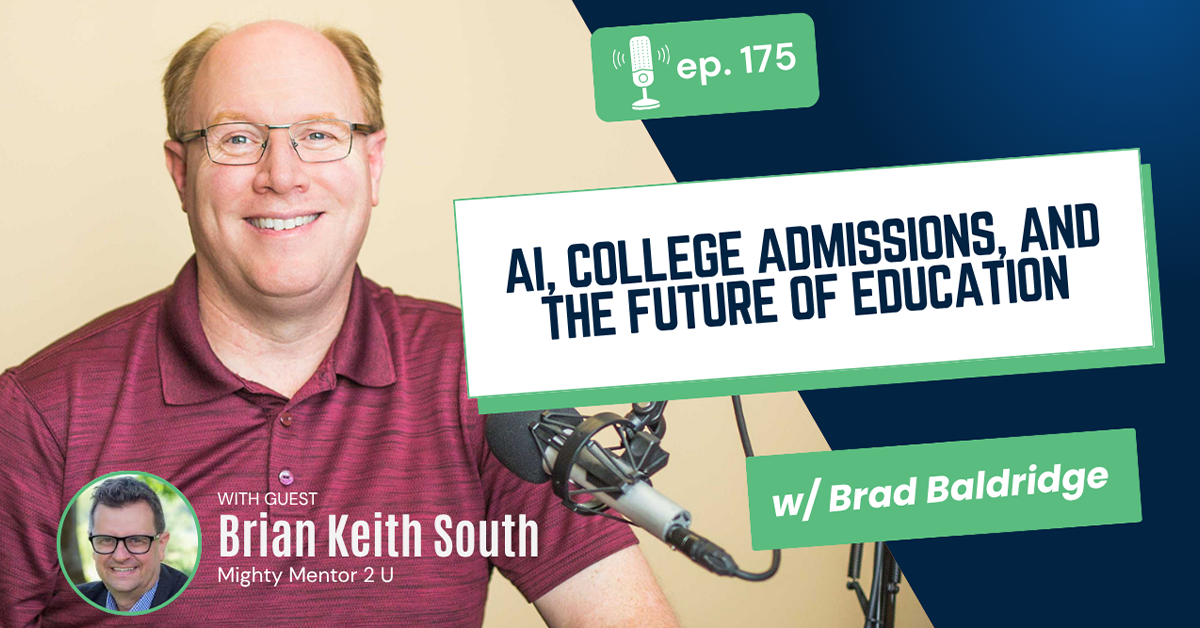
Today’s Guest:
Brian South, author and educational coach
Brian has been an educational coach, advocate, mentor, and supporter of students for more than 10 years. He has a passion for instructing, empowering, and inspiring students of all ages and walks of life to reach their fullest potential.
Brian is the author of the book, Demystifying College Admission: Learn Key Strategies and Develop the Right Mindset to Get into the College of Your Choice. The book is part of his ongoing effort to make college admission accessible to everyone, regardless of their background.
He tutors, coaches, and advocates for college-bound students by specific subject instruction. He also mentors students in college entrance essays, admissions interviews, and provides invaluable assistance in helping students find the best sources for college funding.
Questions Answered Today:
How is AI reshaping education and careers?
Brian describes AI as a paradox: “It’s like nothing has changed and everything has changed.” On one side, headlines warn that AI will eliminate jobs and make education obsolete. On the other hand, optimists believe it will solve every problem. The truth, Brian argues, lies in the middle. AI will replace repetitive roles, but it will also create new opportunities for students who adapt.
From this perspective, several important points stand out:
- Redundant jobs such as bank tellers, phone operators, and assembly‑line roles are disappearing.
- New careers are emerging that demand creativity, adaptability, and entrepreneurial thinking.
- History shows similar shifts (e.g. when cars replaced horses, new industries flourished).
- Students must rethink their identity not as task‑doers but as problem‑solvers.
- Instead of saying “I bolt doors on cars,” a student should frame it as “I solve mechanical problems.” That mindset opens doors to new opportunities.
- AI can even analyze skills and suggest career pivots, helping students see possibilities they might not have considered.
- Entrepreneurial thinking is becoming essential. Cookie‑cutter employment is fading, and having multiple careers over a lifetime is becoming the norm.
Ultimately, AI isn’t the end of education or careers. It’s a powerful tool that students must learn to leverage while cultivating adaptability and problem‑solving skills. Those who embrace this mindset will be better prepared for industries that don’t even exist yet.
“It’s not AI against humanity. It’s synergy. It’s like human touch with AI doing the heavy lifting.” – Brian Keith South
How can students use AI to overcome academic challenges and strengthen college applications?
Brian points out that the real question isn’t about what can students do with AI. What can’t they do? With so many tools available, students are like kids in a candy store, overwhelmed by choices. The key is knowing how to use AI strategically to simplify learning and enhance applications.
He shares a powerful example: one student with reading challenges was struggling in AP courses. By uploading the textbook into AI platforms, Brian asked the system to rewrite the material at a 10‑year‑old’s comprehension level, break it into bullet points, and add visuals and videos. The result? That student earned an A+ in AP English and an A‑ in AP History—achievements that would have been far harder without AI as a “silent partner.”
Here’s how AI can make a difference in academics and admissions:
- AI can reframe complex material into simple, digestible lessons, tailored to a student’s learning style.
- Visuals, summaries, and even video suggestions help students engage with content that they might otherwise avoid.
- What once took weeks of planning and research can now be prepared in minutes, giving mentors more time to focus on guidance.
- Tools such as collegio.ai provide personalized college recommendations, scholarship finders, and essay feedback.
- Platforms such as appily.com and College Decider help students filter schools by cost, major, and selectivity, and instantly generate reach/target/safety lists.
- Even government resources now integrate AI, showing earnings potential, debt navigation, and graduation rates, which gives families a clearer picture of value.
AI doesn’t replace effort or human mentorship, but it amplifies both. Students who use it wisely can turn weaknesses into strengths, build confidence, and present stronger applications.
Is fairness in admissions changing with AI?
Brad and Brian discuss how admissions criteria have shifted, especially around standardized testing. COVID forced many colleges to make SAT/ACT optional, and that changed some of the students who were accepted. Some institutions later reinstated the tests, while others decided they weren’t necessary at all. AI now adds another layer of complexity, raising questions about fairness and fit.
They talk about how the landscape is evolving:
- Testing policies are inconsistent. Some colleges dropped standardized tests permanently, while others brought them back, creating confusion for families. Students who test well may feel disadvantaged when scores aren’t considered, while those who struggle with tests may see new opportunities.
- Essays and personal narratives carry more weight. With test scores optional, admissions officers often lean more heavily on essays, recommendations, and extracurriculars. This makes guidance crucial. Students must learn to frame challenges as strengths.
- AI complicates fairness. Students can now use AI to polish essays or generate application materials, while colleges may use AI to process the flood of applications.
- Fairness is subjective. Brian points out that fair or unfair depends on whether it helped or hurt the student in particular, not globally. For one student, optional tests may open doors; for another, it may close them.
- The bigger question is fit. Both Brad and Brian emphasize that admissions shouldn’t just be about “winning” a spot at a prestigious school. The real goal is finding the right environment where a student can thrive academically, socially, and personally.
Fairness in admissions has always been fluid, and AI is accelerating that change. Families should focus less on whether policies feel “fair” and more on how students can present their authentic strengths and find colleges that truly fit their needs.
Links and Resources
Helpful Articles and Resources
- Taming The High Cost Of College
- collegio.ai
- appily.com
- College Decider
- Brian South’s Contact Info:
THANKS FOR JOINING US!
We’d like to extend an invitation to our listeners to share their feedback and questions. Contact us to submit a question.
If you find our podcasts helpful, please share us on social media and tell your friends!
The bottom line is that we care what you think and want to help you out, so we’d appreciate you reviewing us on your favorite podcast platform. Even better, receive automatic updates by subscribing to the show through your preferred podcast service.
Presenter 0:00
Welcome to the Taming the High Cost of College podcast. Here is your host, certified financial planner Brad Baldridge.
Brad Baldridge 0:10
Welcome to Taming the High Cost of College. I'm your host, Brad Baldridge. Today we're talking with Brian Keith South. He's an author and an expert in AI and other things around college, and we spoke with him a few years ago, so this is a kind of a return, and you're certainly welcome to go back and listen to his episode, it's about three years ago, and but we want to get things updated because a lot has changed. So, welcome, Brian.
Brian South 0:35
Thank you, it's I'm honored, and to be on your show.
Brad Baldridge 0:39
Right, so I was reviewing your book that you published, you know, just a few short years ago, and a lot of that stuff in there is very good and very interesting and very appropriate. However, I noticed there's one chapter that's getting a little stale, and that would be the AI chapter, where you talk a little bit about, you know, how AI is going, and that type of thing, and I think you probably put this to bed just before the main AI breaks use of Chat GPT, etc. Where it went from stuff that big corporations do is build chat bots, and Google uses it to find you, do your searching, and Amazon uses it to sell you stuff
Brian South 1:16
Right
Brad Baldridge 1:16
And it's kind of switched over now, where you know it's now available for everyone to some extent, so let's start there. What's, in the latest breaking AI, and that type of thing. We get a lot of headlines about AI has taken everybody's jobs. AI is killing colleges. We know it. Nobody's ever going to need an education again. You know, the world is coming to an end because of AI
Brian South 1:40
Right?
Brad Baldridge 1:40
On one end and the other end of that spectrum is AI is going to solve all our problems in a few short years everything will be fixed and life will be great. Where do you stand on that and how does it apply to education?
Brian South 1:52
Well, that's that's a fascinating question and it's something I think about all the time and the reason why I find it kind of hilarious is because two things have happened that are that are a paradox. It's like nothing has changed and everything has changed, you know. It's almost like reading A Tale of Two Cities. It's the best of times and the worst of times kind of a scenario. And actually, both statements are equally true and not true. So, let me say, so I'll give you an answer of what I think about it. I mean, when I was first writing about AI, would be no different than if I were in the 1800s and I was in the middle of the 1800s writing about the invention of the automobile, and someday that will happen, and then you and I have an interview in 1920 when cars are off the assembly and they become almost affordable, everyone, and the blacksmiths are out of work, and the torch lighters are gone, and the butter churners are a thing of the past. So, what I've noticed is that I take the middle of the road approach. First of all, people have always been doomsdayers. I mean, in the 1950s isn't it true? There were shows about Martians that were going to invade Earth, and you know, and during, yk, people thought that the computers would shut down, we'd all be running around like Mad Max, you know, that's not happening, right? Life goes on, and the same as AI. What I understand is that on the one hand, yes, AI will replace a lot of jobs, that's that's a fact, because, because especially jobs that require redundancy, those, those will be replaced, bank tellers are going to be a thing of the past, phone operators, even many customer service jobs probably will not be, but then AI will create new opportunities. What I would tell students is, is to keep an open mind, you know, stay true to your dreams, but embrace this new technology and leverage it. So, I don't believe that AI is going to completely decimate us and leave us penniless. Nor do I think it's going to be a utopia where we're all going to be on cloud nine and never have to work and live happily ever after in perfect harmony. I think we're going to be in the middle of the roads just as we always have been. It's just that life will continue as it always has been. It's just that certain tools that we'll be able to use of AI will, it'll just be on steroids. So I can tell you how I've been using AI in my college coaching ventures. Some people would say to me, well, you know, you're, you know, isn't it true? Because now students will be able to hire agents, and you'll probably be out of work, because they can have AI write their essays, they can have, they can get a virtual coach that can do everything that you do, and I would say just the opposite. I think they're going to need human connection more than ever, and I kind of intimated this back in. A back, and you know, in the last century, I guess you could say, when I said that, that AI will actually, in some ways, compel us to be even more human, in a sense, because it's because, here's, here's, here's, here's the AI is fantastic, because you actually can have everything at your fingertips, but that's a liability, in a way, too, because what do you choose what do you do? I mean, if everything is there, it's like a kid in a candy store, they, there's so many choices, so much availability. What do I choose? So that's where the services I do will be more valuable than ever. I think Tony Robbins actually said, you know, that the quality of our life depends on the quality of questions
Brian South 5:41
Now if you got an adolescent with raging hormones, little experience, and not solid guidance in their home, they'll have this amazing technology, but they, you know, the only thing they may know how to ask is, what video games or am I can I play next week, or, you know, or, you know, or, or they may even ask it to write their essay, but it probably going to an AI will probably write a polished essay, but it'll sound generic and canned. The wisdom, the experience, knowing you know that you get by getting knocked around in life and by reading voraciously and thinking deeply. Just imagine if you have a mindset like that that uses AI and asks, well, how can I best tailor my needs to tailor your services to provide the best, most comprehensive, and personalized support for the student? See, that's why you need people more than ever. It's not that it's not AI against humanity, it's synergy, it's using it's a powerhouse, it's like human touch with AI doing the heavy lifting, and that's how I see how I offer services
Brad Baldridge 6:47
Right, exactly. And I certainly agree with most of that. I think a good analogy would be, if you focus in on one job, so let's say that you work the assembly line, building cars in the 50s, and there was lots of people on that line, and your job was to bolt a certain thing, you know, put the doors on the car, and now they've built robots that put that out, you know, do that all day, it was a tough job, because doors are heavy, and so forth, and now the robot does it, and now you're out of work, is one way to look at it
Brad Baldridge 7:21
But I think a lot of people need to get a lot more entrepreneurial in saying, well, I was solving the how to get doors on cars problem, now that problem is solved. What's the next problem I can solve? Because you could talk to the average business owner at every level, they've got zillions of problems that they would love to be solved, and they will hire people that will solve those problems, whether they're internal or external people. You know, sometimes they're going to outsource lots of companies will outsource their accounting or outsource their whatever it might be, and sometimes they'll do it internal, but I think for a lot of situations, I think students and parents need to start thinking about, well, if my job, if I, if my identity is, how do I solve putting doors on cars, and now that job's not available anymore. Well, yeah, that can be a challenge. But if your identity is, I'm good at solving mechanical problems in a car plant, well, again, there's lots of problems, and they can always do it better, they can always do it faster, they always can do it cheaper, and if you're willing to participate in that, instead of just saying, you know, the world owes me a job, and this is what I know how to do, and if you know, if that job goes away, woe is me. Well, yes, that is a reality for many people, that multiple jobs, multiple careers, even are the norm compared to what our grandparents did
Brian South 8:41
Right. Well, that's why my services are essential, because I help them open doors
Brad Baldridge 8:46
Right. Absolutely
Brian South 8:47
Yeah. And the thing is, you could actually, you could actually use AI. I mean, you could actually ask a question. Hey, I was a former door assembly man in an auto plant 1950 I possess fine motor skills. I have off the charts mechanical abilities. I've led a team in over the years. If I take these skills and apply them to 20th century world, what opportunities would be available for me, and it would spit out tons of possibilities. List, list, list, either companies you could apply for, courses that you could take to upgrade your skills to be even more competitive, and even provide a step-by-step approach to how to navigate to the new new dimension of I think employment is actually an archaic word now, like, because I think, like you were saying, I think I think the trend is you have to be more inventive, more creative, more entrepreneurial, you know, I think I think the cookie cutter days of putting a, putting a stamping in at 9o'clock And taking your coffee break, lunch break, and you know, water fountain break, and then you know, you know, clock out at five, or are you know, I mean, they're unnecessary, they're probably, maybe a few of those left, just you know, like they're probably still some people that write with goose quills and ink, for the most part, you know, we're in a whole, a whole new world, or I'll just talk to say a brave new world, that's what it is
Brad Baldridge 10:25
There you go. So, yeah, so, so, how do you see students using AI right now as part of the admissions process or college process? And how could they take it to the next level?
Brian South 10:38
I mean, that I think the answer to that question is what can't they do? I mean, there are so many choices, there's so many things that they could do. That's what I was intimating earlier. It's not a question of what you can do. It's like you're in the candy store, what do you select, or you know, so here, here's a couple of things I'll approach this from how I support students using AI, and I can throw out some, you know, just a few of, like, you know, countless resources that they could use to use AI to jump to the next level. First of all, like, I'm right now working with some students that are taking AP level courses and struggle, they struggle with with reading and with comprehending that, because that's not really their round wheel, some of the ones I work with are fabulous with, with mathematics, and you know, the in-depth literary analysis that they need to do these type of problems are just, it's just, I might as well, you know be speaking a completely different language to them, so what I've done is take their textbook and I would upload it into a number of AI platforms, and I would say I need you to help me prepare a lesson that I could explain to this student that covers every single thing they need to know in order to ace you know their AP exams, but I want you to write it at a level that a 10 year old could understand. It take all the concepts, write it very simple language, everything that's in this text, break it down into bullet points that I could explain, add some visuals to really bring it alive, and maybe even a couple of videos to really to really catch their attention, and I've done that, and one student in particular, who the parent described, you know, experienced some reading challenges, or whatever, got an A plus in AP English and an A minus in AP history because of that approach. So, because I was able to use AI as my silent partner, and, and, and bring it. I was able to explain these things to them. I mean, I could have done something almost similar to that three years ago, but it would have taken weeks of planning and tons of research. I was able to, you know, I could walk down the street before the traffic light turned green. I already had everything all laid out and plans, so that's one way from from a mentor or an instructor's way that AI has been extremely helpful. Now, now let's look at it from the student angle. There are there are resources that students can use in conjunction with my support that could, that could skyrocket their college application approach. One of them is called collegio.ai It's a free college counselor that provides personalized college recommendations based on 1000s of data points, their goals, their interests, what stages they are. It even includes a scholarship finder and essay feedback, so if they want an additional support, besides, I assemble all that together, bam, and just a matter of minutes, they've got a neat little profile that will, that will give them everything that they need to make an intelligent decision. There's another resource, it's called appily.com it's a free college search tool, it filters the college by cost, by major, by selectivity. It has virtual tools and scholarships that they could use to custom tailor their college approach. And there's also another one called College Decider. It's a free AI tool. They can enter their GPA, their test scores, they, and it'll spit out the instant reach target and safety schools list that they can provide, not to mention there are other tools that they could use, that like US Department of Education sites now that can show them their earnings, their, you know, the amount of how to navigate student debt, it'll provide graduation rates for some of the places that they're applying to, so they can actually, they could actually write up something that would make the average business plan of yesteryear seem like chicken scratch.
Brian South 14:54
I mean, so that's what AI can do for them. From what I've seen in fronteye views, that's a far cry. From our life is over now that AI is here, you know. Now, actually, it'll give them more options that they ever can be. Now, that doesn't mean they're going to be happily ever after in La La Land. It just means that they have more tools and more decision and more resources to make more intelligent decisions
Brad Baldridge 15:20
Right? Yeah, I mean, I think that's the other piece of it, right? Is most students have challenges, and sometimes they're big challenges, sometimes they're small challenges, but most students, again, are struggling with something, whether it's academic related or socially related, or what their home life is, or financially related, all these different struggles, and you throw AI on the mix, and there's still going to be all those types of struggles. It just might be different students and different struggles, etc. Right? When covid hit, it was nearly impossible for students to take the ACT and SAT. So, most colleges said, "Well, if we continue to demand the test, then we're not going to have any customers," and, of course, that made no sense. So, they said, all right. Well, we'll make the test optional now. Since that time, some colleges said, you know, what, that test didn't seem that important to us. Now that we haven't had it, well, we can skip it forever. We decided we don't need it. Other colleges are bringing it back and saying, actually, we would like to see test scores, but that changes, you know, potentially. If you could put up great test scores, that would be another feather in your hat, and it might make you get accepted to some schools that you wouldn't have been accepted to because you were not able to put your test score out there.
Brian South 16:30
Yeah
Brad Baldridge 16:30
But and then some other kids got accepted because they didn't, they weren't going to test very well, and they didn't have to, and therefore they were accepted on their other criteria.
Brian South 16:40
Well, I think a funny thing that opened when I went ironically during the covid time, even though the colleges made testing optional, I had many families want me exclusively to tutor them or guide them on passing the SAT or the ACT, and I said, look, you don't have to do this. A lot of the colleges say these are optional. They said, no, that doesn't matter. I want him to, you know, I want him to do it anyway. I said, you know, but actually, according to the data I have, a more, a more pragmatic approach would be to focus on the essay, because that's something that is unique, tailored specifically to the student, and that will probably be a far greater determinant of forgetting into the college to go. No, that doesn't matter. We want you to help them with this, even during the even when was optional. I had a lot of people that wanted, wanted preparation for that test.
Brad Baldridge 17:38
Right, absolutely. But you know what happens is they move the goal posts, they change how it's going to work, and different rock star students got accepted to the highly selective schools than would have been accepted had they not made the changes, but in the end, is that fair or unfair? Right?
Brian South 17:56
I think from a student's perspective, fair or unfair is whether it helped or hurt me in particular, not whether it's globally a good idea or not, right? So kids that could test well say that was unfair, they didn't take my test score, and kids that got in say, oh, the way it was fair, because they were using that unfair test in order to keep me out, right, but, but, but even before any of this happened, it long before, before I mean, even before the internet came into scene, there were students who had perfect SAT scores, you know, 4.5 GPAs. They were the captain of their football team, the captain of the row boat team. I mean, you know, using the joke from, you know, the movie Legally Bond, even de-wormed orphans in Somalia, let's say they still didn't get into the college of this. They said, "I'm sorry, we regret to inform you that you know we can't admit you." And they go, But on paper, they were perfect. I mean, they couldn't have done any better. And then there were students that I knew personally that didn't even have a B average that got into UC Berkeley just because they knew the right people who helped them say the right things in their application, and they slipped through the cracks, and they got in anyway. So it's that's right, yeah
Brad Baldridge 19:10
Right, exactly. And that's right. So that's the whole process of AI is changing the landscape, and some of the rules are changing, and that's, you know, that's what's going to happen is how they admit, I think that's one of the big problems that we're dealing with in general, right? Is it's not so much, you know, when in the job situation, right? I have these skills, how do I find somebody that needs these skills in the college area of admissions and that type of thing? It's like, well, colleges want, you know qualified students that will excel at their institution, they don't want people that will struggle, they don't want kids that will drop out or change careers or change majors, that's not their goal. I mean, it happens, but if they knew for certain that some kids are not a good fit, no matter what their statistics look like, they would choose to not. Take them, it's not in anybody's interest to do that. Correct, problem is it's really hard to do that match and do it well, and I, you know, and as we get better at that, you know, that would be great. You know, there's the, there's a comedian that talked about AI and said, you know, I didn't have time to write the email, so I just wrote a couple quick bullets, and I took it to AI, and they, it formatted into a nice, you know, perfect email with all the grammar was correct and looked very business-like, and I sent it, and then the guy that received it didn't have time to read it, so he put it into AI, and AI tore it down and put it into bullets, you know, I think that's that's the reality of when it comes to a lot of this stuff, right? AI isn't making it very easy for students to apply to a lot of colleges. Yeah, so now colleges are getting so many applications that now they're going to use AI to help them read them, because so it is a kind of a Catch 22 of how this is all going to play out, but as things get better, as they realize, you know, how this works, and again, with the goal of doing what we really want, we know we don't want people sneaking in and that type of stuff. What we really want is good fit to be found in at a reasonable effort, right? Right, again, reading all the applications and all that stuff. So, if they can streamline it, they will. And is that fair? Well, I don't know. Fair is a very challenging word.
Brian South 21:21
Yeah, I think that's always been true, though, about fairness and effect, and what seemed fair. What I, what I, what I tell the students I work with is that, regardless, with AI or not AI, is to, like I've mentioned in my book, to do a thorough inventory of themselves and know what's important to them, what their values were, and be forthcoming about what their challenges are, and rather, and when they present them on paper, to present them where they're actually, where their strengths were actually, that these, these challenges gave them a certain insight, which actually gave them the focus to pursue a major and a career choice, or a way of helping them understand, you know, or or way of seeing the world in a way that maybe someone without that particular dilemma would not be able to come up with it, you know, so that's what I tell them to do, in other words, you know, you know, because one thing that one thing that seems kind of universal about colleges, especially in the essay, they'll, they'll, they'll ask, what challenges have you, have you overcome, and that's tricky for a lot of students, because they, without the proper guidance, they'll treat that question as a confessional, and they'll spill all their dirty little secrets on, you know, I got caught smoking grass, and my, I got kicked out of college, and now I was ashamed of my family, and no, you don't want to say that in your essay, you know, you want to, you want to say that, you know, at the beginning, because I was so enthusiastic about all the opportunities that I wasn't clear about which choice I wanted, but then with insight, with the, with the, with the proper mentoring and coaching, with a few courses, now I'm more focused than that, or not, and if I didn't have these challenges, I would have not not have the level of focus that it's going to make me excel at your university, that's kind of how I guide them
Brad Baldridge 23:10
Right? Exactly, yeah, so I mean, yeah, obviously you present the best possible student and in the best possible way as just kind of by definition, but again, that's also the goal isn't necessarily to, you know, just win, so to speak, because you want to win at the institutions that are the right fit for you,
Brian South 23:30
Exactly.
Brad Baldridge 23:30
Just because you can figure out how to get into XYZ prestigious school, the real question is, do I even want to go there, or should I go there? I think that's the step prior to how do I present the best possible student, because realistically it's how do I present the best possible student for this school, right? This school is the part that you need to figure out first.
Brian South 23:52
Well, I, my approach in working with students is a holistic approach. When people like, like the service you do about cost of college, what I think most people think about when they think of the cost of college, they think of the most prestigious school, and how much would it cost for me to do that. Well, maybe that prestigious school is not a perfect fit for the student, as you said. What you have to look at is the whole picture. Okay, there's the cost, but then also, what, when we think of costs, you also have to think of value, what value is that going to bring to that individual student? Like, for example, is a student applying to medical school at Harvard because they really want to be a doctor, and Harvard is the best institution that will nurture that particular student's needs and be the perfect environmental and politically fit a niche that will will launch them into the into the career that scale, or you know, what if that person is prone to depression and can't stand cold weather, and grew up on the beach their whole life, and now they, they've never been to a place where they never, they won't see the sun for another six months from now, you know. Is that that going to be the best environment for them to focus, and to, and to do that? Now, some people make that choice, they'll say, 'Look, okay, I've been a beach bum, no, the last 20 years, but I'm willing to sacrifice four or five years of my life to be, you know, in a, you know, in a cold, you know, because the education that's going to be offered at this school is going to be worth the sacrifice, but others may not be able to do that. Then they also have to think about where they're going to live, like for example, you know, the cost of living in Kearney, Nebraska, is going to be different than the cost of living in San Jose. You know, I mean, so when you think of costs, we're not just thinking of the cost of the college or the housing, we're also thinking about living. Is it? Is the university a self-contained university? I mean, I, for example, chose to go to UC Berkeley because I didn't want to drive 10 miles in every direction, you know, to get.. I wanted everything right there at my fingertips, so I could be focused not only on my studies, but on, you know, my social, you know, socialization - everything was right there, kind of in a centralized atmosphere. So, for me, that was important. That might be not important to someone else who wants to study, let's say, zoology or engineering at a college, let's say at UC Davis, which is kind of somebody spread out, so you know you have to look at all these things, you know, like the environment of where you're going to school, the cost of the school, the type of student that's going to the school, what they're going to study, and how is the information presented. Now, some people are hands on, you know, they need direct intervention, or they need to be in smaller classes. Others, you know, they could be, could be dropped in, you know, in a class of 300 people, it won't matter to them. So it really, you know, they really have to look at where, you know, the whole picture, as you say, not just the college and the cost, but what is the value cost for that student individual
Brad Baldridge 27:02
Right. Absolutely. So, holistic planning is important. Hey, it's not going to completely end the world, at least that's our opinion. We could be wrong. So, let's wrap things up here. But before I let you go, can you tell people a little bit more? I know you've got a book out there, you do some consulting services, so if people want to learn more about what's going on? Can you tell us what your website and other information might be?
Brian South 27:24
Sure, they can go directly to my website, which is Mighty Mentor 2 U, and that's mighty Like "mighty", and the number 2 and the letter U dot.com and that will provide my contact information. It will describe the services I offer students I've supported in college, they've got into, and and then they could even book an appointment directly to meet with me.
Brad Baldridge 27:50
All right, we will put all that information in the show notes as well, so if you're driving or exercising right now, you can just pop to our website and look it up. All right, that's all for today. Thank you, Brian. And we'll talk again soon.
Brian South 28:03
All right. Thank you.
Presenter 28:03
Thank you for listening to the Taming the High Cost of College podcast. Now it's time for you to take action. Head to tamingthehighcostofcollege.com for show notes, bonus content, and to leave feedback for Brad. The next step on your college journey starts now.
Presenter 1 28:21
Brad Baldridge, is a registered representative of Cambridge Investment Research and an investment advisor representative of Cambridge Investment Research Advisors, a registered investment advisor. Securities are offered through Cambridge Investment Research Incorporated, a broker dealer and member of FINRA and SIPC. Brad owns two companies, Baldridge Wealth Management and Baldridge College Solutions. The Baldrige companies are not affiliated with Cambridge Investment Research.
Transcribed by https://otter.ai
Sign up to receive email updates
Enter your name and email address below and I'll send you periodic updates about the podcast.