

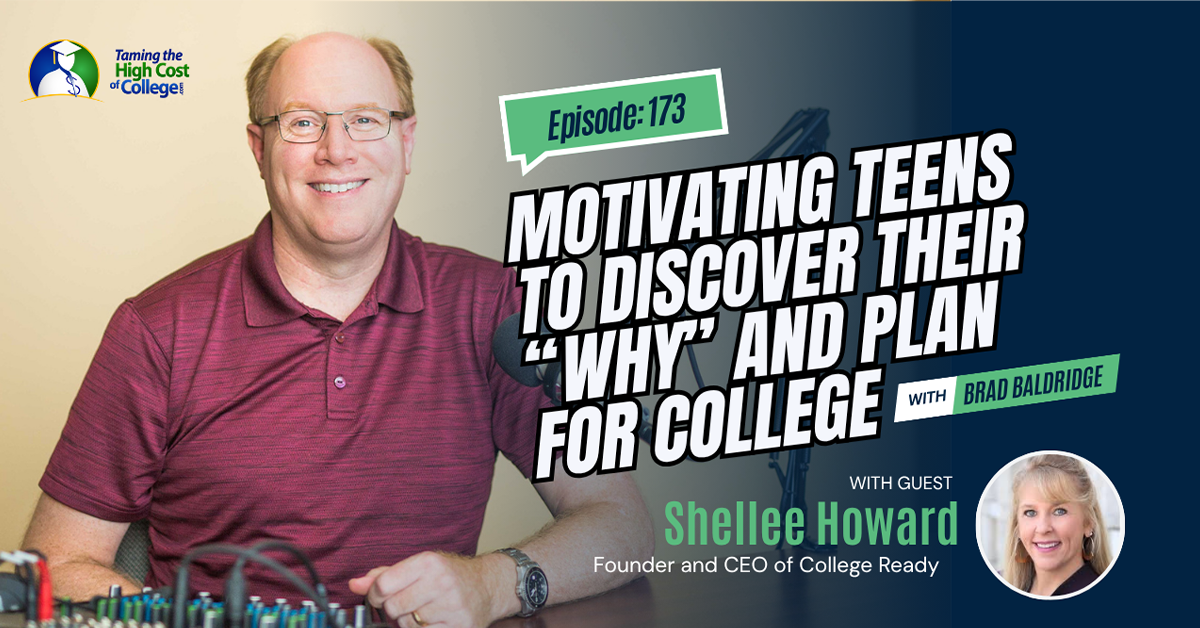
Today’s Guest:
Shellee Howard, Founder and CEO of College Ready
Founder and CEO of College Ready, Shellee helps families navigate admissions, find the right college fit, and graduate debt‑free. She specializes in scholarships, merit aid, and guiding students to make smart choices early in the process.
Questions Answered Today:
When should families start planning for college? Is it ever too late?
Shellee explains that the best time to begin college planning is when students start showing curiosity about careers, majors, or college, which often happens in middle school.
Starting early gives families time to explore interests, develop leadership, and build a strong academic and extracurricular record before the pressure of junior and senior year arrives.
Shellee suggests that the summer after eighth grade is often an ideal starting point. Students can begin exploring scholarships, leadership opportunities, extracurricular activities, and career interests during this time.
However, many families don’t begin planning until much later. Shellee says that while it’s never completely too late to start, beginning late can limit certain opportunities.
For example:
- Students can apply for independent scholarships as early as fourth grade.
- Waiting until senior year may mean missing years of potential scholarship opportunities.
- Late planning can lead to rushed decisions about majors, colleges, and financial strategies.
Starting early allows families to take a more thoughtful approach instead of scrambling to fix problems during the final years of high school.
What are colleges really looking for in students today?
Shellee explains that strong grades and test scores are still important, but they are only part of the admissions picture.
Colleges want to understand three core things about every applicant:
- Who the student is
- What matters to them
- How they’ve demonstrated those interests
If two students have the same GPA and test scores, admissions officers often choose the student who has demonstrated leadership, curiosity, and meaningful involvement in activities.
This is why Shellee encourages students to focus on developing authentic interests rather than simply trying to check boxes on a résumé.
“They want intellectual curiosity. They are looking for people to come to their school, make it amazing, have some great stories to tell, put the diploma on the wall. And now all of the sudden you’re advertising for them. The cycle goes on and on and on.” – Shellee Howard
Shellee encourages students to develop what she calls a “passion with a purpose.”
This means identifying something they genuinely care about and turning it into meaningful action.
Examples include:
- Starting a club or project
- Leading a community initiative
- Volunteering in a meaningful way
- Building an organization or nonprofit
These experiences demonstrate initiative and leadership, which can help students stand out in competitive admissions.
Shellee mentors students through a nonprofit initiative called Empower Education that allows students to gain leadership experience while supporting educational programs internationally.
Why do some students seem unmotivated about college planning?
Shellee explains that many teenagers who seem unmotivated aren’t lazy; they simply haven’t discovered their “why.” Without a clear sense of purpose or understanding of what matters to them, students often disengage from school, activities, and planning for the future:
- Teens may feel lost or unsure about who they are—especially at ages 14–17—and often pretend they know how to appear mature.
- Once students identify their personal “why”—what excites them and what goals matter to them—they become motivated and willing to take action.
- Parents don’t always need to solve this alone; sometimes it requires guidance from mentors, coaches, or professionals who can help teens figure out their passions and strengths.
Shellee shares a personal example: her third child had many talents but didn’t know what motivated him. By using a fun approach—reading the book Teenage Love Languages and making a friendly bet—they discovered his love language was acts of service. With this understanding, they could tap into what actually motivated him, rather than relying on traditional praise like “attaboy.”
She also emphasizes that college planning should be tailored to each student:
- Identifying who they are and what matters to them.
- Setting up a strategy to show proof of their strengths and passions.
- Exploring potential majors and careers—considering factors like how AI might impact their future work.
The main takeaway: unmotivated students often just need guidance to discover their “why”. Once they do, motivation follows naturally, and planning becomes meaningful.
How complicated is the college application process today?
Shellee explains that the college application process is far more complex than many families expect. Students must consider these multiple elements at once, and each requires careful planning.
- Building a balanced list of reach, target, and safety schools that fit academically, socially, financially, and sometimes athletically or artistically.
- Deciding whether to apply early action, regular decision, or with scholarship priority.
- Choosing an appropriate major at each school, which can vary widely between institutions.
- Crafting multiple essays (sometimes 4–18 per school), each highlighting a unique aspect of the student’s experiences or goals.
Shellee emphasizes that a strong application tells a consistent story about the student, aligning extracurriculars, accomplishments, and essays. Without a clear strategy and understanding of who the student is, applications can feel generic and fail to showcase their strengths.
When should families seek professional guidance for college planning?
Many capable students still need external guidance to navigate the process effectively. Even motivated students can struggle with the volume and complexity of applications, essays, and strategic decisions.
Indicators that professional support may help:
- The student doesn’t know how to articulate their experiences or strengths in essays.
- Parents feel overwhelmed by the process or uncertain about how to guide their teen.
- The student needs to align interests, career goals, and college choices for a cohesive application story.
- Families want to maximize scholarship opportunities and minimize costly mistakes.
Professional guidance can come in many forms—from full-service consultants to specialized coaches for essays, test prep, or college strategy. Shellee stresses that having an outside voice can make a huge difference, especially when students are unsure, unmotivated, or overwhelmed.
Ultimately, whether a family handles it themselves or hires a professional, the goal is to set the student up for success while avoiding regrets.
Links and Resources
Helpful Articles and Resources
- Taming The High Cost Of College
- Empower Education
- How To Send Your Student To College Without Losing Your Mind or Your Money
- The College Admissions PLAN Simplified
- Teenage Love Languages
- Shellee Howard’s Contact Info:
THANKS FOR JOINING US!
We’d like to extend an invitation to our listeners to share their feedback and questions. Contact us to submit a question.
If you find our podcasts helpful, please share us on social media and tell your friends!
The bottom line is that we care what you think and want to help you out, so we’d appreciate you reviewing us on your favorite podcast platform. Even better, receive automatic updates by subscribing to the show through your preferred podcast service.
Presenter 0:00
Welcome to the Taming the High Cost of College Podcast. Here is your host, certified financial planner Brad Baldridge.
Brad Baldridge 0:10
Hi, welcome to Taming the High Cost of College. I'm your host, Brad Baldridge. Today, I'm talking with Shellee Howard. She works and helps families with the admissions process, so she does a lot of stuff that I just don't do, and I'm not qualified to do. You know, I work on figuring out the money and helping parents understand your need-based aid and merit aid and loans and negotiating with schools. Then, when the student needs help, that's when we bring in someone like Shellee's. So, welcome, Shellee.
Shellee Howard 0:36
Thank you so much, Brad, for having me on the show.
Brad Baldridge 0:38
Right now, can you briefly tell us a little bit about your company. Where did we find it? What's it called?
Shellee Howard 0:44
Absolutely, so College Ready was started 18 years ago, when my first born was navigating this process. I won't go through the details, because we only have a short amount of time together, but if you want to know them, I'm happy to share. The bottom line is, I ended up going back to college, becoming a certified independent college strategist. When my son applied to college, he applied to 12 schools, got into 11, got a full ride to 7, and he got a full ride to USC, and Harvard matched it. So he went to Harvard, pre-med, got his first B. That was kind of shocker. And then from there he went on to UC San Diego for medical school, and he is now the chief resident at UCLA as an orthopedic surgeon, and he is leaving for fellowship back to Boston for one more year, and I have three others that have done all the way through college without any debt. So I'm happy to share with you how I did it, what's involved, and how you can take that opportunity as well.
Brad Baldridge 1:41
Right. Absolutely, so you're helping families, and I guess more specifically students. So, can you touch on that a little bit about where students are usually starting, as far as what they understand and what they need to know, and then ultimately what goes through the process for the typical student?
Shellee Howard 1:58
Absolutely. So, families contact college ready and my team at very different times. I've had people call me right after they deliver their baby and say, "Hey, we need to get this plan started,” and I'm like, "Whoa, whoa, whoa, not quite yet.” And then I have people contact me in elementary school, "Hey, my child's gifted and talented,” that's great, teach them to love to read, but when it's really a great time to have this conversation is when they're in middle school and every child has a unique personality, so it's not a certain age, it's a certain maturity. I have some seventh graders in college ready that are more mature than my 12th graders, so you know it's not really about the age they're at, it's their maturity and their intellectual curiosity. So, when that student comes to you and they are curious about a career, a college, a major, money, all of that, that's the best time to really lean into them and help them understand what will they need to be a doctor, a lawyer, a CPA, an engineer, or a plumber, electrician, whatever that career looks like. That's when it's the best time to have that conversation. So, what College Ready does is step one is we figure out who is the student, what matters to them, and how will they prove it. Those are the three most important things colleges are looking for right now, and so we want to help the student to be able to articulate while we're helping the family understand what is involved with the FAFSA. How did they know what their student aid index is? We want alignment of the family thought process. Are you looking for an academic fit, a social fit, an athletic fit, a financial fit? Like there's a lot of things involved here. So I talk about it like this. If you wait until their junior or senior year, it's like taking off on a runway where the pilot has just told you, "Hold on, it's going to feel like a rocket ship,” versus the pilot that says we're on a long runway, don't worry, we're going to take off sometime soon. It's either a nice, slow, gentle runway or it's hold on to your seats and we're going to take off. College Ready meets your child where they're at in this process and helps you navigate getting into college without losing your mind or your money.
Brad Baldridge 4:21
Right? Okay, so start early, I think, is what I just heard. But when is it too late to get involved? I mean, if I've got a senior in high school, is that too late? If they're already on the bus going to school, is that too late?
Shellee Howard 4:35
Yes. So a couple, couple, yes and no. Yes, it's too late if you want the big scholarships, because you've given up. Kids can start applying for independent scholarships in fourth grade, so you've given up all of these years of not talking about this or doing this. We can't fix that. We can't fix if you pick the wrong college list and everything was a dream and your child's barely. Going to get in, they're not going to get the big money, so there's some barriers you put up in front of us that we let you know straight away. If your assets are completely in the wrong area, we send you to Brad, and we're like, hey, we gotta fix some stuff here, right? Then we help you to get really clear about what is the most important thing is, your child going to go to community college for two years, but is it going to take 234, or five years for them to graduate? That's a real thing. Parents, are they going to go to a local state school? Will it take them four or five or six years to get a graduation from one of those impacted schools? We want you to know before you make a poor investment, we look at college as a stepping stone to their future. It's not the end game. So, what is a good return on investment? It's helping your child know where they want to go, what they want to major in, what career they want. Will I be doing that job when they graduate, and will they have to take on loans? That's a lot of information to fit in in a very short amount of time without blowing somebody's head up. So we take it from a very gentle place when parents are just starting this process, and we hope the student is mature enough if they find us in their senior year. We help students transfer from community college or from a four year institution that wasn't a good fit, if you did it on your own, we can fix the broken pieces, but it's so much more difficult and emotional. It's a lot easier to go right into a four year college than it is to transfer in. It's a lot of information, Brad, but hopefully they get the gist
Brad Baldridge 6:43
Right. Exactly, you know, when I'm working with families early, you know, maybe sophomore year is good. Generally, I'm not going to say, "Oh, you're way too early.” Now we might do some planning and say, "Actually, you're in a pretty good spot.” You know, we can coast for six months, barely, but that does happen that way, but when you roll in with a late junior, early senior, it is that scramble, and now instead of doing good planning, we're more of doing triage of, well, let's fix the biggest problems, we don't have time to fix all the problems, and maybe just, you know, maybe decisions are already done, and you know, I use the example of, you know, it's based on, you know, financial aid is based on your income, and they look back two years, so a lot of times, as I'm working with families, the tax return that's relevant for the freshman year is already done, we can't change what happened on that tax return anymore, because it's already done, because that year typically is half sophomore, half junior year for most kids, so if you start earlier, then maybe we can do something earlier, and if there's nothing to do, well, then we can, we can coast a little, but the other way around doesn't work as well. So, what do you think your ideal is? I mean, obviously the mature seventh grader, but is the typical freshman or sophomore mature enough? I mean, is that the level that is typical, or?
Shellee Howard 8:01
So. Here's the thing, and I love to talk about this mindset of a parent. When, when the generation who has teenagers going through right now, when you went to school to college, you didn't have to pick a major, you could be undeclared, undecided. That's one huge difference. Number two is the cost of college was minimal compared to what you're going to pay now, so that mindset has shifted. The third mindset is at least when I applied, I typed it on a typewriter, we put a stamp on it, and we prayed it got to the university. Now these kids are applying to a ton of colleges, and it's clogging the pipeline, so with all of that in mind, it's not that college is really that much harder to get into, really. If you, if you weigh it all out, it's just so different. So, if you think, well, I didn't start until my junior or senior year, I don't think we need to start so early. I don't want to freak out my kid. I want you to know that is very dangerous in so many ways, especially for money. So, the best time, the ultimate time, if I could give you like my secret best strategy, it would be the day they promote from eighth grade. Why? That summer is the most wasted summer of any summer they're going to have. They're like, "Yay, I promoted from eighth grade. I'm just going to hang out at the beach or on the computer on my phone.” They can be applying to scholarships, they can be working on a passion with a purpose project, they can work on their standout strategy, they can do research, they can do leadership, they can do extracurriculars, they can have fun, they can do all of this and have fun, and they're getting a jump start, and financially, if you got your house, financial house in order with Brad, my goodness, talk about a nice long pause, you can be like, I don't know what everybody's worried about, this is so simple, it really comes down to the more you prepare, the better you. Think about this. If you started preparing for retirement when you're 75 that's like applying to college when you're a senior. There's this moment, like, no, am I going to be able to do this? And it's the same exact thing. And why would you wait? It's not going to cost you any more to start now. It's not going to be any more difficult if you start now. What is the reason why you haven't started? Is the question I want parents to ask. Do you think your child is not mature enough already? Well, then that's a reality in its own. Have you taken them on a college tour? You know, we take our kids to museums, to our art galleries. Have you taken them on a college tour, not with pressure of what you're going to be or what you're going to do, but hey, would you like to wake up at noon and do all your classes at night? Would you like to take classes that you really care about and are interesting to you? That's what we're talking about. The joy of being able to get the intellectual curiosity from an accelerated upper education is so much more fun than having to take math, history, science, English over and over and over. They don't know that we need to help them understand it, and so if they're not super excited to do more work, they're normal people
Brad Baldridge 11:14
Right? For sure. So you mentioned a couple things in there, like passion project. Can you explain a little bit about what you're talking about, as far as you know, it sounds like there's things to do, so to speak.
Shellee Howard 11:25
So, back in the day, we, as applicants, we had a great GPA and a test scored a match, and you pretty much got into a great school. It was not much harder than that. Maybe you did something additional, but it sure wasn't like it is now. So, here's the reality. Parents, college is a business. I want you to think of yourself as an employer, and if I come to you and I say, “I really want to work for you, Brad,” and you say, “can I see your CV or resume,” and I'm like, “Brad, I spent a lot of time at the beach this summer, haven't had much time to get it ready,” and you're going to say “sorry, not a good fit,” and child number two comes to you and says, “Brad, I really want to work for you, like you're the man,” and you say, “Can I see your CV,” and you're like, “Brad, I'm so sorry, it's four pages long, I tried to narrow it down to be three, but I've just been doing so much, you know, you can go on vacation, I can do your job.” Would you pay them more money? Absolutely, you would. Right, college is the same thing. They're looking for students who want to be educated, who want to come to their school and make it better by starting a club or an organization. They want intellectual curiosity. They are looking for people to come to their school, make it amazing, have some great stories to tell, put the diploma on the wall, and now all of the sudden you're advertising for them. The cycle goes on and on and on. So, when you think about this passion with a purpose, why it's so important is colleges want to know who you are, what matters to you, and what have you done to prove it. Well, your GPA and test score, okay, that's check, check. But what if Brad and I have the same GPA and test score? How will you decide if you're the university? Well, you better come up with some kind of strategy to teach them. So, when my son got into Harvard, everybody asked me, Shellee, just tell me what it took, and then when they found out he went for free, they're like, "Please, I'm begging you, tell me what he did, and I will tell you, he had leadership all four years in college, he had five things he was voted in to lead, he had well over 300 service hours, and something he had huge passion for, he had extracurriculars, he was varsity soccer player for four years. He didn't just hang out on the beach or play, he did play some gaming. I'm not gonna lie, it made me a little crazy, parents, but that's okay. So, it doesn't mean that every student needs to play a sport, it doesn't mean every student needs to have every single… What it means is your child needs to be genuinely them. Do they love playing piano? Do they love badminton? Do they love spending time with the senior center? What, what do they love if they're signing up and showing up to tutor or feed the homeless, and they don't want to go? Stop it. Just stop it. It's not teaching them what we want them to understand when they're an adult, we don't want them to look back at childhood and go, I never want to serve another person in my life, that was horrific. No, we want them to say, I learned so much about myself and how I lead others, and creating that change is amazing. So, what I did is I created a nonprofit, it's an international nonprofit. I like to invite your listeners to. There's no cost to it. It's called Empower Education dot world. In two years, 50 plus students from all over the world have come together, and we built a school in Uganda, Africa. We educate 850 little people. Up until high school, and support an orphanage in Oaxaca, Mexico. Students lead other students to create the change. I mentor, I stay in the back, I'm coaching them. They're getting leadership, they're getting four leadership certifications, eight national awards, community service hours, all in one hour a week, that is a standout strategy,
Brad Baldridge 15:22
Right? Okay, so you're helping students kind of get out there and build a resume and do things, and so forth. I think sometimes parents would say, but that's not my kid, you know, they're really good at Instagram and Xbox, and they hang with their friends, and they're just not all that interested. What happens with those kids? As far as, can you help them, do you help them, or maybe there's a line somewhere where you know they can't be helped, so to speak.
Shellee Howard 15:50
Absolutely, a lot of it is parents who are listening, they haven't found their why. So, instead of trying to figure it out on their own, do you remember being 14, 15, 16, 17, You're like, so, so lost, like I don't even.. I'm just trying to make friends, like I don't know who I am. And so, because they don't know, they don't want to say they don't know, because then they would be telling you they're immature, and they sure aren't going to do that. They want to be very mature, right? And so they don't know, so they're not going to do anything. They're going to put their head in the sand, and they're just going to pretend it's not there. But once they learn their why, it's important to them, not to you, to them. They're on fire. When I talk to students, and I ask them very simply, do you want to go to college? If they don't, I talk to them about trade school. I talked to them about being an influencer. I mean, I am way open to whatever they can dream. At the end of the day, they need to be educated on how to create a business plan if they want to be an influencer. If they want to be a plumber, they need to understand, do they want to get under a sink at age 50? I want them to know that before they go into that profession, I want them to know, so they can make educated decisions. There's no judgment at all on my part, because it doesn't matter to me what they do. I'm not a parent, I'm no skin in the game, and so they thump all of this out, and they're just like, oh, and they tell me everything that I would ever want to know, and the parents are sitting there with their mouth wide open, like they don't even talk to me. The difference is, is I'm helping them figure out who they are, what matters, and how they're going to get what they want. With that, they have their why, and they're willing to do whatever I say. If you have a student that is truly unmotivated, I would ask you to figure out what their why is, and if you can't, then get people who can. There's going to be somebody who can get to their why, and once you do, and you tap into it, I'll tell you, my third child, I could not figure out his why, and he couldn't either. And I read this book called Teenage Love Languages. I don't make a dime off of this. Parents, I'm just telling you, as a parent, I was so confused. I did it with number one and number two, so easy. Number three stumped me, and he wanted to tell me, but he just didn't know. He was really good at a lot of stuff, and that's usually the number one culprit. Is they have so many great talents, they're like, I don't know what I want to do, and I read this book, and we made a bet, and I wrote down what I thought his love language was, and I put it in an envelope, and then he read the book, did the quiz, he did his love language, if I was right, I bought him dinner wherever he wanted, and if he was right, I bought him dinner wherever he wanted. Do you see how that works?
Brad Baldridge 18:41
Oh, of course.
Shellee Howard 18:43
And so the beauty is we made it fun, and I was so wrong. I thought I knew exactly what he loved... I was telling him, atta boy, attaboy. He could care less about atta boys. He wanted me to do acts of service. I'm like, what? He goes, yeah, when I get an A, will you make my bed all right? Great. And it was such a little thing to figure out his why he wasn't working hard. He didn't care if I was his biggest cheerleader. So we put a lot of thought and a lot of care into helping teenagers. It's not just me, it's me and a team. I have the Dean of Students from the Claremont McKenna schools, I have essay professional editors, I have test strategists, I have these certified college consultants, and then I have me and all of us together pour into your family, so you don't have to worry about doing any of this if your teenager doesn't talk to you, just know unfortunately that's kind of normal, and not every child will. I had three that did and one that really didn't, and so we all did it. We all made it through, and they're all successful, but you do need to treat each one uniquely different, and that's how college ready starts. The process is, we help them figure out who they are, what matters, setting up a strategy, so they can show proof of what they're good at and what they're passionate about. Then we take them through what's a good major, what's a good career. Then we can tell them, will AI be doing their job by the time they graduate from college. These are all very important things to get a return on your investment
Brad Baldridge 20:21
Right. Okay, so then if the family is working with you and they're kind of jumping into this, it sounds like you'll help with things like majors and career paths, and what do I want to be when I grow up? Well, what about the minutia? You got to figure out the application process, or the student does. If you apply to 12 schools, you might need 24 essays. Can you just use the same essay every time, or do you have to write 24 separate essays? And who gets into all that and figures out what you know what's reasonable first of all, and what's right, and what's best? And there's three different things, potentially.
Shellee Howard 20:56
And that's such a great… I mean, I hope every parent's thinking this through, so College Ready is very unique. We don't do college planning like every other college consultant. We start with a strategy and your child first. We don't start with, “I want to go to MIT, can you fit me in there,” because we don't know if your child can or wants to. We may know that that's what the parent wants, and we will honor that. We will go for the dream, but what we need to figure out is if your child cannot articulate how they got into National Honor Society and what they got out of National Honor Society, and everything else about that experience, they're not getting into MIT or any other college. So, if you just start with a fresh high school student who doesn't know who they are. Their essays are not going to be great. They're going to be really generic, and they are not going to be the ones that are going to get them into UC Santa Barbara, or, you know, any college for that matter. So, once we help the child get their voice, then we can start to articulate what our college is looking for, and we help them to rank their extracurriculars on the UC, the University of California application. There's a spot for 20 activities, honors, and awards. I didn't make the application, it's not my vision, but that's the truth. On the Common App, there's 10, so we know that beyond your GPA and your test score, there this is what they're looking for. I've had students, when they've come to me and they say, "I'm good, Shelly, I just need an essay, and I'm like, "Ah, can I just take a look this little peek? And it's disaster. They have at the top that they were part of the Pep Squad, and at the bottom they were a Girl Scout Gold Award winner. I'm like, you've got this completely backwards. What they're like, I didn't like the Girl Scout Gold Award. I'm like, it doesn't matter what you like, it matter, it matters to colleges what you've accomplished. So, how do we blend the like and the accomplishment to the acceptance? First, we have to pick the right schools: reach, comfort, and safety. We want to see which is the best academic fit, social fit, and financial fit, and athletic or theater fit. From there, once we pick the right schools, then we have to pick will they apply early action, regular decision, priority decision, scholarship priority. How are you going to apply to that school? What is the strategy next? You have to come up with a major, and it's different at every single school. You can't just say business, it doesn't work like that. Every school has different categories, and some schools don't even have a business department, they have an econ department. So we need to first make sure that the school fits the desire of what the student wants to do in their career to see if they even have the right major, that's where many families are totally confused. From there, then we have to have a strategy of how has the student shown that they want to go into this major. If everything the student has done leans to mental health and in psychology and really caring about people, and they're applying as an engineer major, that admissions person is going to be so confused, they're going to be like, is this the same student? There has to be some synergy for the application to make sense, or else it's going to feel like two totally different people. Now, you can have both of those gifts, but you need to make sure they match. From there, we need to make sure that the student has a strategy of their essays. You don't want to write about the same thing in every essay.
Shellee Howard 24:34
You can't just talk about your champion ping pong player in five essays, you get one to talk about that. Okay, so your child will write between fourteen essays per university. There's one university right now that's 18 essays to apply. Most will sit around 4. So just thinking about that, how am I going to write all of the different things about who I am, it goes back to our strategy. If you don't know who you are, how are you going to write all those essays?
Brad Baldridge 25:08
Right? Exactly. And let's push back here a little bit, because in many states, there's a lot of colleges where the number of essays is zero
Shellee Howard 25:16
Correct
Brad Baldridge 25:17
You just apply if you're in the top third of your high school class, they've already accepted you, right? So the stuff we're talking about is the student that's got a lot of drive and is willing to write essays and get involved in that, but there are colleges out there whose target audience is the kid that is not ever going to write an essay, just doesn't want to, but they do want to become an elementary ed teacher or a right auto mechanic, so they got to go to some sort of school that will get them up to speed, and that could be a two year or four year, you know, all these different choices, but you know some of the stuff we're talking about here, I think is, you know, the go getter kind of kids for sure, and some of the kids that want to step it up and get into that crowd, they didn't realize they needed to do it, and now they're gonna, you know, get after it, and say, all right, I realized I want to go to a competitive school. I realized when I said that as a freshman, I didn't know what I was talking about. So now I need to, my goal is to go for it, because Shellee just told me, if these are the goals, I've got to step it up, or it's not going to work. Now, again, some kids that will push back and say, if I got to do all that work, then I'm not interested anymore. How do you think parents can suss that out from a kid that is really capable of doing it, but they haven't figured out their why, as compared to a kid that, even if they had their why, you know, they're better off to just go again, go to the local state school, go to something that's a good fit that isn't quite so challenging. I mean, I had one of those kids, right?
Shellee Howard 26:42
Yeah
Brad Baldridge 26:42
He visited one college, he said it'll work, I'm going there, and he says, and what do you need to get accepted? And he says, whatever, right? Turns out, you know, and we had a great situation, because mom works there, so the tuition is zero. We didn't really want him to go anywhere else and pay based on his relative lack of motivation.
Shellee Howard 27:01
Totally, I hear you loud and clear. And I want parents to know your child is uniquely them, even if you have twins or triplets or multiples. I have them all in my program. What I do know is being a teenager right now is really hard. They see everybody's best day on Instagram, and their life just doesn't feel quite that, and so they lose motivation very quickly, because it's hard to keep up with what they're seeing. So, what I encourage families to do, you have two choices: you can do nothing that I've said and hope your child adults well, and it really is a hope, right? You don't know, because they're not showing any indicators that they have this intrinsic motivation. I had one. I think every family should have one. It balances out the family. And why is that important? You have to meet them where they're at. I still believe that I don't coach students to do any of this to get into a college. I help them to say you are getting ready to adult, you can adult at this level, you can adult at this level, and you can adult at this level. Do you want a new car once a year or once every 20 years? It does not matter to me. I have no preference whatsoever how you choose, but I want you to know and not have regret. So we use that a lot in when we're talking to teenagers, is helping them understand life has choices, you can do A, B, or C. If you do A, you get this, if you do B, you get this, and if you do C, this is where you're, where you're going. Again, it doesn't matter to us what path they go on, but what I have seen is many students do not understand that their choices now, like freshman year and getting bad grades, they can't recover when they wake up their junior or senior year, and they have put themselves so far behind that we have to do a different strategy. It's not like they can't go, it just means maybe if their dream is a little too big, we have to have multiple steps to get there now, versus had we told them, "Hey, it's your dream, what do you want? How do we get there?” If they're most.. I don't know, I've had friends or students look in their phone while I'm talking to them. I don't know, I'm just going to scroll until I figure it out, and that is a reality. So, the only way to get past it, two things: when your child serves another human being that has less than them, they start to figure out their life is pretty good. It's they're pretty amazing, and when they figure that out, and they're like, "Wow, I am fortunate because I just help these people.” There's a huge awakening there that shows them if they don't do A, B, and C, they could be potentially in that category. That's terrifying to them. They're like, "What? No, I definitely don't want to choose to do that, you know, live in a tent or anything like that. So then now they're like, so what do I have to do to not be that, and now we're able to start talking about what kind of life do you ever want to live out of your parents' home, and parents, if they say no, stop buying groceries and stop feeding them, it's very simple, and you're like, that's harsh, I'm like, well, you could feed them when they're 30, 40, 50, I don't know, but it's point we have to say no. Our role is to help them adult to be, you know, self-sufficient. It's not meant to be just meant to be helpful in helping them to see if they ever want to live on their own, and most will say yes. Then we have to teach them how much is electricity, how much is gas, how much is food? They have zero concept. Why? Because high schools don't teach that
Brad Baldridge 30:51
Right?
Shellee Howard 30:51
That's where the problem lies. They don't know this because nobody's teaching it to them, unless you're a parent that's having these conversations and they're listening
Brad Baldridge 31:01
Right? Exactly. So, let's go back to that question, then, right? Because I think a lot of parents try to have those conversations, and maybe they're listening, maybe they're not. Do you get that sense when you're working with a student kind of on your own that I should go back to the parent, and they actually absorbed a lot? They just, you know, because again, I think when I'm talking with parents, I get that kind of feedback, of well, we kind of talk about it, they kind of pay attention, but I don't get a strong sense that they care about anything other than this and that, and they're a little disheartened, of with, you know, and again, not all parents, and not all, you know, there's lots of different situations, but the situation that I see a lot is the students is supposedly bright and capable, but for whatever reason they don't seem to care, and they're just letting it slide. Do you think that there's a good chance somebody from the outside can make a difference, and if so, is there any indicators when pulling somebody in is likely to be more helpful than others?
Shellee Howard 31:55
I say yes. I mean, I love teenagers, so I look at them all with a glass half full, so I may come from a different angle, and I want to be honest about that. I truly have never met a high school student I don't truly adore. I think I love how transparent they are. I love how they're not trying to be fake, keep up with this. If they don't choose not to talk to you, parents, I know I hear this all the time. I feel bad. I feel bad for you, because that has to be super frustrating. But you have two choices. You can either have an aunt, an uncle, a grandparent, somebody whom they will talk to, step in and help support them through this. I don't have a problem. I've had more teenagers tell me things that their parents are blown away. I record every single meeting and I send it to the parents, so they can hear their teenager talking to an adult about their future, and their parents say that is worth more money than I could ever have invested, because they don't tell me any of this, and I say, because I have no skin in the game, like I'm not paying for their college. I'm not telling them that art is stupid, or you'll never make enough money in dance, or whatever that is, right? So they tell me things because I don't have any judgment about it. I'm like, wow, tell me about that, that sounds amazing. That's the kind of thing that we need, I call it a village. We need a village for these children, these teen, I call them children because they're not quite adults yet, but we need somebody to be able to connect with them. Sometimes it's their best friend's parent. Have you ever had your child? Have you ever had a parent tell you your child's the most polite, most kind, most amazing, and you're like mine, like they don't even clean up their bedroom, like I don't know what you're in there, that's exactly what I'm talking about, you know who that is, right? Right, that's what your child needs, they need that confidant, and so yes, a lot of times I know parents pay to just have us handle this, so they can love their child, and they'll want to come back when they do leave for college
Brad Baldridge 34:06
Right. Absolutely, and I think that's again one of the challenges with that. A lot of families are dealing with is, well, my kid potty trained when they were two, and you're still struggling while they're three. What's wrong with you, or what's wrong with them, or what's… And it's like, well, actually, if you dig into it, you realize that there is a wide spectrum of potty training, and it's all normal, but I think that's now fast forward to dealing with college - is sometimes that outside voice is useful, sometimes maybe it doesn't help, and I think that's the challenge that I see a lot of parents dealing with, is they're already overwhelmed, and how hard do they have to work on it, and why does this have to be a huge project, and in some cases, you know, it doesn't have to be a huge project, but sometimes it should be a huge project, and I think that's how do you know when it should and shouldn't, and I think that's important. So one last quick question, if we go to that driven student, right?
Shellee Howard 34:57
Yeah
Brad Baldridge 34:58
You know, mom, and you know this is what I hear a lot, mom, mom, dad says, just, you know, I went to the local state school, or I did whatever, and then I got some good, good paying jobs, and whatever, and you know, I worked my way up in a small business, or I, whatever, right? So I don't really understand this competitive college thing, but it seems like my kid wants to get in there and, and go for it. What's your advice there? As far as I mean, do you want to try and coach them? Do you just want to let them figure it out? When, when do you pull in someone to give guidance? Is it, you know, because I feel like there's people out there that are the Harvard or bus kind of consultants that say we could take any kid and get them accepted to Harvard, or whatever it might be, and there's certainly lots of consultants that specialize in a lot of other things, whether it's learning disabilities or athletics or performing arts, or you know, a B student, you know, so there's lots of other choices, but where does the how does a parent know when it's time to pull in someone like you, if they have that strong kid, that well, you know, they probably could just do it on themselves. They, they're the smartest person I know. Why do they, you know, just a lot of them go do it?
Shellee Howard 36:10
So important. I mean, you know, I didn't get to get into my story too much, but my firstborn was that child, so I can speak to it honestly. And what happened is, when he came home from eighth grade, and in the spring he comes running into the kitchen to have his snack, and he says, "Mom, I know exactly where I want to go to college, know exactly what major I want.” And I'm like, "What happened at school today?” He said, "The high school counselor said that we need to pick our classes for our freshman year, we can be whatever we want to be.” And I'm like, oh, okay. I said, "So, what do you think?” And he goes, "A brain surgeon and go to an Ivy League school,” and I'm like, oh, just that, okay? We have no medicine in our family, and no Ivy League in our family, you know? I was the first generation to go to college, and I changed my major five times, and I'm okay. He says, "Mom, can you help me?” Like, he didn't even care. He's like, "Yeah, yeah, yeah, yeah, yeah. And I said, of course, I will help you. Right, that's just what we do. And then I did what you're talking about, Brad. I'm like, oh dear, now what am I going to do? How do I help him? And back then there was no internet, there was no… I mean, Google is so scary, chats a whole another scary level, but there was none of that. And so I took him to his high school counselor, and this is not a diss on high school counselors at all. I think they're brilliant, they just have way too many students to be successful. So I said, "You tell her what you told me, I'm not that parent.” He says, "So I want to be a brain surgeon, go to an Ivy League school.” And she says, "Why? They don't make money anymore.” And I was like, "Did she say that out loud,” and I looked at him, and he's like, 'Mom, now what?” And I said, “Wow, I guess we're on our own.” And we walked out, and he says, “What are we going to do, Mom?” So I went back to school, and I got my master's degree, and I went back to school, and I became a certified college strategist. And then I started touring 25 colleges a semester. So you too can be a crazy parent and help your child navigate this, or you hire somebody like me, and you get to do your job well, but that is how you know when it is bigger than you, heavier than you, higher than you. You don't want to mess up their future parents, right? I mean, that's just how we feel. It'd be like anything else if, if my child came to me and say, “Hey, I really want to play soccer, but I don't know how. Will you help me?” I'm like, “I'll go learn the rules, I will figure it out, or I will get him on a team that has a coach who can coach him.” But I'm not going to just do nothing. That's the strategy you need to be thinking, is, is it you? Because it's sure not them, they are definitely not able to do this on their own. So either you can learn it and be crazy like me, or you can hire somebody and you just go do your job and let them handle it. That would be my suggestion.
Brad Baldridge 38:56
Right? Exactly. And I give the same analogy, except piano lessons. It's like, well, my kid wants to learn piano. Do I have to go learn piano, so I can teach him piano? Well, of course not. We all think of that piano teacher, right, that lived on the block, that took in the kids and got them started. It's just that the world has expanded now, and there are people that can help with help students with admissions and essays and all those different things, whether it's just a small piece like just a CT testing, or a bigger piece, like the whole college package. There's people like me that help parents work on all the financial stuff, and you know, and I generally don't work with students. And then there's all kinds of other coaches in that stuff, and I think a lot of, a lot of times, parents are doing it already, right? The kids on the traveling, this team, and on this kind of sports team and involved in this dance, and but we're sometimes missing the boat of saying, well, is that their future or is that just their fun, and maybe some of that effort and resources could be redirected towards whatever it is that they want to do long term instead of just satisfying their itch around extracurriculars.
Shellee Howard 39:57
So good.
Brad Baldridge 39:58
Alright, so that was great, we. A quite a long time here, but if people want to learn more, where can they reach out and find you?
Shellee Howard 40:04
So, college is it's a bunch of puzzle pieces, parents, and if you're feeling like your puzzle is really the pieces are small and mini, and you're like, I just need, I need some free resources, I would encourage you to go to College Ready Plan p-l-a-n.com and sign up for our free resources. That's number one. You don't have to do this alone. For your listeners, Brad, I have both of my best-selling books on Amazon right now for $4.99 for your listeners. And the first one is How to Send Your Student to College Without Losing Your Mind or Your Money, and the second best seller is The College Admissions Plan Simplifying, so both of those are on sale, and that's the framework. If you want to attack this on your own, I wrote the books for you, and then it's up to you if you want to do it on your own. And then finally, if you're like, I just need to see if we're on track, go to College Ready Plan dot info, i-n-f-o 30 minutes with our team, you will have no doubt. We will give you a checklist. Here's you are college ready, and here's areas of opportunity. You can either go and do them on your own, or you can hire us to do it for you. But we do this because we think it's important to set your child up for success. Last year we had 29 seniors get over $10.3 million in earned scholarships, that is an investment in their future without taking away from your retirement. So, parents, we've got this, you can do it
Brad Baldridge 41:33
All right. Thanks, Shellee. And we'll talk again soon, I'm sure.
Shellee Howard 41:36
Thank you.
Presenter 41:37
Thank you for listening to the Taming the High Cost of College Podcast. Now it's time for you to take action. Head to Taming the High Cost of college.com for show notes, bonus content, and to leave feedback for Brad. The next step on your college journey starts now.
Speaker 1 41:55
Brad Baldridge is a registered representative of Cambridge Investment Research and an investment advisor representative of Cambridge Investment Research Advisors, a registered investment advisor. Securities are offered through Cambridge Investment Research Incorporated, a broker dealer and member of FINRA and SIPC. Brad owns two companies: Baldridge Wealth Management and Baldridge College Solutions. The Baldrige companies are not affiliated with Cambridge Investment Research
Transcribed by https://otter.ai
Sign up to receive email updates
Enter your name and email address below and I'll send you periodic updates about the podcast.