

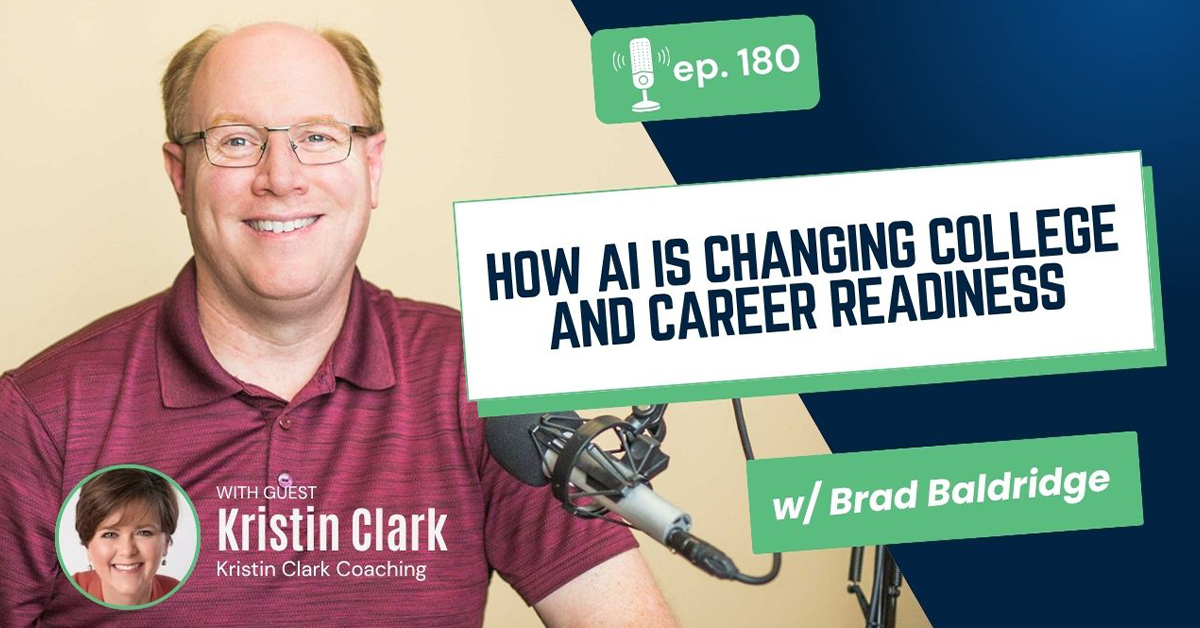
Today’s Guest:
Kristin Clark, Career Exploration Specialist
Kristin Clark helps students aged 16 to 26 to discover career paths that excite them and align with their strengths. She guides students and families through the challenges of choosing majors and planning for the future—focusing first on what makes students happy in their day-to-day work before considering financial outcomes.
Through one-on-one coaching, small group programs, and her innovative Parent Lab, Kristin empowers both students and parents to have meaningful conversations about careers and college. Her passion is watching students light up when they find a career direction that truly inspires them.
Questions Answered Today:
How is AI changing the college process and career readiness?
Kristin hears growing concern from parents about how AI will affect their kids’ future job opportunities. She explains that AI is excellent at repetitive tasks, which means that many entry‑level job opportunities are disappearing—the very jobs where young people used to learn by doing. Brad adds that AI often gets blamed for layoffs, even when other factors are involved, showing how complex the picture really is.
So, what does this mean for families and students?
- AI will take over routine work, but strategic thinking, creativity, and people‑focused skills will remain essential.
- With “grunt work” gone, students must learn to validate AI’s output and build skills in new ways.
- Colleges first banned AI as a cheating tool, but many are now integrating it into coursework or offering AI‑specific classes. Families should check if schools are keeping up.
How can parents model positive use of AI?
Kristin emphasizes that parents need to experiment with AI themselves, so they understand what their kids are facing. Brad warns that, if parents treat AI as “doom and gloom,” students will absorb that negativity. Instead, families should see AI as a tool to explore, learn, and prepare for the future. It could be as simple as:
- Trying AI at work, in volunteer projects, or even personal tasks
- Showing curiosity and positivity, just to highlight how AI can be useful, not scary
- Avoid framing AI as the end of jobs; instead, point out new opportunities it creates.
Why should students experiment with AI early?
Brad and Kristin agree that students shouldn’t wait for formal courses in AI. They should just “play” with AI tools now. Kristin notes that surprisingly few teens are using AI meaningfully, often due to negative messaging from adults or mixed signals from schools.
Here are some ways students can make using AI more meaningful:
- Move beyond “parlor tricks” such as funny images; apply AI to writing, brainstorming, or problem‑solving.
- Practice prompts and learn how to adapt AI’s output to your own style.
- Use AI early to build confidence and get comfortable with the tools, which will help when interviews or internships expect AI literacy.
- Treat AI skills as an advantage. Mastering them can help students stand out in emerging fields and even shape their own career paths.
Links and Resources
Helpful Articles and Resources
- Taming The High Cost Of College
- Parent Lab
- Kristin Clark’s Contact Info:
THANKS FOR JOINING US!
We’d like to extend an invitation to our listeners to share their feedback and questions. Contact us to submit a question.
If you find our podcasts helpful, please share us on social media and tell your friends!
The bottom line is that we care what you think and want to help you out, so we’d appreciate you reviewing us on your favorite podcast platform. Even better, receive automatic updates by subscribing to the show through your preferred podcast service.
Presenter 0:00
Welcome to the Taming the High Cost of College podcast. Here is your host, certified financial planner Brad Baldridge.
Brad Baldridge 0:10
All right, we are back for another podcast. Welcome, Kristin.
Kristin Clark 0:14
Hello, good day to talk about AI.
Brad Baldridge 0:16
Absolutely, so yeah, today we're going to talk about how AI is changing the college process for high school and soon to be college students, and I think there's a lot of change. There's also a lot of hype, I think. So, we'll get into some of that as well. So, why don't we start there? What's the latest headlines that you're hearing, what are you hearing from your parents, as far as are they buying it? Are they worried about it?
Kristin Clark 0:39
I see more worry than anything, and you know when they're talking to me, being a career exploration coach, their biggest question is, how is this going to affect the types of work that they're looking for? And you know, guys, this is really an easy kind of thing to think through. It's going to affect the stuff that's redundant, you know, like, are they repetitive. So, any of your repetitive work, you know, AI does a really good job on that, and the stuff that it's not going to affect is the stuff that deals with strategic thinking and people, and you know, thinking about, you know, how the people are in the workforce, so you know, and it changes every day, so it's one of those things that you gotta, you're gonna have to keep your pulse on it, and really just kind of watch out for it, but for the most part, that's the biggest thing to keep in mind, so repetitive tasks versus people work, and you know, you, you kind of get
Brad Baldridge 1:29
Right, absolutely, I mean, I've seen, certainly seen a lot of these types of jobs are going to go away, and those types of things in the headlines all the time, right, AI is coming for this, AI is doing that, and maybe some of the larger corporations have kind of frozen their hiring, and I don't know if it's legitimate AI impact or if it's they've over hired in the past, but AI certainly takes the blame for every layoff that we've seen in the last year or so, for sure, even if perhaps AI had nothing to do with it.
Kristin Clark 1:58
Yeah, and I think there's definite truth to the fact that AI has affected, because we can do things better, faster, cheaper, and it's taken out kind of a layer of workforce, and I think that to me is the scariest part, is that because AI is, you know, so good at doing, I just call it grunt work, that I think that our young people are going to miss out on that chance to learn by having to actually go in and mess with the data, and you know, look at this stuff that we normally had to look at, where AI is going to spit it out, and how do they validate that? You know, so there is this weird thing happening where I think that they're going to miss out on some really cool learning, but we just got to figure it out. It's not going away, so we just figure it out.
Brad Baldridge 2:24
Absolutely, right. So, let's talk about some of the five steps then, so I've got, the first one is to understand the AI policies at the colleges themselves, because I think that's the first thing that college students are going to run into, right? Is AI is not just a workplace thing, it's also very much, I mean, it's already in high schools as well, right? How is it impacting your current education at the high school level, and how would impact your education at the college level?
Kristin Clark 3:07
Yeah, and when I see that, Brad, and when we were thinking through this, I looked at it from a couple different perspectives. One was, yeah, what are their policies? What are they, how are they attacking this as a tool, you know, a learning tool, but I think also you have to go in and look at it and say, what are they offering me to learn AI? So there's kind of two pieces of...
Brad Baldridge 3:28
Right? Exactly, there's been a very quick evolution in the education, where when AI first came out, it was, my God, all the college students can use AI to cheat, and therefore we're going to ban it, we're not going to let you use it, and everything else, and it didn't take long for at least some colleges to figure out. Well, that's pretty short-sighted, because AI is here to stay, and if we just say it's like saying you can't use a calculator, or you can't use a computer, because when I went to college, we didn't have calculators, or we didn't have computers, or we didn't have spell check, we had to spell things on our own, we had a dictionary. Yes, great. You know, great boomer, as they would say,
Kristin Clark 4:03
Right. Well, and you know, the colleges, they're figuring this out too, where they've got software to be able to figure out if some kid did a full essay based on AI, you know. So, again, everything's moving so fast, but the colleges are figuring out that piece of it now. Exactly.
Kristin Clark 4:19
Now, I want to make sure that they put the same amount of effort into, how do we start teaching this, you know?
Brad Baldridge 4:24
Exactly.
Kristin Clark 4:25
Yeah.
Brad Baldridge 4:26
Right. So, right, now, that's, I guess, where we're going with this. Is I don't know if you want to pick a college based on their AI cheating policies. If that's if they're stuck at that level, then they're probably falling behind quickly, because I think a lot of, in a lot of situations, colleges are now offering courses on AI, and or just incorporating AI into every course within a major, or again, they're all trying to figure it out, and some are going to do it better than others, and I think that's one of the things that families need to start evaluating. The types of work that you're considering will probably be impacted by AI. And is the college that you're looking at up to snuff on that, and are they going to do it a way that you think is appropriate, and just like you want to figure out, do they have the right athletics for me, or the right anything else, is do they have the right AI strategies, policies, etc. for what we're looking to do.
Kristin Clark 5:17
Absolutely, and I would also say to parents, especially, you know, the ones that have older kids right now that are in college. If your college hasn't caught up, then have your kid go out and use chat or use an AI tool and find out what types of programs within AI that they have to learn based on what they're trying to do as far as a career. So, right now you're going to have to go out and do a little bit of searching on your own and fill the gap
Kristin Clark 6:04
So, Brad, is this the first that you've kind of gone in and played, or have you been in there a little bit?
Brad Baldridge 6:07
Oh, no, I use it quite a bit for, but mostly for strat... I use it personally for a lot of strategy and understanding a problem that, where I'm kind of new to it, so I've used it a lot for rules and laws around inheritance, as an example, because inheritance has a big impact on need-based aid and financial aid. So, I'm trying to understand, well, what could we do differently in the inheritance side of things to help with financial planning and college planning. And, of course, you can't do whatever you want, you have to follow the laws, and the laws are relatively complicated and a state by state thing. So, it's like, instead of chatting with a lawyer, I chat with ChatGPT, and it gives me reasonably good answers. And then I can take that to the attorney and say, you know, is this accurate? Is this what.. and you would say
Kristin Clark 6:52
You hit the nail on the head, right? It's validate, validate, validate, you know, which you have to. You know, where I've used it a lot as a solopreneur is going in and saying okay, I'm working in Squarespace or Active Campaign or one of these places. How do I build blah blah blah? And truthfully, their answers are better than what I get from the websites of the actual product that I'm using in my business. So I use it a lot for it, I use it a lot for content, which that is one of the areas that is being impacted is, you know, your marketing, because they are pretty good at content, you know, all your chat stuff. Again, I go in a lot and I have to put it in, put it better into my voice. And then also, sometimes what I see is chat will give me something kind of blam, like they say a lot and don't say a lot, so making sure that I like what they said, but you think about that again. It's using chat for good, not evil, for the brainstorming part, and then you're still putting your own flare on it
Brad Baldridge 7:49
Right? Exactly. And what I found around college planning is it's not very good, because what it learned from is not very good. So things that are on the internet, and you know, or has been on the internet forever, and is probably really accurate, like you know, what is the contribution limit to an IRA for 2025? Every investment company out there has put that on the internet, and with the same answer. Okay, when ChatGPT goes to find it, it'll probably most likely come back with the same answer. Now, if you said, like, is college worth it? Well, the source material has lots of yes and no, and all kinds of spurious logic, and all kinds of bad advice, and it rolls it all together, and takes the good advice, the bad advice, it doesn't qualify it very well, and that a lot of times what it squeezes together looks a lot
Kristin Clark 8:34
It looks generic
Brad Baldridge 8:34
Like quite a lot more questionable, I guess is the right word.
Kristin Clark 8:36
Yes. Well, hell, people's conversation the other day, it depends, right? It all depends. So, yeah, yep
Brad Baldridge 8:43
Exactly. So, idea number two is that have the parents get out there and use AI. So, and again, I think the parents need to do it just so they understand what they're talking about, and how do you do that? Well, you could use it for work if it's appropriate, maybe you know, volunteer to be on the committee that's evaluating AI at your workplace, if that type of thing, those opportunities exist, or if work's not appropriate, then use it for your volunteer work, use it for your personal life, use it for wherever you want to try it, and just go for it.
Kristin Clark 9:13
And I can't emphasize that enough, Brad, because my kids, now my kids are 25 and 27 they were kind of chuckling, they're like, mom, you use this a lot, and I'm like, I know, like, I was kind of like in the in crowd, but it is important for parents. It's because, let's go back to this. I'll probably say this a million times. It's not going away. It's kind of like, the www, back in the day, when everybody's like, is this thing gonna stick? Yeah, it stuck
Brad Baldridge 9:39
Right?
Kristin Clark 9:40
Yeah, so get in there, play. You can't screw this up, you know. So don't be afraid of it
Brad Baldridge 9:44
Right? Yeah. And then kind of a caution when it comes to the parents. What I would encourage is be positive about AI, because if you treat it as doom as we know it, and it's taking all our jobs, and the world is ending, well, that's what your students are going to pick up. Fun, and that's the way they're going to feel about it, you know. All hope is lost. AI is going to take my job. Why even try, and we're done, you know. I think realistically that's not going to be true at all. I think there might be different jobs. Right, when the cell phone came along, there's a whole bunch of people that learned had to learn how to program a cell phone and make apps and do that kind of stuff, but there was no college courses on the subject, because it's brand new idea, so they jumped in from other industries, and they learned on the job, and they did all kinds of things, and that's where we are with AI right now. You know, there's not a lot of courses, there's not a lot of this is how you do it set in stone yet. It's everybody just trying whatever they want to try and seeing what works and what doesn't, and so there's a kind of a wild west in the AI arena.
Kristin Clark 10:40
There is, and we'll all figure it out. Completely agree.
Brad Baldridge 10:45
And a typical young person, you know, give an iPad to a four-year-old, they figure it out really quickly, because they're not afraid to just push buttons and see what happens, right? Yeah, sometimes they break it, and you have to reset it, and you get frustrated because they bought something in your name, and whatever. But in general, you know, just give it a try, I guess. The next point would be for students as well, they also need to get out there and give it a try.
Kristin Clark 11:09
I gotta tell you, I've been very surprised, because obviously I'm working with that age group, right, the 16 to 26 year olds every day, and I've actually been fairly surprised at how little they have really used AI to date, and you know, I always ask, are you using it for good, you know, or are you cheating and doing all the things you're not supposed to do, and, and I get both answers, you know, I think to your point, as adults, if we're talking about here are all the benefits of it, that you know the students will pick it up and use it. I think that they've been a little bit waylaid because of what they're hearing adults say about AI, and on their quite frankly, on their campuses, whether it be high school or college, whether they're embracing it or not. So...
Brad Baldridge 11:53
Yes.
Kristin Clark 11:54
So I think actually kind of like the little bit older people, especially in small business arenas, where it's like, oh, we'll take all the help we can get. I think we're actually a little bit more well-versed on it than even a lot of the young people at this point, from what I've seen.
Brad Baldridge 12:07
Yes, yeah, for sure. I think for a lot of young people it's again some, some are obviously getting involved in using it, but I think for a lot of people it's, it was the parlor trick kind of thing, of we'll see what, look at this cool picture, I can take this and it can take this, and it can merge it, and it's just kind of a, oh, that was cool, but then to actually sit down with it and say, all right, well, how could I use this to create artwork for a business, or how could I use this to write something meaningful and useful for me? You know, what it would be like to journal your personal journal using ChatGPT. I don't know, I mean, I don't journal, but people that do experiment with it, see how that works
Kristin Clark 12:42
Right? I gotta tell you, I've, I've kind of veered away from doing the graphic side of it, because the first four, you know, first couple times I tried it didn't work so well. So that's another one of those that you know I need to practice what I preach and get in there and just kind of play and learn it and figure it out. Yeah
Brad Baldridge 12:58
Right. Well, I think that I think that's the reality of it is, it doesn't do, it can do a lot of things, but it doesn't do it as easily as people think, and that's why I think there's going to be a whole lot of jobs, right? Because you and I would hire someone that could use AI to do artwork when we need a podcast cover page, or we need a picture for this, or a graphic for that.
Kristin Clark 13:18
Yeah, and let's talk. I mean, I, you're bringing a really good point, Brad, and that you know when I was running marketing departments, I was pointing fingers and telling people what to do, right? Normally, I wouldn't have been the one in there trying to figure this out. So now you think about a young person coming into a marketing area, market corporate office, and that's going to be the expectation that they can get in there and really kind of whiz bang it out pretty quickly, but you do need to know how to do the prompts and how to make it do what you want it to do. So I think if you flip it and say, wow, get in there and you be the expert, you might be able to write your ticket
Brad Baldridge 13:52
Right, absolutely, and that's why I think people need to just kind of pay attention to all the new jobs that are AI tangent, perhaps art created within various industries.
Kristin Clark 14:04
Absolutely, yeah.
Brad Baldridge 14:05
All right. So, and then another way or area that we can use this is for career exploration, and I think you've been starting to encourage students and giving them some ideas. I'll let you speak to this one.
Kristin Clark 14:16
Yeah, for sure. So, I still like for my students to go and do a career exploration type assessment, because we've got some really good ones out there that are aptitude based. They're asking the right questions to present a whole bunch of different career ideas to the students. Then I take that information and we talk about it, and I'm like, I look at all the things that came up, and let's explore. I want you to broaden your thoughts on what is all out there, and don't think you know what something is, like actually read the results and find out what something truly is. But after that, when they want to do a little nuance to something, or to say, you know, I'm really interested in something in medicine, I like this aspect. Not that aspect, give me some ideas. Chat's wonderful for that type of just really quick responses, so that they can kind of look at and go, oh yeah, and, and as you know, they can keep going deeper and deeper and deeper and deeper and asking it questions, and I, for that reason, I love it for career exploration.
Brad Baldridge 15:19
Yes, absolutely. So, I think of right, if you said, well, here's two or three things I'm interested in, can you give me a number of careers that would be tangential to these things? Right? I always think of the medical profession, because my wife teaches PA students as her career, and PA, you know, is one job, doctor's another job. But most students, if you ask them, well, what are the medical professions? It would be doctor and nurse, and they're done. It's like, well, what about the person that runs the ultrasound? Oh yeah, I had an ultrasound once, and there was a tech that did that. Well, what about MRI? What about all the administrative? What about the accounting? What about the... and all of a sudden, you know, you can expand it to a lot of different medicals. I mean, there's a huge number of medical, all the way from two year nurse to, you know, PhD level physical therapy and lots in between
Kristin Clark 16:08
That's where my head was going to, is you know, you might want to get into medical, and you're like, I don't want to put 10 years into this. There's so much out there that only takes a two year degree, or even a certification. So, yeah, that's another great way to use AI to say I don't want to be in school for that long. What are my other options?
Brad Baldridge 16:25
Right, exactly
Kristin Clark 16:27
Yeah, and here's one other way, too. Brad is to take two very different things and to mush them together and just say, if I wanted to, I always use no one's just because he's easy, where he loved golf, but then he also liked being creative and being outside and doing different things, where now he's doing landscape architecture to build golf courses. So, how do you take two very different ideas and smush those together, and what do you come up with?
Brad Baldridge 16:51
Right. Absolutely. So, all right. And then our final idea is kind of a capstone on this, is just become AI ready, you know. We kind of alluded to this already earlier, but if AI is here to stay, you know, when you're in the interview to get admitted to a college, you're in the interview for your first job or your first internship, AI could very well come up, and you probably shouldn't be the first time you thought about it, is when they asked the question right then and there.
Kristin Clark 17:16
Yeah, yeah, because they're going to expect that you know something about AI in the industry, that's just going to be table stakes, you know, you're going to have to know, yeah
Brad Baldridge 17:26
Exactly. And I think that's again where, when we talk about various careers, a lot of times people that are very interested in the career will do hobbies or other things that are associated with the career, or they are somehow already tinkering in it, or on the volunteer basis, or whatever it might be, right? So you think of the kid that wants to be an auto mechanic, he's already fixing cars or lawn mowers, he's already getting his hands dirty and doing stuff around autos, and a lot of employers would say, well, you seem to have experience, and he just did it on his own because he thought it was a fun thing to do, he bought old cars, fixed them up, because it was fun. The other candidate might have actually gone to a tech college and gotten the formal training, but for a lot of employers, they might consider that equal. But what they're probably not going to hire someone that says they want to be an auto mechanic, but have never touched tools and never been in a garage, never went to the school, never done anything at all, and they just say, well, I woke up this morning and decided auto mechanic was...
Kristin Clark 18:20
Sounded fun. Yeah, yep.
Brad Baldridge 18:26
So I think, again, AI ready applies there as well, of you know what parts of AI are appropriate, you know, have some opinions, right or wrong, you just have to understand it and be able to talk intelligently about it, along with many other areas, of course, depending on your career choices.
Kristin Clark 18:42
Yeah, I mean, it's as simple as that, right? Don't be afraid of it, touch it, feel it, get your handAs dirty, and go from there. And it all gets easier. It all gets, you know, like everything else, it gets easier.
Brad Baldridge 18:54
All right. Well, thanks, Kristin. We'll wrap it up here. That was our five ideas that we wanted to run through quickly.
Kristin Clark 19:08
All right, we'll see you next time.
Brad Baldridge 19:09
All right, thanks, Kristin.
Speaker 1 19:11
Thank you for listening to the Taming the High Cost of College podcast. Now it's time for you to take action. Head to tamingthehighcostofcollege.com for show notes, bonus content, and to leave feedback for Brad. The next step on your college journey starts now.
Presenter 1 19:28
Brad Baldridge is a registered representative of Cambridge Investment Research and an investment advisor representative of Cambridge Investment Research Advisors. A registered investment advisor, securities are offered through Cambridge Investment Research Incorporated, a broker dealer and member of FINRA and SIPC. Brad owns two companies, Baldridge Wealth Management and Baldridge College Solutions. The Baldridge companies are not affiliated with Cambridge Investment Research.
Transcribed by https://otter.ai
Sign up to receive email updates
Enter your name and email address below and I'll send you periodic updates about the podcast.