

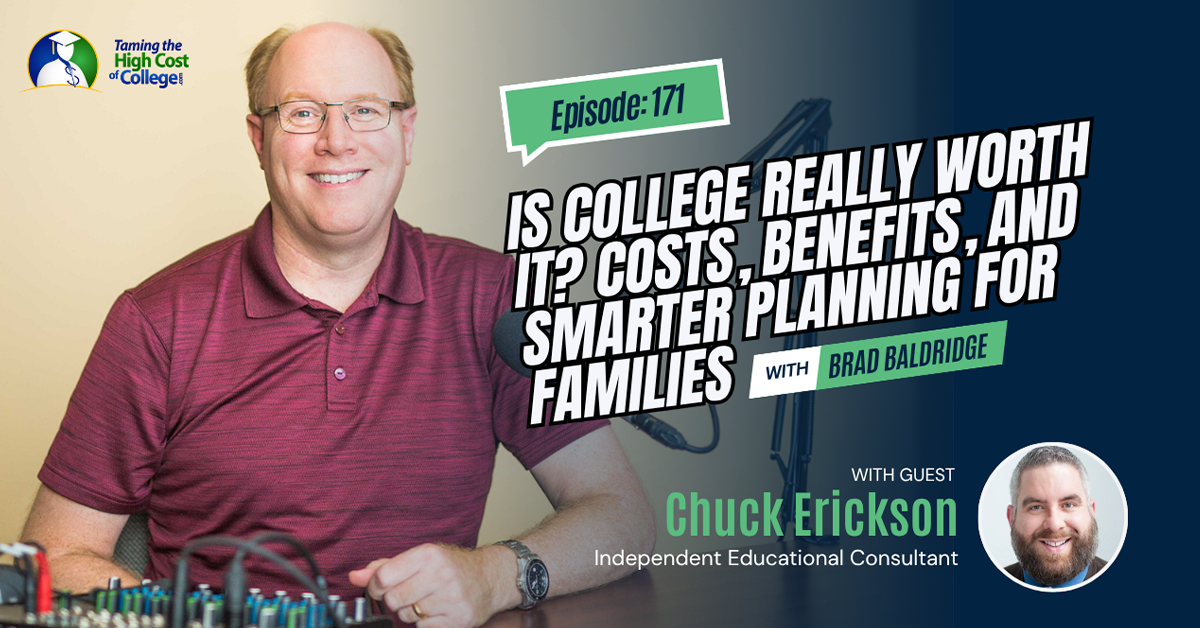
Today’s Guest:
Chuck Erickson, College Counselor & Former Associate Director of Admissions
Chuck Erickson brings over 25 years of experience in admissions and counseling. He helpsstudents navigate the college search while host Brad Baldridge focuses on guiding parentsthrough the financial side. Together, they tackle the big question:Is college really worth it?
Questions Answered Today:
Is college really worth it today?
Chuck explains that the value of college depends heavily on context: career goals, financial realities, and long‑term outcomes. Some professions now require more education than ever, while others no longer demand a bachelor’s degree. Families must clarify whether they’re asking about short‑term costs, five‑year returns, or lifetime value. Brad adds that averages and ROI calculators are misleading for individual families, since no student is “average” in grades, costs, or salaries.
It’s also worth noting that anecdotal stories—about students thriving or struggling—often skew perception, making it even harder for families to judge whether college is truly “worth it.”
How should families interpret college price tags versus actual costs?
Many parents confuse the published sticker price on school websites with what they’ll actually pay. A $90,000 school might cost $10,000 after aid, while a $30,000 school could end up more expensive due to fees or program costs. Chuck stresses that families must understand the difference between price and cost, and Brad warns that costs rise each year, so planning must account for increases.
- School website price ≠ actual cost: aid, scholarships, and fees change the numbers.
- Costs vary by major, housing, and meal plans.
Should earning potential be the main factor in deciding on college?
Chuck cautions against treating college like a stock market investment. While salaries matter, college also provides experiences, networks, and personal growth. Predicting a career path at age 18 is unrealistic, and many professionals (including Brad and Chuck) ended up in careers unrelated to their original majors. Brad adds that families should avoid obvious mismatches, such as borrowing heavily for degrees with low salary prospects, which can lead to financial hardship.
“With college, the earning potential is one factor, but it’s also the experience, the knowledge, the connection to other students…” – Chuck Erickson
Is college always the next step after high school?
Not necessarily. Chuck highlights the growing use of gap years, where students pause to gain work experience, improve mental health, or explore other opportunities before committing to college.
He points out that 5–10% of his students now take this route, and it can be healthier than rushing into higher education. Brad adds that government messaging such as “college for everyone” has created pressure. But alternative paths such as trade schools, certifications, or gap programs can be equally valid.
- Gap years allow students to regroup, gain skills, or study abroad.
- Mental health concerns make pausing before college a smart choice for some.
- Government messaging created pressure for “college for all,” but alternatives exist.
- Social media trends (TikTok, Instagram) now influence college choices, sometimes irrationally.
What practical steps can families take to decide if college is worth it for them?
Chuck emphasizes that families must begin with two parallel conversations: the student’s exploration of interests and the parents’ financial reality. Students often know only what they see around them, so career exploration tools and reflection exercises are essential. At the same time, parents must define a realistic budget before the search begins. He warns against chasing “unicorn strategies”—rumors that families can magically avoid paying for college.
Brad adds that most families should expect to spend $20,000–$25,000 per year at minimum, unless they qualify for significant aid or scholarships.
- Student side:
- Explore career interests early, even if they change later.
- Consider academic fit, social fit, and personal growth opportunities.
- Parent side:
- Clarify financial capacity before touring schools.
- Expect realistic budgets of $20,000–$25,000 per year.
- Aid comes from clear sources: need‑based aid, merit aid, athletic scholarships.
- Other considerations:
- Explore out‑of‑state or international schools for unique opportunities.
- Balance academic, social, and financial fit to avoid mismatches.
- Avoid decisions driven by prestige, peer pressure, or social media trends
“They might be in the wrong academic fit, the wrong social fit, and… the wrong financial fit, and that could be disastrous.” – Chuck Erickson
Links and Resources
Helpful Articles and Resources
- Taming The High Cost Of College
- Don’t Chuck It Up Podcast
- Chuck Erickson’s Contact Info:
THANKS FOR JOINING US!
We’d like to extend an invitation to our listeners to share their feedback and questions. Contact us to submit a question.
If you find our podcasts helpful, please share us on social media and tell your friends!
The bottom line is that we care what you think and want to help you out, so we’d appreciate you reviewing us on your favorite podcast platform. Even better, receive automatic updates by subscribing to the show through your preferred podcast service.
Presenter 0:00
Welcome to the Taming the High Cost of College podcast. Here is your host, certified financial planner Brad Baldridge.
Brad Baldridge 0:10
All right, welcome back to Taming the High Cost of College. This is a podcast about planning and paying for college. I'm your host, Brad Baldridge, and today I'm sitting down with Chuck Erickson. He's a college counselor that I've worked with for many years now, and he kind of does helping with the students, where I do mostly helping with the parents. So, a lot of times we work on the same problem, just from different angles. Welcome, Chuck.
Chuck Erickson 0:34
Thanks, Brad. Great to see you again. We haven't chatted in a while, and I'm happy to be back on your podcast.
Brad Baldridge 0:40
Yes, and we're trying something new here. We're actually going to put it out there on video now as well, so we'll see how that goes. All right, so today I want to talk about, is college worth it, or is ex college worth it? That's going to be more than our other choices, and I think that comes up a lot, and you see it in things like discussion boards, especially where everybody has their opinion, and we could get very heated about, oh, college is never worth it, or what a scam, or all that kind of stuff, of course. But I have this discussion a lot with parents, and I think you do as well. So, where do we begin with that idea? As far as what are you thinking, or what questions do you come back with when parents ask, is it worth it?
Chuck Erickson 1:19
I think it really depends upon what the context of the situation is, so I've been a college counselor for 10 years, and prior to this work I was associate director of admissions, so I worked literally in an admissions office for 15 years, and I'm really trying to help understand where they're coming from with that question. So, is an expensive college really worth it, or is just any college worth it? I think we also have to look at what's going on in the world as far as employment opportunities. There are some careers now that definitely require education, in fact, further education than what they required even five or 10 years ago. And there are other professions that used to say you need a bachelor's to be in this career, and that is no longer required. You can be self-trained or do some training online through different courses and modules and certificates, and that might be enough to be able to prepare you. I always want to find out from parents, what are you saying? Is it worth it? You mean in the one year investment, the five year investment, the lifetime investment? It's kind of a loaded question.
Brad Baldridge 2:21
Absolutely, and I think that's one important point. Is there's a lot of people out there that try and calculate, is it worth it? Their return on investment, well, if you spend this much and you have this career and you make this much money, then look, it's worth it, or it's not, or this college is going to be better than that college, because their average starting salary is this instead of that, and my caution is, while that statistical analysis is perhaps useful for public policy, or for colleges themselves trying to decide what to do with their programs, and that type of thing. I think it's relatively worthless for the typical family, because you're not average, you're not going to get the average salary, you're not going to get the average grades, nothing's going to be average, you're not going to pay the average price, and your student is going to be above average or below average academically, etc. etc. So, trying to do that analysis, I think, while it's interesting and perhaps valuable for the averages, and again more useful, I think, if you're trying to plan, what should the state of Wisconsin do about this particular program or this particular benefit, yeah, then averages are worthwhile, but when you're talking about just this one student or just the three kids in our family, I think all that kind of, it's a little bit of a waste of time, because anecdotal evidence also pops up. Well, I know this kid that did this and did that, and and it turned out fantastic. Well, okay, well, I know this kid, where everyone, just the opposite way. What's the point?
Chuck Erickson 3:43
And I think that's always hard on social media, especially. We always see the success stories of a student who got admitted to every Ivy school and got a full ride scholarship, or whatever, and what have you. But those are few and far between stories. And what's the truth of the matter is, as you said, is that every situation is different. I think I love that you brought up the thought of price and cost. I think part of this question about is it worth it is that a lot of families and parents are seeing the actual price tag on the website, and they're not fully understanding what that really means, as far as an out-of-pocket cost. That's probably a whole other topic for a whole other day to help families understand what is the price tag versus what's the actual cost, but especially for families, the ones that I work with that have not gone to college and now their student wants to go to college, there really is a misunderstanding as to what the price versus the cost of college is, so we could talk about that a whole another time,
Brad Baldridge 4:40
right. Exactly, so what you're alluding to is, while some colleges list between, say, a 5000 a year all the way up to 90,000 a year, what you actually play could be a steep discount, where a $90,000 college might cost 10,000 and a $30,000 college might actually cost a little more than that, because of the price. Size, you're in a major that costs more, or they have extra fees, or.. and it's just kind of a challenge out there to really understand the actual numbers.
Chuck Erickson 5:08
Absolutely, and that is always a challenge for parent planning, and you know, then also the rising cost of college. You hear as a big buzzword right now, costs are not stagnant, so the price that you see for the first year may not be the same price in future years, and as you mentioned, the major might impact it, where the student is living, what type of meal plan they picked. You know, this is where colleges are using averages, so the price that you see is an average price, but that may not be exactly what your particular student or family will be paying.
Brad Baldridge 5:38
Right. Absolutely, and some of it's in your control, and some of it's out of your control. So, that's the cost. Well, so if we're going to do it, is it worth an analysis? Let's talk about the other side. Well, what are the benefits? And now we're trying to compare. Well, is this benefit worth x, right? But I think for some families it really is earning potential that they're focused on. What are your thoughts on that? Is, I mean, is that a good way to look at it, or not? So, I think, if
Chuck Erickson 6:06
you're only looking at earning potential, you're really only talking about more like a stock market investment, you know, you're putting money in and you're expecting to get some type of return really straight away, or in the future, where with college, the earning potential is one factor, but it's also the experience, the knowledge, the connection to other students, and leaving your home. We know that students who go off to college are interacting with a wider variety of people, making more connections, finding a future spouse. I think could be a potential benefit to going to college. When I look at my friends circle myself, I have some that I've stayed friends with from high school, but a large chunk of my friends and connections are from college, whether that was from my undergraduate experience or my graduate school experience. So, I think there are benefits beyond just looking at, okay, will I make money? Yes, that should be a factor, but also it's really hard to predict. Okay, student at 18 is going in at this major, and this is going to be their exact career trajectory five years later, not to mention 10 or 20 years later. I mean, you could look at the two of us as perfect examples. Neither of us went to college specifically to do the jobs that we are doing now, for sure,
Brad Baldridge 7:22
right?
Chuck Erickson 7:22
So our whole world changes, and it's hard for parents to just say, "Yep, you're going to go in this major, it's going to be very linear, and we're going to get a really great return on investment,
Brad Baldridge 7:31
right? And I guess, and I agree with all that. I think there is one caution where you are setting yourself up for a very obvious failure. I mean, I think it was one of the California schools, USC, I think it might have been where they kind of got in trouble because they were pushing people into a master's program in sociology. It was very expensive, and it turns out once you have that master's degree, your starting salary is 30 or $40,000 and the math just doesn't work. You borrow that much money, and they were pushing kids to borrow it, just saying, well, you know, go ahead and borrow it, then you can pay it back, and it turns out they couldn't pay it back because their salaries were so low that they could barely survive on that. So, I think, is you want to be at least a little bit conscious that you're not, you know, completely delusional, but from there, anything beyond that, I think there is a little more nuance to it.
Chuck Erickson 8:22
Yeah, there is a real factor about being over educated and under experienced, and many colleges and universities are offering those accelerated programs who are able to get both a bachelor's degree and a master's, or even start a PhD, or another higher level learning. Why? Because they're businesses, they know that you are already a client, you are a customer, and they are giving you this opportunity to remain a customer for additional time and get that extra tuition dollars. You really need to be sure that getting a higher level degree immediately is going to benefit you, as you said, where it is true in some professions that will actually excel you in your career, but in many others, you know, I point out to, like, MBA programs, a lot of MBA programs want you to actually go out into the workforce and work for a while, and then come back and get your MBA, where many colleges are saying, yeah, you can complete your MBA with an additional year, is that going to be beneficial, or is that going to make your job prospects actually worse,
Brad Baldridge 9:22
right? I mean, it is a little bit of the college's upselling. It's the equivalent, it's the college equivalent of, do you want fries with that? You know, as long as you're here in the drive-thru, can we sell you a couple more dollars worth of fries? And colleges are as long as we have you here, can we sell you another year with another degree, or another two years, or whatever it might be. And again, nothing wrong with it, but I think understanding how it really works in the real world is where you know, got to do that due diligence and understand, and I, you know, because I, what you just mentioned there, of will you know an MBA without any experience matter in the workforce, that would be something I would have to research. I don't know the answer to that for sure, but I'm guessing they would rather see an MBA and experience much more than just a lot of book work,
Chuck Erickson 10:07
even within places like MBAs or Masters of Science, or even my own profession, Master of Education. Part of the curricula says, you know, write about your experiences and what you have been learning in your career. Well, if you're a 22 year old recent undergrad graduate, and now you're starting an MBA, you don't have much experience to be able to pull from and talk about, okay? Have you written a business plan? Have you gone through several fiscal cycles? Like, how do you reflect on that? In my own master's, I had already worked for almost two years before I jumped into my master's, and not that it was a long time, but it was enough experience for me to go, okay, I learned this while I was in the real world, and I was working while I was getting my master's, and that influenced my master's program, and it made it better, but yeah, I'm always worried about overeducated and lack of experience, and I'm worried that that's impacting some of the students who are trying to find jobs,
Brad Baldridge 11:02
right. All right, so the next thing to discuss a little bit around this decision is, is this a rational decision or an emotional decision? I think for a lot of families it gets all intertwined and it's hard to parse it out, for sure. And I think emotions, and where I see the emotions are things like, I loved college, I want my kids to have the same experience. Therefore, I'm willing to pay what it takes for my kids to have the experience. It's not really career related, it's not really, you know, earning potential or any of that. It's go to college and have fun like I did, and that's me. I mean, I quite literally, that's part of my reason to be happy to pay for college, as I thought it was a great experience. I want my kids to have it. Turns out, luckily, the kind of careers they're interested in kind of require college, so it's a good fit for them as well. I'm not sending them to a four year college in an effort to become a welder or something. They are choosing careers that require a four year degree, so it's working out, but I see that a lot with families, of you know, I went to this type of college or I had this experience, and if I could reproduce that for my kids, I'm all in.
Chuck Erickson 12:08
I also feel like, and I agree with everything you've said, but I also feel like there's this again this social pressure, or this idea of kind of the book of life, of you know, you graduate high school and you just automatically go to college, and I am now seeing anywhere from five to 10% of my students taking a pause. You know, they may go through the college search process while they are in high school, but they may say, you know what, I'm going to take a year, maybe even two after high school and learn some executive functioning skills, or do a low-entry job in the field that I'm thinking of, or take care of my own mental and physical health before I dive right into college, because if they've been stressed, you know, we have a high level of anxiety and depression going on with our teenagers right now, and if they don't take care of that before they go off to college, that can really get to a different level, so I caution parents to think that, oh, the next step after high school is you just have to go into college, because that's just kind of the social norm. It's not for a lot of people, and it is okay to take a year to, or to, to regroup, understand oneself, grow up a little bit. There are lots of programs out there if you don't want them sitting at home on the couch. I totally get that there are programs out there that cost less than college, where the student can be independent and learn some skills. There are even study abroad opportunities where students can, you know, spread their wings and try a new experience. So, I want to caution people about, like, oh, the obvious, as you said, the emotional response is, oh, high school, college, and that doesn't have to happen,
Brad Baldridge 13:38
right? Exactly. And what we're talking about is commonly referred to as a gap year, and there's a couple podcasts in the collection going back a few years where we talk about semester at sea as an option, and then just gap year and couple gap year experts on the podcast in the past, so there is some information out there, but yes, gap years and all kinds of things that are kind of new and exciting and different, I think that's what's maybe changing, is we went from college, is kind of not really a luxury, but kind of a small percentage of people went on to get their college degree, an even smaller percentage went on to get anything advanced, and those numbers have climbed and climbed and climbed over the last say 40 or 50 years, we kind of peaked a couple years ago, where it's like, okay, 3% of high school graduates going to college, perhaps was too much, and it's actually started to come back, and again, with the prices going up, and the, you know, do we really need this degree for this career, and some rationality, again, the whole, I mean, I think the government did a very big disservice when they said college for everyone, because they put that idea in your head that, well, college is the path to success. It's the only path, and therefore we have to make it available for everyone to be fair. You know, that's not that's far from the truth. Lots of people have other paths that are just as good or better, and more importantly, better for that particular student. I think we got to circle back around to that, is what. Really matters is what's good for this particular student with these, with these facts, these goals, you know, these abilities, whatever it might be, and stop so much about, you know, this is good for everyone or this is bad for everyone.
Chuck Erickson 15:12
Yeah, and that's where you and I really complement each other, is that you're really focusing on the financial aspect and helping parents understand the financial side, and I'm really student-focused, you know. 90% of what I do as a college counselor is working one on one with the student to help them figure out what do they want. You know, having a kid look at the college search process is like, you know, letting them run free in the Mall of America and say, all right, you can shop in all the stores that you want, but you really had to pick only one where you spend all of your money, and that's just overwhelming for a teenager. So, I help them figure out what is the best fit academically, socially, and then listening to parents and advice from you as far as financial fit as well, because a lot of times those things can be imbalanced. They might be in the wrong academic fit, the wrong social fit, and as we're talking about today the wrong financial fit, and that could be disastrous,
Brad Baldridge 16:03
right. And then we've kind of talked about the parents being irrational, as far as, and again, not in a bad way, but that's just that's life, right? Where you feel guilty that you can't afford to help as much as you want, or again, you have your preconceived notions of what you want for your kids, you know, there's the stereotypical, you know, certain ethnicities, or whatever, you know, you have a choice, you can be a doctor or you can be a lawyer, those are your choices, right? All those, all that baggage, so to speak, and it kind of applies to the parents, but there's also another irrational actor in all of this, and that would be the student, where, again, in my opinion, most students, you know, I always use this analogy, right? Take a typical middle-income, upper-middle-income family, and the student at 12 or so says, "Well, everybody else has a phone, I should get a phone, and it's so unfair. And next birthday, Christmas, whatever, a phone shows up, and they have a phone, and then they get to be 1617, and they're saying, "You know, Dad, you know, you have to drag me back and forth to my sports and my this, and my that, and you know, if we had another car, life would be so much better for you. And Dad's like, yeah, that would be good for me. Next thing you know, a car shows up. All right, now there's going to, now they're going to do college shopping, and especially if you're at a little more prestigious high school, or a private school, or whatever it is, everybody else is looking at the expensive schools, so that you're going to look at the expense of schools, because everybody else is saying USC or NYU or all the name brands, and it's just normal. They have no concept of dad's just going to shake the money tree or mom's going to shake the money tree and somehow pay for it. If it's $9,000 for a car or $90,000 for an education, it's just a big number. They don't really comprehend it that well, and I don't know what the solution to that is, but I certainly see the problem hit my own kids as well as all over the place.
Chuck Erickson 17:46
Well, and I love all those points. I think that's really especially important for parents to hear is that you don't have to do what the other parents are doing, but there is a lot of pressure about this. You know, I have parents that say I went to a very hyper selective school when I went to college, and so I want my kid to do the same, and I'm just going, well, your kid might not be the fit for that, or they're saying our neighbors are all going to tour XYZ, very selective college, we need to go tour that as well, and some of this I've reminded parents is who is going to be going to that college, you know, parents get to wear, you know, proud dad of whatever, you know, university sweatshirt, but the kid is actually going, so I, you know, I know you want to put the bumper sticker on the back of your car, and for people to go, "ooh, but that shouldn't be your sole way of choosing what school you should attend at. Same thing, students are getting the social media pressure. We talk in my community, in the college counseling community, about the TikTok influence, and there are colleges that no one had ever heard of 345, years ago that are now surging in applications because students are all swarming to those particular places. We're seeing a huge push towards the SECs, and a lot of the large southern colleges, which used to have acceptance rates very high up there, that are now becoming hyper selective and very challenging to get into, even for in-state students in the South. So, this has all become social media pressure. So, it's just like, okay, you know, the state of Florida, University of Florida, and Florida State have both become very selective, even if you are from Florida, because so many students are looking to go to those institutions from out of state and in state, thanks to things like TikTok, Instagram, and other social media influencers. So, a lot of changes. I
Brad Baldridge 19:33
think that's the colleges doing a good job of marketing themselves, and I mean, that's where colleges want to be, right? They want us to have so many applicants that they can be selective, and then they can raise their prices, and again fill their classes, and life's much better when you get to say, well, we're just taking the best students, we'll take the students that are willing to pay, well, you know, everybody wants to be the Harvard and Yale, where they have a lot of leverage, and they can, and some colleges over the years have kind of evolved to be like that. It so now with TikTok, do you think it's students driving it, or is it the colleges with some brilliant marketing, or both?
Chuck Erickson 20:06
Well, I'll tell you that Harvard still markets a lot every year. They send out 10s of 1000s of postcards to kids who have achieved high scoring on the ACT or the SAT, saying, "Hey, have you heard of Harvard? You should come check us out, and I get students all the time that will message me saying, "Hey, Harvard's recruiting me, I got a postcard. I'm like, "No, that's marketing material, calm down. They're not specifically going after you. As far as TikTok and social media, it's not as much the college's social media, it's again peers, so it's students from their high school who went to that college who are a year or two older, they were social media friends. They're now seeing what's going on at the college, so the college's social media accounts are not exploding with popularity. It's students who are there. Fun fact: the last time we had the summer Olympics, many of those Olympians are going to college, and students were falling in love with them on the Olympics, and then following them on social media, and going, "Oh, they go to that college, and then we saw a surge in application to that college because of the social media influence. Other thing, like Villanova's applications are way up. Why? Because Pope Leo went to Villanova. We're seeing the Pope effect, so he's become popular with Catholics, and so all of a sudden a lot of students are applying to Villanova. I will tell you, 10 years ago Villanova was not difficult to get admitted to, and here we are, 10 years later, and we've got a college that has become very selective.
Brad Baldridge 21:30
Right. Absolutely. So, obviously, we've talked a little bit about the problems and some of what we see. What are the solutions? So, let's assume that we're there, right. We've got it. We're a parent of a high school junior, high school senior, and we're in the throes of all of this. What do we do to make you know, because you know, mom or dad or student or everybody's is thinking, is it worth it? So now, and you say, well, I can't go by the statistics. Well, what do I go by? How, what do I do to figure out, is it worth it, or is it worth it for us, or what's the.. you know, how do I think that through?
Chuck Erickson 22:03
That's really challenging, because you've got to first listen to figure out what your student is possibly interested in doing in the future, and helping them. This generation has not done a ton of career exploration, they only really know what they see in front of them. So, there are some great resources online, and through your high school to help students do some reflection as to what they might potentially go into. Keep in mind, though, over 70% of students change their major within their first year of college, so you might want to go broad with that. I think another thing is that parents need to first talk about the financial picture, because I have too many parents that are way excited about getting the financial or getting the college search started. Sorry, but they really need to understand their finances, because they're coming to me saying, "Hey, we need to do the college search. And one of my first questions is, "Great, what's your budget? And they typically look at me like a deer in the headlights, going, "What do you mean, what's a budget? And as we talked about it at the beginning of the show, there's a wide range in what colleges can cost, and so if parents aren't understanding their own financial situation, it's hard for us to get started. I can help a student figure out, okay, who are you, what type of educational experience do you want - big, small, urban, rural, sporty, outdoorsy, geeky, artsy, you know, more technology-based. But parents have to help me with that, and figure out, okay? And how much are we looking to spend as far as this picture, right? 2700 college options, so there's lots of places to pick from,
Brad Baldridge 23:28
right? Exactly. And that's what I do with families, right? As I.. I'm primarily.. you mentioned that you work 90% with students, while I work 90% with parents, working through with the college budget, and how do we do this efficiently, and all that kind of stuff, and I'm offering a course now as well that will help families figure out what their college budget should be, but more importantly, what a realistic college budget should be, right? Yeah, because I'm sure you've heard things like, well, yeah, we want to send our kid to college, and we've got $5,000 a year that we can pay, it's like, okay, well, that's not even going to cover the community college, you know. We got to get more realistic, right? Your budget needs to grow, or your goals need to change, or whatever it might be. I think for a lot of families, you know, the typical college budget is 2020-5000, a year, and up, you know, certainly you can spend more, but even like kind of minimums, you know, the low-cost options, and again, are there exceptions? Absolutely. I mean, if you're very low income, if your student is able to score a lot of scholarships, but now you got to learn the whole process and the whole game of need-based aid and paradigm and all that stuff. And that's what the course is about, is you know, if you're going to go into it cold, assume you're going to spend 25,000 or more if you happen to be the family that can spend less, because of, again, need kinds of, you know, athletics, all kinds of ways that you might spend less, you got to understand why you're going to spend less before you actually will spend less. And there's a lot of rumors out there. I have parents tell me, oh, we don't have to pay a lot of money because of x, and it's like, well, no, I think you're wrong, because. Is that's not a strategy I've ever heard of. It turns out it's, you know, it's not true.
Chuck Erickson 25:05
It's a strategy that's out there. I think it's a, it's like a unicorn. It doesn't really exist, but there's this, this thought that it's a strategy, and you know, I talk on, I'll be a plug for my own podcast, don't chuck it up. So, on my don't chuck it up podcast, I talk through a lot of these things as to how to find fits for students academically, athletically, music wise, going out of going to college out of state, you know, thinking of going to college in the UK as an option, and I bring on guests from my world in the college counseling area to talk about how can we help students find that right fit and help them understand what will work best for them in the long run, and in the short run, and sometimes, as we said at one point in the show, the answer might not be going to college, it might be something else, like a gap year.
Brad Baldridge 25:49
Yeah, absolutely right, and there's a lot to learn, potentially, right? Again, some families, it's pretty straightforward, and they've got the cookie cutter experience, that's, that's, you know, that is not as common as you'd think. Most people have other reasons to learn more, whether it's again the student that wants to be far and wide, a family with multiple children, divorce and blended families, business owners, rental property. You know, there's a long list of, well, I got to do all the normal college stuff, plus I got to learn how business owners pay for college, plus I got to learn how an athlete goes to college, plus I got to learn, you know, special diets or special needs or disability, you know. Again, there's a long list of variation and that kind of stuff. So I guess get educated. I have a podcast, you have a podcast, spend some time listening to podcasts if that's your thing, and watch YouTube if that, if that's the way you're connected with us. Learn and go a little deeper than what are the five hacks to pay for college. Oh, yeah, the five hacks are going to be ABC, they're going to be the same five hacks everywhere, and while they're true, they're also pretty trite, and it's not going to get you where you need to go. You're going to have to go deeper than that and really understand the process.
Chuck Erickson 26:56
Absolutely, and that's why I've been putting out my podcast now for a while I have over 70 episodes available on Apple Podcasts, Spotify, and all the other platforms. I've got the YouTube channel as well, so all of my interviews with special guests and experts are there. And then you can also find me on Instagram, TikTok, and all the other social medias that are out there. So do get this information, and Brad and I are both trying to put this information out there because we are both frustrated at seeing parents who are not understanding this, and they're going into this and making really poor decisions that could have been solved fairly easily by just getting some basic advice from Brad or myself, and as you mentioned, there are a lot of these families that have very particular cases, and those are the ones that typically hire one or both of us. Is that okay? We are in a particular scenario, we need help, we have a special situation, whether it's financially speaking or what the student is looking for, or their particular background or identity. That's what our jobs are as experts, is to help them navigate it. I equate my job as to like a real estate agent, you can buy a house without a real estate agent, but there's a lot of paperwork and a lot of stuff you need to do. I am kind of like your realtor, but for colleges, I can help you figure out and find the places and navigate all the paperwork, and I also do some basic information on financial aid and scholarships that Brad also dives into at a much deeper level.
Brad Baldridge 28:19
Right, exactly, and yeah, I mean, we compliment each other, for sure. Where I generally don't work a lot with students, and when I'm in over my head, which happens very quickly, it's like, well, you need to talk to Chuck, because you know, I am, I don't know anything about an essay, I can't add any value there, I was never good at it, you know, I have an engineering degree, I'm a math person, etc. etc. right. So, yes, absolutely. So, I think certainly, if you're in the thick of it, it's just going to be a learning curve, and it's going to, and if you're not in the thick of it yet, right, if you happen to be having a sophomore, freshman, or even grade school kids, or middle school, there's things you can do now, even though, again, you're probably not visiting a college with an eighth grader, but certainly parents,
Chuck Erickson 28:57
I might argue with that with you, I might say, yes, you should,
Brad Baldridge 29:02
perhaps, but most people aren't right. Right, occasionally the eighth grader takes along when you're visiting with your junior, and they happen to be part of the family, but - and I've done that a little bit with my own family - what happens is the eighth grader tends to not pay attention because they don't think it's not for them, they don't think, and they play with their phone, and when it's their turn, they're going to have to go back, most likely, but
Chuck Erickson 29:24
they'll have to go back. But I think tagging along, I think the eighth graders paying more attention to what is going on than what some parents may assume. One of my most recent podcast episodes is actually talking about how to start the college search in eighth or ninth grade, because what we're, what's happened in the United States, and partially because of Covid recently, is a lot of this has gotten pushed later, and so students aren't starting until late junior year or early senior year, and in my professional opinion, that is almost starting too late, because there is all of this knowledge that you need to acquire and all this information you need to collect that. We should be starting earlier, so that could be even sending your kid to a summer camp at a college campus, so they start seeing what a college campus looks like for a week over the summer. You know, that's kind of like dipping your toe in the water a little bit, get the experience, but it's not a huge commitment, because you're just there for a week in the summer,
Brad Baldridge 30:16
right? Exactly, yeah, but right, so there's things you would do again, you're maybe you're not taking the formal tour that's targeted to juniors, but there's other things that the student might do, but then there's definitely things that parents can do. Parents can figure out their budget, parents can figure out if they're going to qualify for need-based aid and merit aid. Parents can do, are we saving enough, should we save more? Parents can have the discussions of philosophies, are we paying for it all, are we paying for some, are we willing to 15 years ago when I first started getting involved in college planning, I had many parents say they can pick out any college they want, just whatever is a great, you know, that's great, we'll figure it out. Parents don't say that anymore, they've, you know, they've caught on a little bit and realized that leaving it that open that it could really cost you. So now it's what I encourage parents to say is something like, well, any college at a reasonable price. And then big asterisk, well, what does reasonable mean? Well, I don't know
Chuck Erickson 31:07
exactly.
Brad Baldridge 31:08
That's what you got to figure out, but you got to put that caveat in there. You tell your student they go wherever they want until the bitter end, and you're setting yourself up for some interesting challenges, and it happens every year. You deal with it, I deal with it. Of
Chuck Erickson 31:22
yeah,
Brad Baldridge 31:23
surprise, with you know that number is bigger than we thought. What can we do? We don't want that to happen either. So that's why starting early, understanding your options is important. All right, wrap things up here. Why don't you tell us a little bit more? What's the name of your podcast, and how can we find you again?
Chuck Erickson 31:36
Sure, so I'm Chuck Erickson. I'm an independent educational consultant and podcast host on my podcast and YouTube channel are both called Don't Chuck It Up, so you can search on Apple Podcast, Spotify, or YouTube for Don't Chuck It Up, or find me on any of your favorite social media. I'm talking about helping students and parents navigate the college search and the application process like a boss.
Brad Baldridge 32:00
Absolutely. All right. Well, great. And I'm always at Taming the High Cost of college.com We'll have show notes and other information, and we also have the YouTube channel, et cetera, under the same name. So, all right, that's all we have for today. We will see you next week. Thanks, Chuck. Thanks, Brad, for having. Always great shot with you.
Presenter 32:17
Thank you for listening to the Taming the High Cost of College podcast. Now it's time for you to take action. Head to Taming the High Cost of college.com for show notes, bonus content, and to leave feedback for Brad. The next step on your college journey starts now.
Presenter 1 32:34
Brad Baldridge is a registered representative of Cambridge Investment Research and an investment advisor representative of Cambridge Investment Research Advisors, a registered investment advisor. Securities are offered through Cambridge Investment Research Incorporated, a broker dealer and member of FINRA and SIPC. Brad owns two companies: Baldridge Wealth Management and Baldridge College Solutions. The Baldrige companies are not affiliated with Cambridge Investment Research
Transcribed by https://otter.ai
Sign up to receive email updates
Enter your name and email address below and I'll send you periodic updates about the podcast.